
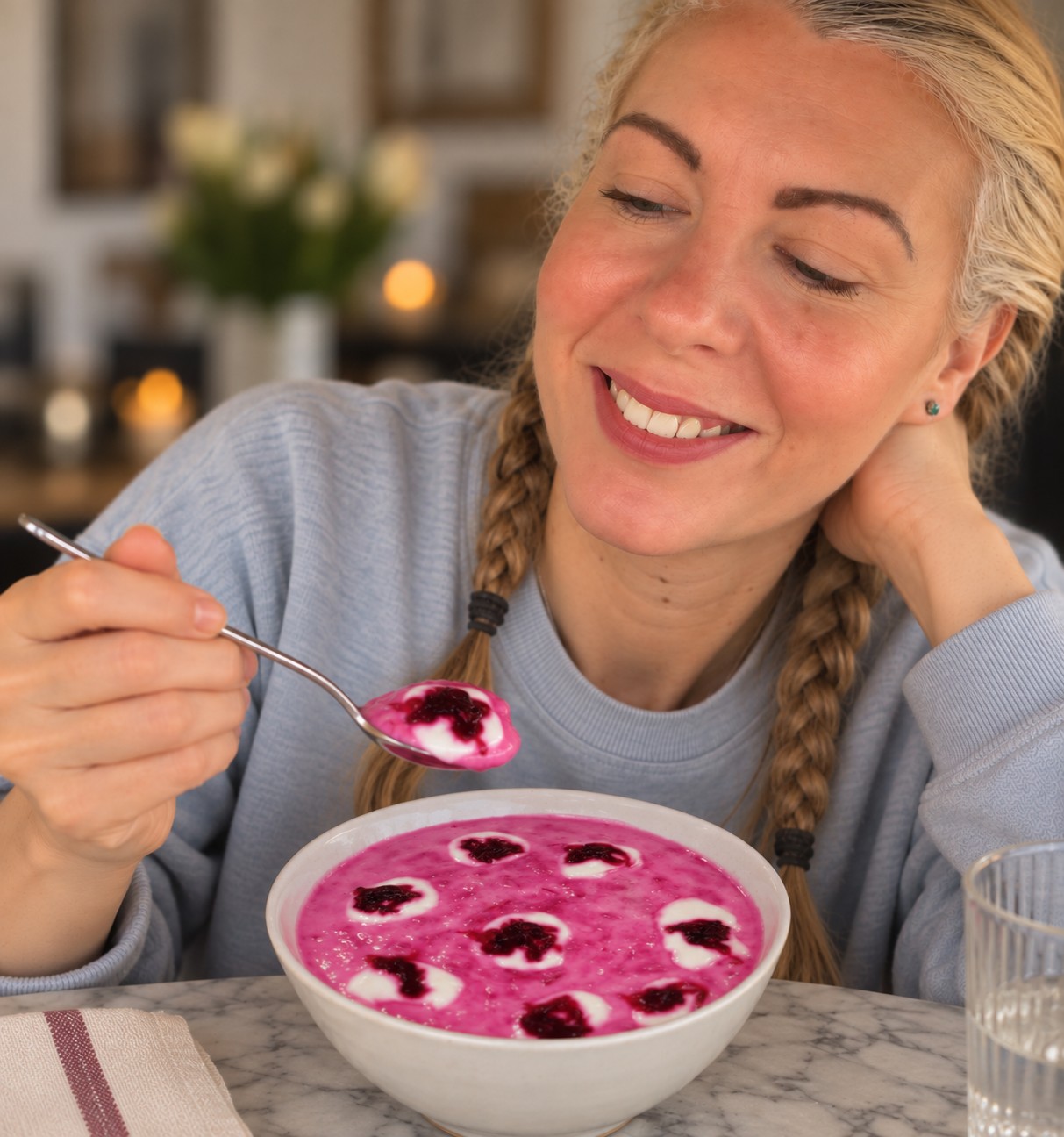
Mast-o-Laboo: the Persian beetroot and yoghurt dip I discovered while pregnant in Iran.
I was 12 weeks pregnant with Cyrus in Iran, suffering from severe morning sickness and sitting in front of a Persian banquet I couldn’t eat. Then I spotted a bowl of startlingly pink and white yoghurt. Years later, Mast-o-Laboo still makes me think about pregnancy, Persian hospitality and why traditional food doesn’t need a wellness makeover to be good for us.
Pregnancy cravings are peculiar things. Some women want chocolate. Others apparently develop urgent relationships with pickled onions. At 12 weeks pregnant with Cyrus, in Iran and suffering from severe morning sickness, I wanted laboo. Beetroot.
Not exactly the pregnancy craving of legend, but there we are.
In Tehran during the colder months, laboo is hard to miss. Whole beetroot is cooked until tender and sold warm, its deep ruby colour making it look particularly inviting when the weather turns cold. I loved it.
I also loved baghali, broad beans, another simple street food that suddenly seemed far more appealing than the elaborate meals my stomach had decided to reject. There was something almost cruel about developing severe morning sickness in a country where food is such an important expression of hospitality because Persian families don’t tend to feed you half-heartedly.
They feed you.
When a Persian auntie has cooked and you can’t eat
One particular meal has stayed with me. We were visiting H’s khalleh, his auntie, who had prepared what can only reasonably be described as a banquet.
The table was covered. There were dishes everywhere, the result of hours of preparation. Persian cooking can involve chopping herbs, soaking rice, preparing meat, frying onions, simmering stews and somehow coordinating everything so that it reaches the table at the right moment. It is food made with effort.
And there I was, looking at all of it and trying desperately not to be sick. I felt terrible.
Turning down food when somebody has spent hours cooking it feels uncomfortable in any culture. In a Persian household, where feeding people is so closely tied to hospitality and affection, it can feel particularly awful. I wasn’t rejecting her cooking, my pregnant stomach was rejecting almost everything.
Unfortunately, stomachs aren’t renowned for their cultural sensitivity. H’s khalleh encouraged me to eat.
“Bokhor, bokhor, azizam.”
Eat, eat, darling.
I wanted to and that was the frustrating part. Then I noticed a bowl on the table containing something cool, creamy and extraordinarily pink. Mast-o-Laboo. Yoghurt and beetroot. It looked like something Barbie might serve alongside a kebab. And, unlike most of the banquet in front of me, I could eat it.
Why Mast-o-Laboo stayed with me
I don’t remember sitting there thinking about folate. I wasn’t contemplating probiotics, cardiovascular health or the state of my gut microbiome. I was pregnant, nauseous and relieved to have found something my body would accept. That is probably why Mast-o-Laboo still has such a strong association for me. Food memories rarely work like nutrition labels.
A particular smell or taste can make or break a pregnant woman! For me, this pink and white yoghurt takes me back to Iran, to being pregnant with Cyrus, to H’s khalleh’s table and to the guilt of wanting to appreciate the food she had spent hours preparing while knowing that eating most of it would have ended badly.
Now I’m in midlife, I look at food differently. I think more about protein. Fibre. Calcium. Heart health. Energy. What keeps me going at the gym and what leaves me hungry again 20 minutes later. Perimenopause has a habit of making you suddenly interested in bodily processes, but it has also made me question the enormous wellness industry that has grown around ordinary food.
Does everything we eat really need a health claim?
What is Mast-o-Laboo?
Mast means yoghurt in Persian, while laboo means beetroot. And Mast-o-Laboo is pretty much what its name promises.
It is a Persian yoghurt and beetroot dish, sometimes described as a dip, although in a Persian meal it can sit alongside several dishes rather than being treated as something requiring a packet of tortilla chips.
Recipes differ from household to household. Some are incredibly simple but others might include herbs, walnuts or different seasonings. The version I remember is gloriously uncomplicated: cooked beetroot, yoghurt and a little salt. Once the beetroot is grated into the yoghurt, the whole thing turns vivid pink. It is almost suspiciously pretty for something requiring so little culinary talent, which suits me perfectly.
Is Mast-o-Laboo actually good for you?
Beetroot is a nutritious vegetable, it provides fibre and folate and contains naturally occurring nitrates. Dietary nitrates have attracted research interest because of their relationship with nitric oxide and blood vessel function.
Plain yoghurt can provide protein and calcium, and varieties containing live cultures also contain bacteria associated with fermented foods.
But Mast-o-Laboo isn’t medicine. It isn’t going to “detox” my liver, I have a liver for that. It isn’t going to balance my hormones, reverse perimenopause or compensate for an otherwise poor diet. And I think traditional foods deserve better than having dubious wellness claims attached to them to make them sound relevant.
Mast-o-Laboo doesn’t need reinventing as a midlife superfood.
It is already good food.
My simple Mast-o-Laboo recipe
This is the sort of recipe I like because the finished dish looks as though you have made considerably more effort than you actually have.
Ingredients
- 2 medium to large beetroot
- 2 cups plain yoghurt
- 1 tablespoon sugar, optional
- A pinch of salt
- Water for cooking
You can adjust the amount of beetroot according to how thick, sweet and violently pink you want the finished Mast-o-Laboo to be.
How to make Mast-o-Laboo
1. Cook the beetroot
Wash the beetroot and place them in a saucepan. Add enough water to cook them until completely tender.
For the slightly sweeter version I remember, add a tablespoon of sugar to the cooking water.
Cooking time will depend on the size of your beetroot, so don’t become emotionally attached to the clock. They are ready when a knife goes through them easily.
2. Let them cool
Remove the cooked beetroot and allow them to cool completely.
Unless you have asbestos fingertips, don’t attempt the next stage immediately.
3. Peel and grate
Peel the cooled beetroot and grate them.
Remember beetroot has no respect for worktops, tea towels or white clothing.
4. Mix with the yoghurt
Put the yoghurt into a bowl and stir through the grated beetroot.
Start with less beetroot if you prefer a milder flavour and add more until you reach the balance you like.
Add a pinch of salt and taste.
Within seconds, the yoghurt will turn that unmistakable Mast-o-Laboo pink.
5. Chill
Cover and refrigerate until cold.
I prefer Mast-o-Laboo properly chilled, when the yoghurt is thick and the sweetness of the beetroot comes through.
Serve it as part of a Persian meal, alongside bread or other dishes, or eat it straight from the fridge when nobody is looking.
I make no judgement.
The problem with turning traditional food into “wellness”
Writing about Mast-o-Laboo now has made me realise how easily we take traditional foods and translate them into the language of modern wellness.
Beetroot becomes “cardiovascular support” and yoghurt becomes “gut health”. Before long, somebody will probably put it into a tiny bottle and charge £6.50 for it. But something gets lost when we talk about food only in terms of what individual nutrients might do for us.
Mast-o-Laboo existed long before I knew what the microbiome was. H’s khalleh wasn’t standing in her kitchen calculating my nitrate intake. She was feeding her family. And when she told me, “bokhor, azizam”, she wasn’t prescribing beetroot. She wanted the pregnant woman sitting at her table to eat.
There is nourishment in that, even if science can’t conveniently put it into milligrams.
What pregnancy taught me about Persian food
My pregnancy with Cyrus gave me an odd introduction to some Persian foods because nausea stripped everything back. I couldn’t necessarily manage the elaborate dishes I wanted to enjoy. Instead, I found myself drawn to simple things.
Warm laboo from the streets.
Baghali beans.
Cool yoghurt.
Mast-o-Laboo.
My body simply liked what it liked, but those foods became tangled up with my memories of Iran in a way I couldn’t have predicted.
Years later, I can see a bowl of beetroot yoghurt and immediately remember what it felt like to be 12 weeks pregnant with Cyrus, far from home, surrounded by Persian family and desperate to eat and desperate not to eat.
That’s quite a lot for two ingredients to carry.
Why I’m coming back to foods like Mast-o-Laboo in midlife
At 50, my relationship with food is changing again.
I want food that supports the life I’m actually living. I exercise, I want to stay strong, and I am increasingly conscious of protecting my health as I get older. I don’t want every mouthful assessed according to whether it is sufficiently anti-inflammatory, hormone-friendly, protein-rich, gut-supporting or optimised for longevity. Sometimes I want yoghurt and beetroot.
Returning to traditional foods offers something useful precisely because they existed before wellness became an industry. They aren’t powders formulated for women over 40 and aren’t promising to fix my hormones. They definitely don’t arrive with a discount code. They are just foods people have cooked, eaten and passed between generations.
Mast-o-Laboo is nutritious. Beetroot brings fibre, folate and naturally occurring nitrates. Yoghurt can bring protein, calcium and live cultures.
Those are perfectly good reasons to eat it.
But they aren’t the reason I love it.
For me, Mast-o-Laboo will always be the pink bowl sitting among H’s khalleh’s banquet when I was 12 weeks pregnant with Cyrus and could barely stomach anything else.
It reminds me of Tehran. Of laboo. Of pregnancy. Of a Persian auntie who had spent hours cooking and my awful guilt at having to refuse almost everything she offered me.
And, above all, of:
“Bokhor, bokhor, azizam.”
Eat, eat, darling.
Is there a food that takes you immediately back to a particular person, place or moment in your life? And have we become so preoccupied with what food can do for our bodies that we’ve forgotten to talk about what it means to us?
Discover more from Saffron & Cyrus
Subscribe to get the latest posts sent to your email.


Saffron & Cyrus is an independent women’s editorial publication with a recognisable voice, real-life perspective, a defined midlife audience and a commercial model built around useful, relevant partnerships.
