
Growing up in Britain, rice wasn’t something we cooked very often. If we ate it, chances were it had arrived in a foil container from the local Chinese takeaway, usually alongside sweet and sour chicken. We were more concerned about who had eaten all the prawn crackers than whether the rice had been cooked properly.
At home, potatoes were what we knew. Mashed, boiled, roasted or chipped, they appeared with almost everything. On the rare occasions we attempted rice, it was more likely to come in a boil-in-the-bag packet. Ten minutes in boiling water, snip open the plastic and dinner was sorted. Years later, I found the same British-versus-Persian contrast in Grandma’s potato fritters and H’s Persian kotlet.
Then I married H, who is Persian, and found I knew very little about cooking rice. In his family, rice was washed, soaked, parboiled, drained and steamed. There were different methods, different pans, a tea cosy thing for the lid, and an interest in tahdig, the golden crust at the bottom that everyone wanted.
My first attempt at cooking Persian rice in a big pan was dreadful. I’d spent ages looking at Pinterest photographs of beautiful saffron rice, with long, separate grains and golden tahdig. I imagined carrying something like this to the table and impressing everyone.
Instead, the rice congealed into one enormous, sticky lump. It looked nothing like the photographs, and there was definitely no golden crust worth fighting over. When I brought it to the table, I asked my guests, “Would you like one lump or two?” They laughed, thankfully because there wasn’t much else they could do.
H, meanwhile, could make Persian rice without appearing to think about it. He knew when to drain it, when to turn down the heat and when to leave it alone. While I kept lifting the lid to see what was happening. After several attempts, a few ruined saucepans and a lot of advice from H, I finally managed rice that was fluffy rather than solid. I even produced a respectable tahdig.
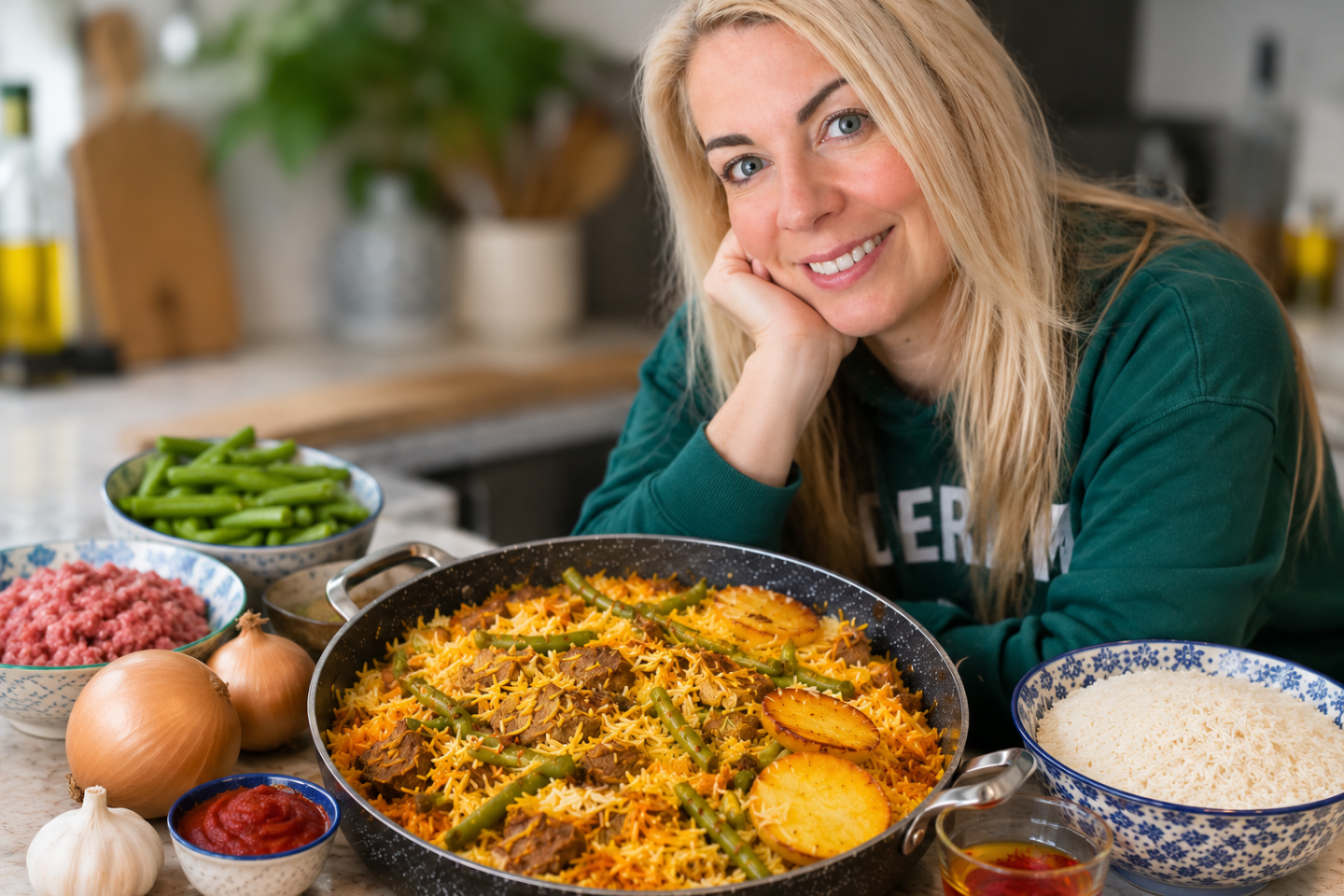
One Persian recipe I really wanted to get right was Lubia Polo, sometimes written Lubia Pollow. It’s made with rice, green beans, meat, tomato and spices, including cinnamon.
I’d grown up in the UK of course associating cinnamon with apple crumble, rice pudding and Christmas cake. Putting it into a savoury dish took some getting used to I can tell you, although I loved the smell of it cooking with onions and meat.
The problem was that I couldn’t leave it alone. I’d add some, taste the mixture and decide it needed more. By the time dinner was ready, the cinnamon had taken over. My Persian rice was beginning to taste like something that should have been served with custard.
H would take a mouthful, pause and look at me. “Too much cinnamon?”
Eventually, I learned to start with a teaspoon and taste the mixture before adding anything else. Some advieh spice blends already contain cinnamon, so adding more without checking isn’t always a good idea.
SERVES 4–6 | PREPARATION 25 MINUTES | COOKING 60–75 MINUTES
- 500g beef or lamb mince
- 2 onions, finely chopped
- 1 garlic clove, crushed
- 1 tsp turmeric
- Up to 1 tsp cinnamon, less if your advieh contains it
- 2 green chillies, optional
- 1 large potato, thinly sliced
- 680g green beans, trimmed and chopped
- 4 tbsp tomato purée
- 1–2 tbsp advieh, to taste
- 3 tbsp brewed saffron water
- 2½ cups basmati rice
- Vegetable oil and 1 tbsp butter
- Salt and black pepper
When I first visited H’s family in Iran, I began to understand how differently rice was treated. It wasn’t an occasional accompaniment. It was part of everyday cooking, prepared in enormous pans, with the sort of attention my family would have reserved for getting the Christmas roast right.
I also had to get used to the idea of putting potatoes underneath rice rather than serving them beside it. The first time I saw potato tahdig, I wondered why anyone would deliberately put sliced potatoes at the bottom of a saucepan and cover them with rice. In my British kitchen, potatoes belonged in the oven, preferably surrounded by hot fat and left until crispy.
As it turned out, the Persians had their own ideas about crispy potatoes, and they were rather good ones. These days, Cyrus thinks nothing of seeing a huge pan of rice steaming on the hob. At his age, I’d have been wondering whether we’d ordered a Chinese.
Lubia Polo has become a family favourite, usually served with mast-o-khiar, a cucumber and yoghurt dip, and Shirazi salad. I’ve learned other Persian recipes too, including Sosis Bandari, a spicy Persian sausage wrap. And when I want something simmered rather than steamed, there is H’s Persian chicken and plum stew. I doubt I’ll ever make rice quite as effortlessly as H, but at least I’ve stopped treating cinnamon as though I’m making apple crumble.
Did you grow up eating rice from the local Chinese takeaway, or was it something your family cooked regularly? Have you ever ruined dinner by adding too much of one spice? Tell me in the comments.
Occasional stories, experiments, discoveries and questions from Saffron & Cyrus.
Discover more from Saffron & Cyrus
Subscribe to get the latest posts sent to your email.


Saffron & Cyrus is an independent women’s editorial publication with a recognisable voice, real-life perspective, a defined midlife audience and a commercial model built around useful, relevant partnerships.
