
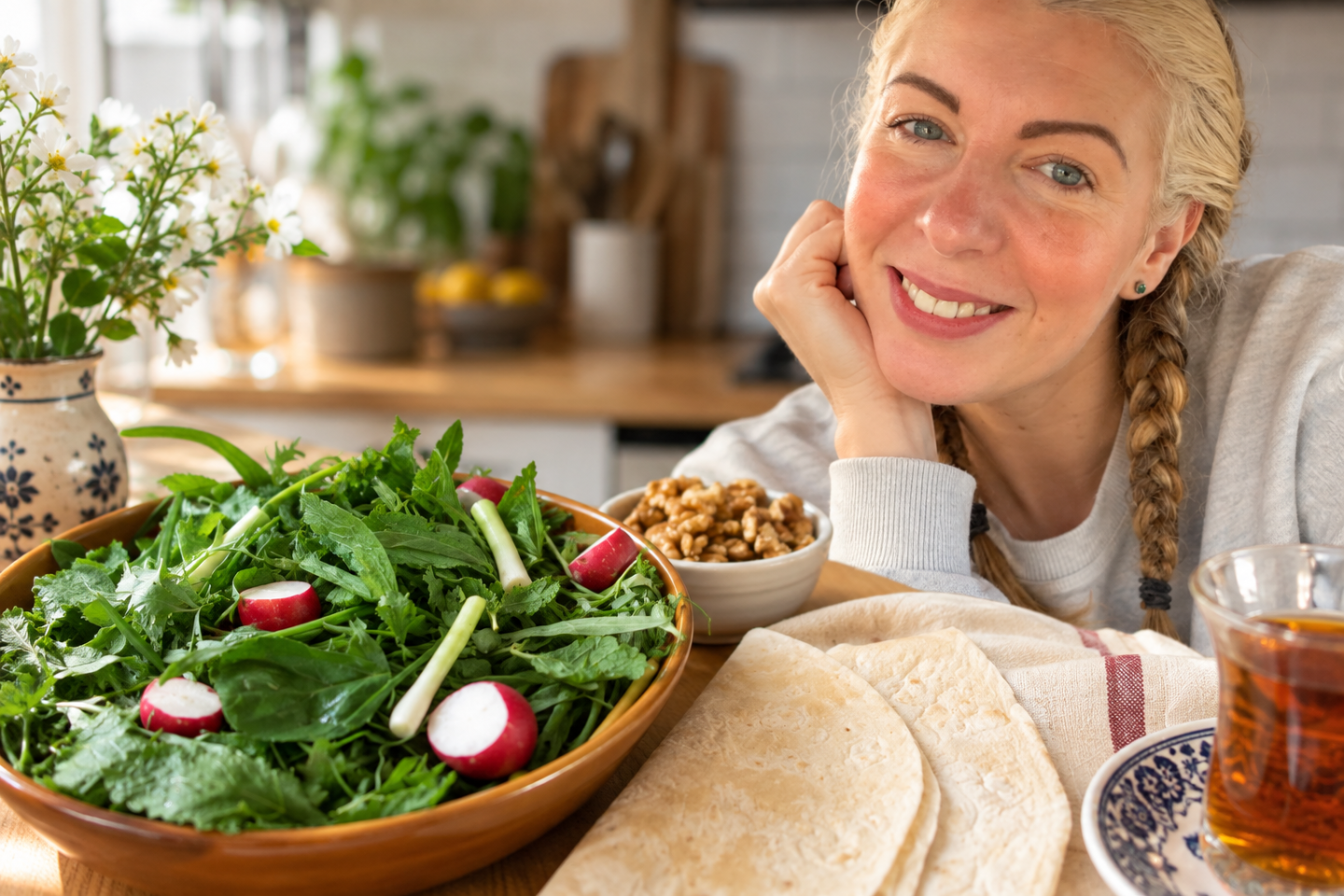
Six weeks pregnant in Iran, I discovered that Persian herbs were all I wanted to eat.
I was a Geordie girl raised on kebabs, chips and garlic sauce. Then morning sickness struck in Iran, and suddenly a plate of fresh herbs seemed more appealing than dinner.
Battling morning sickness in Iran
At six weeks pregnant, I was staying with H’s family in Iran and discovering that morning sickness was a rather misleading name for something that could make me feel dreadful at any hour. H’s many khallehs, or aunties, were doing their best to look after me, but my appetite had developed a mind of its own.
The smell of some cooked dishes was enough to make me retreat from the kitchen. Yet one of H’s aunties put a platter of fresh herbs on the table, and suddenly I found something I wanted to eat. It was called sabzi khordan, a mixture of herbs and vegetables traditionally served alongside Persian meals.
As a proud Geordie girl raised on kebabs, chips and garlic sauce, reaching for fresh mint and tarragon was hardly instinctive. Back home, herbs were something you sprinkled over dinner if you were feeling particularly adventurous. In Iran, they arrived in generous bunches, with radishes, spring onions, walnuts and bread.
Even H’s auntie seemed surprised at my enthusiasm. There I was, surrounded by Persian home cooking, happily picking away at what looked like the contents of somebody’s herb garden.
Forget the kebab and rice. At that moment, I wanted mint, radishes and a handful of walnuts.
What is sabzi khordan?
Sabzi khordan roughly means herbs for eating. It is a familiar part of Persian food culture, with fresh herbs served alongside meals rather than cooked into them. People help themselves to a few sprigs, perhaps with flatbread, cheese, walnuts or whatever else is on the table.
There isn’t one compulsory combination. Mint, basil, tarragon, coriander, chives and parsley are common choices, while radishes and spring onions add crunch. The selection depends on the season, the family and what’s available. The Persian Mama guide to sabzi khordan offers a useful introduction to this traditional herb platter.
What struck me was how normal it all seemed. Nobody was presenting herbs as a fashionable wellness discovery. They were simply part of dinner, passed around the table as naturally as we might pass the salt.
My favourite sabzi khordan ingredients
- Tarragon (tarkhoon)
- Mint (naana)
- Radish (torob-cheh)
- Basil (rayhan)
- Chives (tareh)
- Spring onions (piaz-cheh)
- Coriander (geshniz)
Walnuts, flatbread and cheese often accompany the herbs. You don’t need every ingredient to make a platter worth eating.
When nausea hit, mint became my friend
My cravings turned towards mint, whether in salads or the occasional mint chocolate chip ice cream. Tarragon, with its slightly aniseed flavour, became another favourite. I enjoyed it with chicken salads and roasted vegetables, although there were days when even the thought of cooking was too much.
Walnuts were easy to nibble too. I ate them with yoghurt or straight from the bowl, and later wrote about the Persian tradition of eating dates and walnuts while breastfeeding. I liked having something simple to eat without sitting down to a large meal.
The NHS explains that pregnancy sickness can occur at any time of day, and that different foods and smells can affect nausea. I certainly discovered that for myself. Some meals I would normally have enjoyed were suddenly impossible to face, while a few fresh herbs seemed perfectly appealing.
Sabzi khordan didn’t cure my morning sickness. It was simply something I fancied eating when my appetite was unpredictable. That distinction matters, particularly when pregnancy advice is so often wrapped up in promises about what particular foods can supposedly do for women.
Fresh herbs can form part of a varied diet, but there is no reliable basis for claiming that sabzi khordan improves fertility or treats morning sickness. During pregnancy, wash herbs and vegetables thoroughly, choose pasteurised dairy products and check the NHS guidance on foods and herbal teas during pregnancy. If you cannot keep food or fluids down, contact your midwife or GP.
Newcastle’s fresh herb problem
Back home in Newcastle, recreating the same platter wasn’t quite so straightforward. I could usually find coriander and parsley in the supermarket, but assembling the generous selection I’d enjoyed in Iran took more effort. A few small packets of herbs could cost enough to make me wonder whether I should just order a takeaway.
In H’s family, the herbs weren’t a decorative flourish that somebody removed before eating. They were part of the meal. People reached for them between mouthfuls of rice, meat and stew, adding a little freshness whenever they fancied it.
It’s a habit that works particularly well with Persian dishes such as H’s chicken and plum stew, khoresht-e aloo, where the herbs provide a fresh contrast to the rich sauce. You don’t need to be pregnant or particularly fond of salads to appreciate that.
How to make a simple sabzi khordan platter
The beauty of this Persian herb platter is that there is very little cooking involved. It’s more a matter of choosing fresh ingredients, washing them carefully and arranging everything so people can help themselves.
SERVES 4 | PREPARATION 15 MINUTES | NO COOKING REQUIRED
Ingredients
- 1 mixed bunch of fresh herbs, including mint, basil, coriander, tarragon and chives
- 1 bunch of spring onions, roots removed
- 6 radishes, trimmed
- 1 cup of walnuts
- Lavash or another flatbread
- Optional: pasteurised feta cheese
Method
- Wash the herbs, radishes and spring onions thoroughly under running water, then drain and dry.
- Remove any tough or woody stems, leaving the tender herb sprigs intact.
- Arrange the herbs, radishes and spring onions on a large serving platter.
- Add the walnuts, flatbread and optional feta cheese.
- Serve immediately and let everyone choose their own combination.
What to serve with sabzi khordan: Try it with Persian kotlet, the spiced meat and potato patties that remind me of my grandmother’s British potato fritters. It also makes a fresh accompaniment to rice dishes such as lubia polo, Persian green bean rice.
More than a plate of herbs
Sabzi khordan became one of the small pleasures of my pregnancy in Iran, but it also changed how I thought about Persian food. Not everything needed a complicated recipe, a long list of spices or a saucepan simmering for hours. Sometimes the simplest things on the table were the ones I remembered most.
I arrived as a Geordie who thought a respectable helping of greens usually came with Sunday lunch, preferably covered in gravy. I left with a fondness for fresh tarragon and mint, and a better understanding of why H’s family always seemed to have a platter of herbs within reach.
It was an unexpected pregnancy craving, and one I was rather pleased to bring home. The kebabs and chips weren’t going anywhere, but at least there was room for a few radishes on the table.
Have you tried sabzi khordan, or discovered an unexpected food craving during pregnancy? Which fresh herbs would you put on your platter? Tell me in the comments.
Occasional stories, experiments, discoveries and questions from Saffron & Cyrus.
NB: No spam. Just stories, discoveries and the occasional big question. You can unsubscribe whenever you like.
Discover more from Saffron & Cyrus
Subscribe to get the latest posts sent to your email.


Saffron & Cyrus is an independent women’s editorial publication with a recognisable voice, real-life perspective, a defined midlife audience and a commercial model built around useful, relevant partnerships.
