
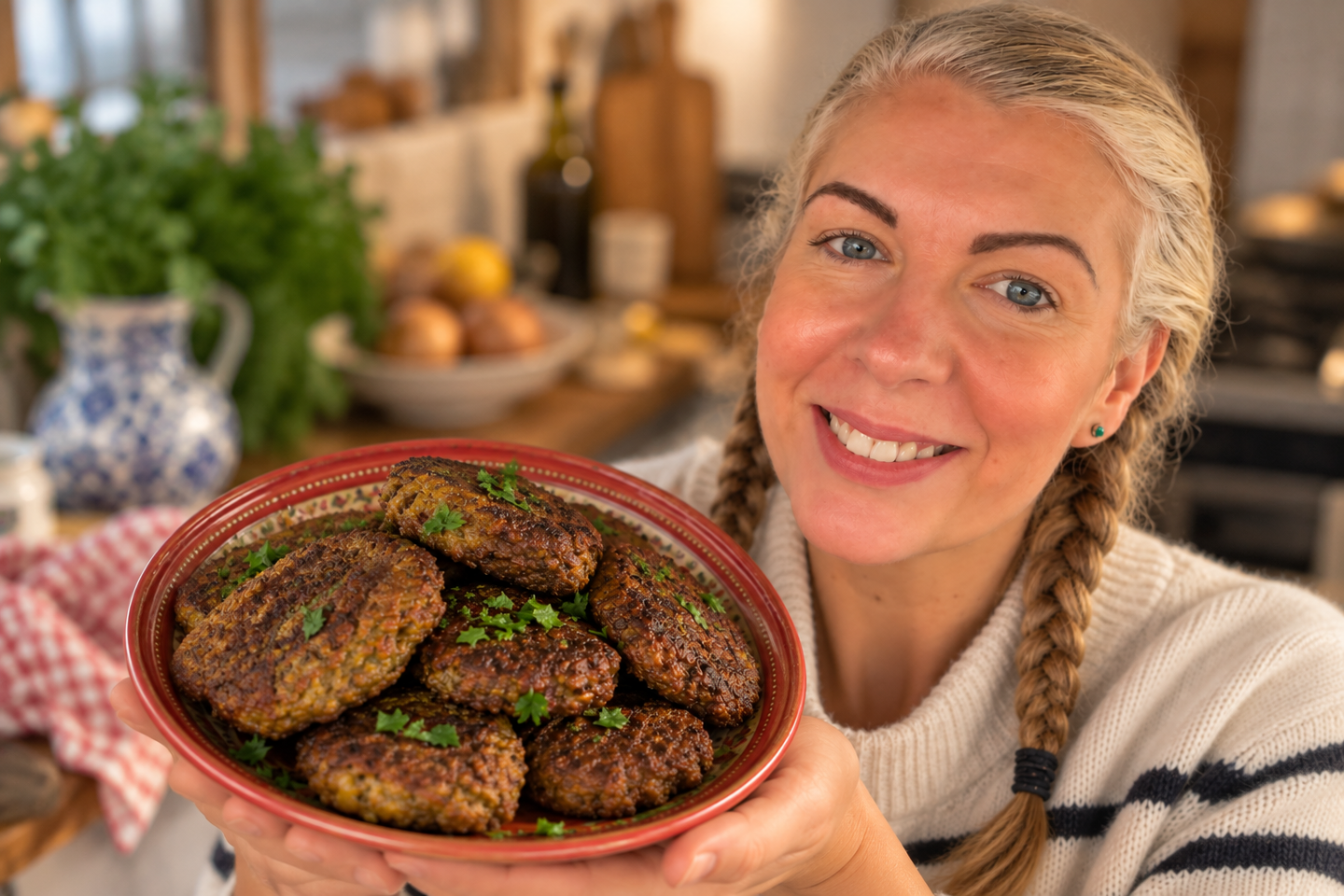
Some meals linger long after the last bite, not because they are complicated, but because of everything that happens around them. Persian kotlet is one of those meals for me.
Golden and crisp around the edges, tender and warmly spiced inside, kotlet is deceptively simple. Minced meat, potato, onion and spices are shaped into patties and fried until golden. They can be served with Persian rice, wrapped in flatbread or packed up for a picnic.
On paper, it doesn’t sound particularly complicated. And that was rather what I thought when I first watched H’s family making them in Iran. Meat. Potato. Onion. Spices.
How difficult could it be?
As it turned out, I wasn’t even trusted with the frying pan.
Because sometimes the important part of a recipe isn’t written down. It is in the hands making it, the people talking over one another and the rituals you are slowly invited into.
I first learned the art of kotlet-making in my mother-in-law’s kitchen in Iran, although “learned” might be stretching it. Mostly, I watched.
H’s mum and aunties gathered around the kitchen table, chatting as their hands worked almost independently of the conversation. One khalleh grated the potatoes, another shaped the kotlets between her palms, while H’s mum was stationed at the frying pan. And me? I was not allowed anywhere near it. I had been relegated to watching, because the British daughter-in-law clearly couldn’t yet be trusted with hot oil and the family kotlet. Probably wise, so I watched and I loved watching them.
There were no measuring spoons lined up neatly on the worktop, no recipe propped against a jar and certainly nobody stopping to consult Google. They worked with the sort of ease that comes from having made something hundreds of times before. The conversation carried on around the food, except “conversation” perhaps makes it sound rather more orderly than it was. They talked over one another while they worked. One auntie shaped, another grated, H’s mum tended the pan, and everybody seemed perfectly capable of keeping an eye on everybody else’s kotlets at the same time. There were corrections.
Meanwhile, the smell of turmeric and onion filled the kitchen, followed by that warm, savoury smell as the first kotlets hit the shallow oil and began to brown. What struck me was how instinctive everything seemed. Every kotlet emerged roughly the same size and shape. Nobody appeared to be concentrating particularly hard, yet everybody knew exactly what she was doing. Shape. Fry. Turn, another batch and another correction.
Standing there, it would have been tempting to think kotlet-making took little more than knowing the ingredients. But behind the chatter was technique. There was knowing how the mixture should feel in your hands, how much to take for each kotlet. How to shape it. when the oil was ready and when to turn one. Even when something wasn’t quite right. The aunties made those decisions without appearing to make them at all and that is what years of repetition look like. The recipe isn’t really the interesting bit, the making is. And a recipe can only tell you so much.
It certainly can’t reproduce several khallehs talking over one another while simultaneously monitoring the quality of everybody else’s work. That, I realised later, was the interesting bit.
Persian kotlet is a popular home-style dish usually made from minced meat, potatoes, onion, egg and spices. The mixture is shaped into flattened patties and shallow-fried until crisp on the outside and tender inside.
A few days later, I was sitting on a picnic blanket in Isfahan.
There were fresh herbs, pickles and sangak bread laid out for everyone to share and there were the kotlets. The same food I had watched being shaped around the kitchen table was now sitting on a picnic blanket waiting for everybody to help themselves. I picked one up and ate it with the bread.
At the time, I was just eating a kotlet, but I knew whose hands had made what I was eating and that was important.
This is the version I know.
- 500g lean minced beef or lamb
- 2 medium raw potatoes, grated
- 1 large onion, finely grated
- 1 egg
- 2–3 tablespoons flour
- Turmeric
- Salt
- Black pepper
- Cinnamon
- A pinch of nutmeg
- Cayenne, optional
- Vegetable oil for shallow frying
Grate the potatoes and onion, then remove as much excess moisture as possible.
Combine them with the minced meat, egg, flour and spices. Mix thoroughly until the mixture holds together.
Take a portion of the mixture and flatten it between your hands to form a patty. If an Iranian auntie is available to inspect it and tell you you’ve done it incorrectly, even better.
Heat a shallow layer of vegetable oil in a frying pan.
Carefully add the kotlets and fry until crisp and deeply golden underneath. Turn and cook on the other side.
Work in batches rather than overcrowding the pan, then transfer the cooked kotlets to kitchen paper.
Serve warm or cold with sangak or another flatbread, fresh herbs and pickles, or alongside Persian rice.
Mine may not emerge quite as uniformly as the aunties’ did. I suspect I need a few more years.
By the time that plate reaches you, you aren’t only eating the ingredients, you have been allowed into everything around them. From H’s mum guarding the frying pan to everyone sitting together on a picnic blanket in Isfahan eating what those women had made. I went into that kitchen thinking I was learning how to make a Persian meat-and-potato patty, but I came out understanding something about how families pass culture from one generation to another. Through repetition, watching and being there. Years later, I don’t remember exactly how much turmeric went into that bowl. I just remember being allowed to stand there and take it all in.
That’s how a simple plate of kotlet makes you feel part of a family. First they feed you, then, little by little, they let you into the kitchen.
Perfect lubia polo: a guide to Persian comfort food
Celebrating Nowruz and Sizdah Bedar: Persian traditions in the UK
Occasional stories, experiments, discoveries and questions from Saffron & Cyrus.
Discover more from Saffron & Cyrus
Subscribe to get the latest posts sent to your email.


Saffron & Cyrus is an independent women’s editorial publication with a recognisable voice, real-life perspective, a defined midlife audience and a commercial model built around useful, relevant partnerships.
