
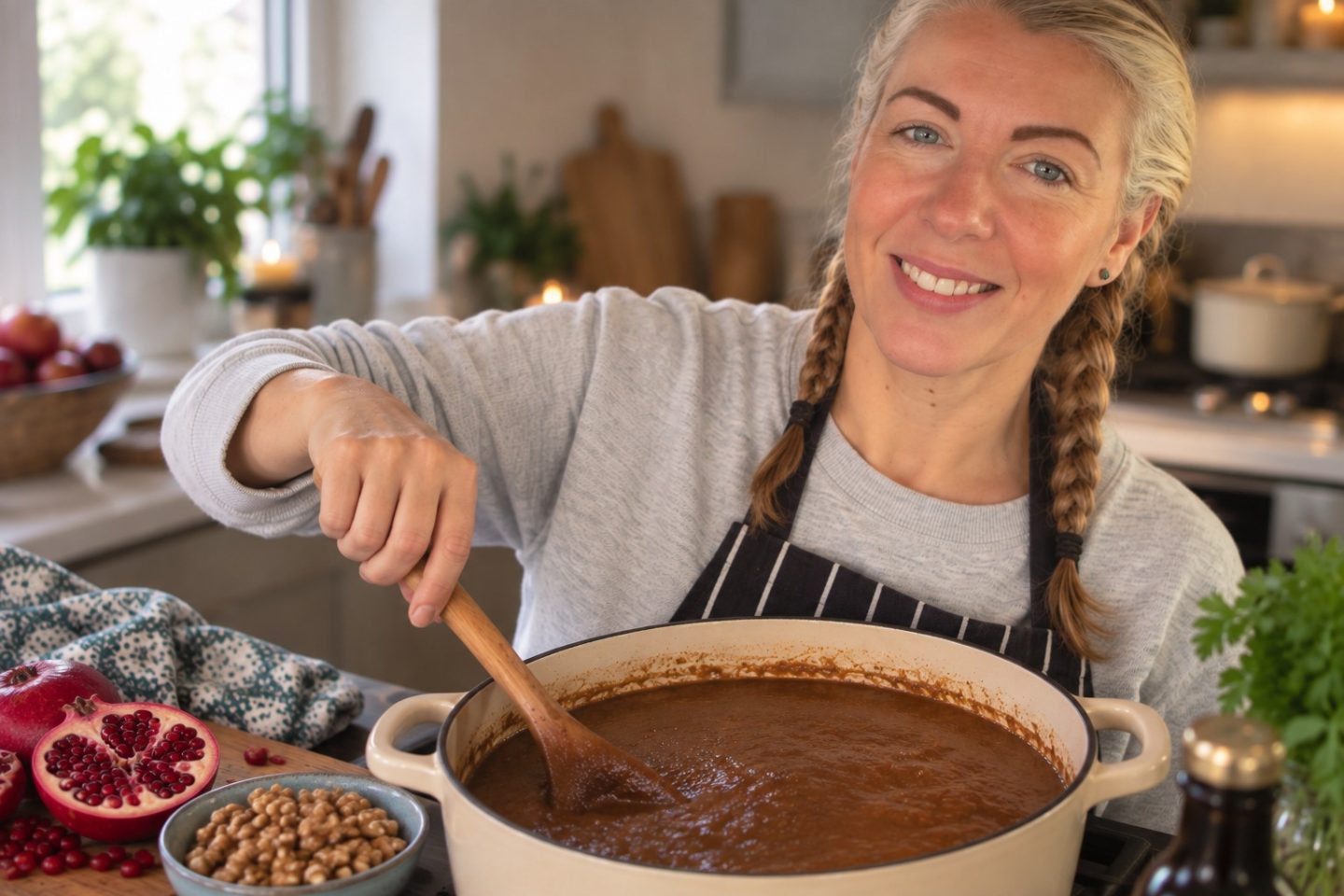
I refused to eat Persian fesenjan because it looked like gravy, but one spoonful changed my mind.
I grew up in Newcastle upon Tyne refusing gravy on my Sunday dinner, so when H introduced me to khoresht-e fesenjan, a dark Persian stew made with walnuts and pomegranate molasses, I wasn’t enthusiastic. It looked more like the aftermath of a bad meal out than fine dining. Then I tasted it.
A Geordie girl meets a suspicious-looking Persian stew
There is no tactful way of describing khoresht-e fesenjan. It’s brown. Very brown. As someone who grew up refusing gravy on my Sunday dinner, I wasn’t thrilled to be presented with what appeared to be the Persian equivalent. At least my mum’s British gravy stayed in a jug on the dining table, where I could avoid it. This stuff looked like it had swallowed the chicken whole.
Many years before Cyrus arrived, when H and I were newly dating, we went to Taste of Persia in Newcastle upon Tyne. H recommended fesenjan, a traditional Iranian stew made with ground walnuts and pomegranate molasses. I trusted his judgement until the waiter brought it over. It looked more like gravy.
H encouraged me to try it and I remembered my mum insisting I eat my vegetables at Sunday lunch, while I stubbornly pushed them around my plate. I closed my eyes, took a reluctant spoonful and prepared for disappointment.
The walnuts gave the sauce a rich, nutty flavour, while the pomegranate added a sharpness I’d never experienced before. I couldn’t believe I’d nearly refused it. Unfortunately, H told his family.
The Persian aunties declared an unofficial cooking competition
By my first trip to Iran, word had spread that H’s British partner loved fesenjan. His mum’s sisters saw this as an invitation to demonstrate their culinary superiority. One auntie prepared it for lunch, another served it for dinner, and occasionally I ate fesenjan three times in one day.
Each wanted to know whether hers was the best. Naturally, I told every single one she’d won. I might have been new to Persian family life, but I understood that telling one sister another cooked better wasn’t going to end well. British politeness had prepared me for many things, although an Iranian MasterChef contest was a new challenge.
Then one auntie raised the stakes. Halfway through eating her fesenjan, she showed me where the chicken had recently been wandering around her yard. She’d plucked and prepared it herself. My experience of buying chicken involved selecting a plastic tray from a supermarket fridge, not becoming acquainted with its former living arrangements.
I appreciated the effort, although I was so glad nobody had introduced us beforehand.
What is fesenjan, and should it taste sweet or sour?
Fesenjan, also written fesenjoon or fesenjān, is a Persian stew traditionally prepared with walnuts, pomegranate and poultry, although there are other variations. Encyclopaedia Iranica traces the dish’s history to Gilan in northern Iran, where walnuts and pomegranates have long featured in regional cooking.
One thing I’ve learned is that Persian families don’t necessarily agree on how it should taste. Some prefer a sweeter sauce, while others favour the sharpness of pomegranate molasses. H and I are firmly in the sour, or torsh, camp.
He dislikes overly sugary food, and I prefer the pomegranate’s tartness against the walnuts. The balance matters because molasses varies between brands. As The Caspian Chef explains in her fesenjoon recipe, different pomegranate products can vary considerably in sweetness and acidity. Tasting as you cook is more reliable than blindly following a recipe.
I’ve noticed similar family variations with khoresht-e aloo, the Persian chicken and plum stew. The dish might have a familiar name, but every household seems to prepare it differently. I’m definitely not volunteering to judge whose version is authentic.
The hand blender that couldn’t cope with Persian cooking
Eventually, I decided to make fesenjan myself. The walnuts need grinding finely so they release their oils and thicken the sauce as it cooks. Unfortunately, I didn’t own a food processor. I had a hand blender and more confidence than experience.
The machine struggled, but I persevered until sparks started flying. Actual sparks. I’d gone from preparing dinner to wondering whether I was about to set fire to the kitchen. I switched the blender off immediately when it started smoking, and it was eventually replaced with something more powerful.
Then there was the rice. My early attempts at Persian rice arrived in one enormous lump, whereas H was accustomed to beautifully separate grains. His cousin eventually bought us a rice cooker without offering any criticism whatsoever. It was the politest culinary intervention I’ve ever experienced.
Fortunately, I learned. These days, I can make decent Persian rice and appreciate why everyone gets excited about tahdig, the crispy golden layer at the bottom of the pan. In fact, I’ve written about my early Persian rice disasters and how I finally learned to make lubia polo. At least nobody has felt compelled to buy me another kitchen appliance recently.
For anyone trying fesenjan at home, my advice is to use a proper food processor for the walnuts, allow the stew time to simmer and resist the temptation to judge the finished sauce by its colour. I learned all three lessons the hard way.
Now Cyrus grinds the walnuts
The funniest part is watching Cyrus help make fesenjan. He loves grinding the walnuts and doesn’t find anything unusual about chicken cooked with pomegranate sauce. What once seemed completely foreign to me is just dinner to him.
Our British-Persian kitchen has quite a collection of dishes I never encountered growing up. Cyrus has enjoyed Persian flavours since he was small, as I discovered when writing about how he learned to love ghormeh sabzi and Persian greens. I’ve also written about discovering mast-o-laboo, the Persian beetroot and yoghurt dip, during my pregnancy in Iran.
For Cyrus, these dishes aren’t unusual or exotic. They’re just part of what we eat at home, alongside the British food I grew up with. He doesn’t need convincing that fesenjan is worth eating, which is more than can be said for his mother at that first restaurant meal.
The Persian stew that changed my mind about gravy
I still laugh about that first meal with H in Newcastle, and while I never developed a taste for British gravy, I’ve become fond of fesenjan. I want the walnuts finely ground, the pomegranate properly sour and enough rice to soak up the sauce.
As for which auntie makes the best version, I’m keeping that information to myself. I’ve spent enough time around Persian families to know when silence is the sensible option.
What’s the one food you refused to eat as a child but now genuinely enjoy?
More from Saffron & Cyrus
Occasional stories, experiments, discoveries and questions from Saffron & Cyrus.
Discover more from Saffron & Cyrus
Subscribe to get the latest posts sent to your email.


Saffron & Cyrus is an independent women’s editorial publication with a recognisable voice, real-life perspective, a defined midlife audience and a commercial model built around useful, relevant partnerships.
