
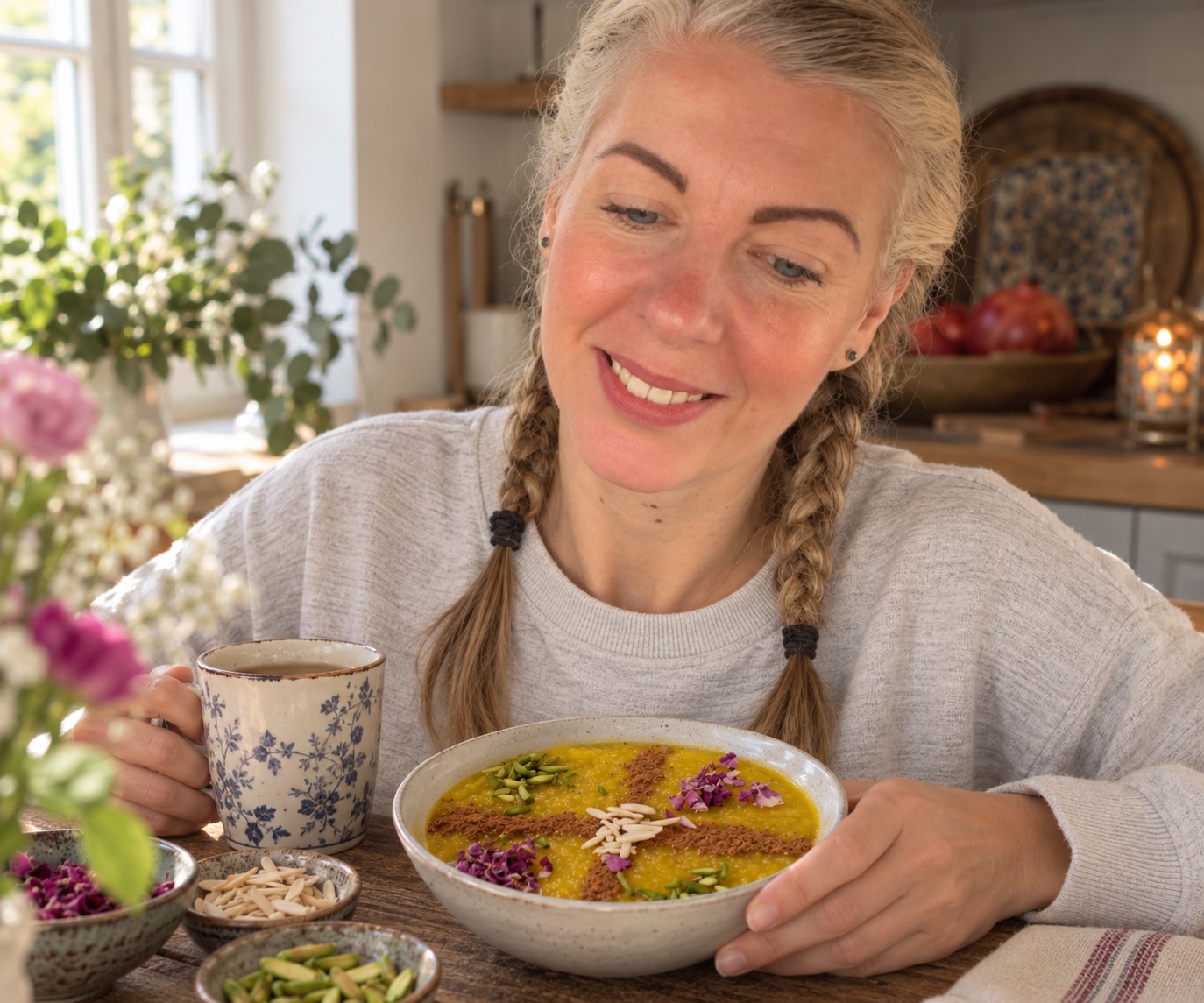
Six weeks pregnant is a strange place to be. You know enough to have imagined an entire future and almost nothing about whether that future is actually going to happen.
We were in Iran and had chosen to have an early scan there because six-week scans aren’t routinely offered in the UK. I wanted reassurance and I wanted somebody with a machine and considerably more medical knowledge than me to point at the screen and tell me everything was fine.
I thought I needed certainty. What I discovered was that certainty and hope are not remotely the same thing.
Instead, I was told there was nothing there. Nothing.
I was frightened, but I was also stubbornly unconvinced. Somewhere underneath the fear was this insistent feeling that the doctor was wrong. So I took the scan photograph away with me and studied it. Again and again.
I examined every fuzzy patch of grey and black as though the answer might reveal itself if I stared hard enough. Essentially, I was conducting my own second medical opinion armed with my ultrasound photograph, maternal instinct and no medical qualifications. But I was sure there was something there.
I couldn’t know that the something I was desperately searching for would become Cyrus. At that point, I had a grainy photograph and hope, and hope, I was discovering, is a very uncomfortable thing to hold when what you really want is certainty.
That was my assumption. If I could just get the right scan, the right answer or the right piece of information, I could stop being frightened. It explains why we’d gone for the early scan in the first place and why I became so fixated on the photograph afterwards.
Look at it. Look closer. Just find something.
I was trying to analyse my way out of uncertainty and this is still rather recognisable behaviour for me. Give me a problem I can’t control and there is every chance I’ll attempt to research it into submission. But no amount of staring at that photograph could tell me what would happen next.
H couldn’t tell me. The doctors couldn’t give me the certainty I wanted either. And that was when H’s family did something completely different.
By then, we were back in the UK, but thousands of miles away in Iran, H’s mum and sister decided to act. They prayed and then they cooked.
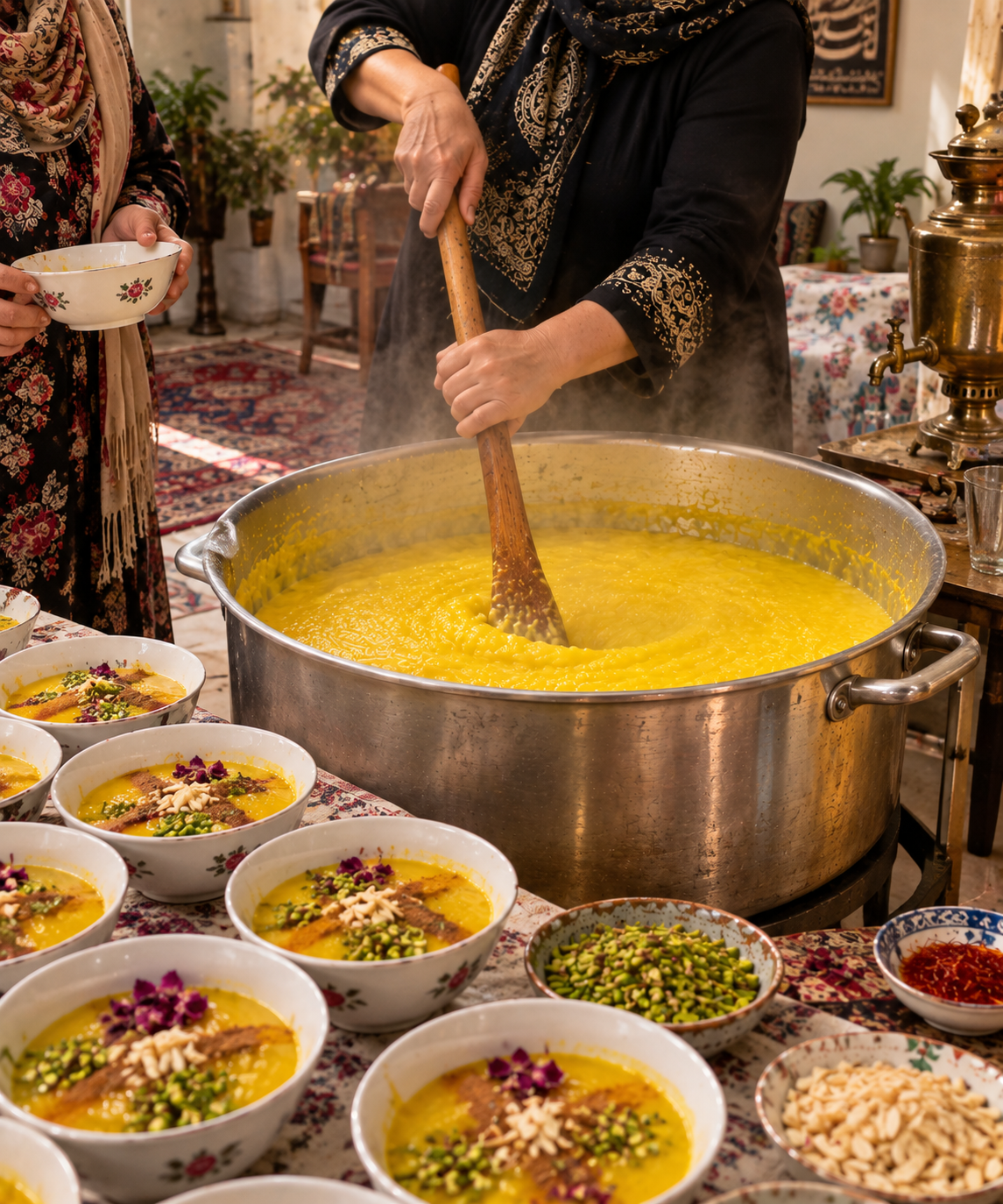
They made an enormous quantity of sholeh zard, Persian saffron rice pudding, to distribute among their neighbours. It took them all night. I wasn’t standing in the kitchen with them, but I’ve imagined that scene many times since.
The smell of saffron and rosewater drifting through the house, steam rising from what I can only describe as a giant cauldron. H’s mum and sister stirring the rice as it softened and slowly turned golden.
Bowls and containers lined up, waiting to be filled. They were praying for me, for the pregnancy to continue and for the baby to be healthy. And then they gave the pudding away.
There is something wonderfully Persian about responding to a family crisis by cooking enough food for everybody else. At the time, though, I needed H to explain what was going on. For him, it was familiar, but for me, it wasn’t. Suddenly he wasn’t simply translating the language, he was translating the tradition.
This is the part of the story I find fascinating now. I was in Britain scrutinising a six-week ultrasound photograph. H’s mum and sister were in Iran stirring an enormous pot of saffron rice pudding through the night. Same uncertainty, but very different coping mechanisms.
My instinct was information, theirs was tradition. I wanted evidence, but they turned towards prayer, family and community. We were all trying to do something with the helplessness.
It touched me deeply and it was different from anything I would have thought to do. But underneath the cultural difference was something I didn’t need H to translate.
Love.
This was the part that initially puzzled me. I was the frightened pregnant woman. Why were the neighbours getting pudding?
The answer lies in the Persian tradition of nazr, an offering or vow that can be associated with prayer, gratitude, hope or religious devotion. Food can be prepared and distributed among relatives, neighbours and the wider community. The giving matters.
Something private becomes communal. A family hopes for something, makes something and shares it with other people. That distinction changed the way I thought about what H’s family had done. They weren’t simply sitting at home hoping harder. They had turned hope outwards.
Sholeh zard begins with remarkably ordinary ingredients.
Rice. Water. Sugar. Saffron.
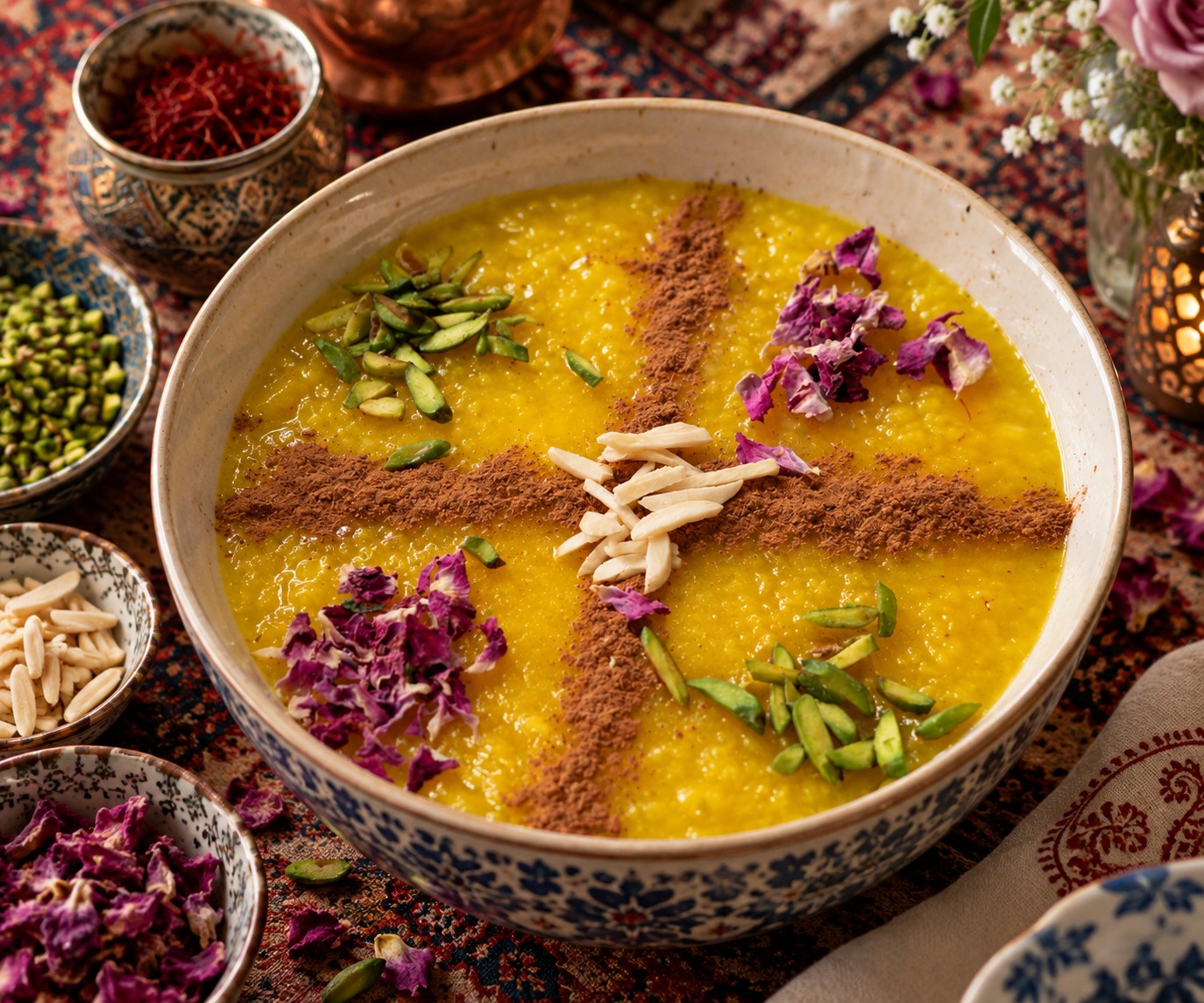
The whole thing turns a glorious yellow-gold. Rosewater brings its unmistakable perfume. Cinnamon, pistachios and almonds decorate the top.
It looks celebratory before you know whether there is anything to celebrate. I love that about it.
Make enough for the neighbours and you are approaching catering-operation territory. Which is how I picture H’s mum and sister that night. Standing over their giant cauldron, stirring and portioning until goodness knows what hour.
I wasn’t there, yet somehow that kitchen has become part of my memory of the pregnancy. Sometimes we inherit scenes we never actually witnessed because they become part of the story of us.
There is another detail that makes the choice of sholeh zard particularly fitting.
I couldn’t get enough of it.
When I was in Iran pregnant with Cyrus, I craved sholeh zard. Of all the things pregnancy might have selected, my body apparently decided Persian saffron rice pudding was urgently needed.
I loved the soft rice, the sweetness, the saffron and that rosewater. Pregnancy cravings are strange. Your body can suddenly reject something you’ve happily eaten for years.
For me, sholeh zard made the list.
So while H’s family were making industrial quantities of it as part of their prayers for my pregnancy, I was carrying the baby responsible for making me crave the stuff.
And here’s the bit I particularly love.
Ten years later, Cyrus loves it too. I feel there should probably be a genetic study.
Cyrus is 10 now.
That sentence still does something strange to me when I think about the six-week scan, because now I can see the person.
He has a face I know as well as my own. A voice, opinions, favourite things and a brilliant sense of humour. He can definitely sit at a table and eat sholeh zard.
The baby in that scan had none of those things yet. To everybody else, it was an uncertain early pregnancy. To me, he was already someone I was desperately trying to find in a smudge of grey on a photograph.
And thousands of miles away, people were hoping for him too before they knew what he looked like.
His grandmother and aunt stayed up through the night making food and praying that he would get the chance to become somebody at all. Then they gave that food away.
I can finally see what they were doing. They were giving uncertainty somewhere to go.
I can’t tell this story without including the recipe because the ingredients are part of the memory.
There are, naturally, almost as many opinions about Persian recipes as there are Persian families, and I have been around Persians long enough to know better than to announce that mine is definitive. This is just a version you can make at home.
- 1 cup jasmine rice
- 1½ cups sugar
- 2 tablespoons rosewater
- A pinch of brewed saffron
- Unsalted butter
- Ground cinnamon, for decorating
- Slivered almonds
- Slivered pistachios
- Dried rose petals, optional
- Rinse the rice thoroughly, then cook it in water until very soft. Stir occasionally to prevent it catching on the bottom of the pan.
- Add the sugar, rosewater and brewed saffron. Stir gently as the pale rice slowly turns golden.
- Reduce the heat, add a little butter and simmer gently for a few more minutes.
- Spoon into individual bowls and leave to cool.
- Decorate with cinnamon, almonds, pistachios or dried rose petals.
There is enough simmering time for a small Persian dance around the kitchen. I refuse to believe this adversely affects the recipe.
For another take on this traditional pudding, The Caspian Chef’s sholeh zard recipe and Persian Mama’s version are useful places to explore.
I went for that six-week scan because I wanted certainty, but I didn’t get it.
Instead, I was told there was nothing there, so I tried to manufacture certainty for myself.
Look at the photograph. Look closer. Analyse. Look again. Find something.
H’s family had no more control over the outcome than I did. Their tradition looked different, but neither could make my pregnancy continue. And I think that’s important to say.
I don’t want 10 years of hindsight to turn this into a story in which prayer, instinct or saffron rice pudding somehow produced a healthy baby.
Families can hope just as fiercely, pray just as hard and perform every treasured tradition they have, and experience a very different ending. That’s not where the meaning of this story lies for me.
Hope isn’t certainty.
That is what I understand now.
Hope is what we reach for when certainty isn’t available.
I tried to find mine in the pixels of an ultrasound photograph. H’s family put theirs into an enormous pot.
But they did something else too.
They shared it.
And that is my answer.
When hope is all we have, we find a way to carry it. And when it becomes too heavy to carry alone, family, tradition and community can help us share the weight.
Ten years later, the indistinct something I was searching for on that scan is Cyrus, sitting in front of me and happily eating sholeh zard.
Behind that ordinary moment is another image I never actually witnessed but somehow carry with me.
A kitchen in Iran.
H’s mum and sister.
The smell of saffron and rosewater.
A giant pot bubbling through the night and rows of bowls waiting to be filled.
Neighbours receiving pudding because a family was hoping that a tiny baby thousands of miles away would be all right.
They couldn’t fix what frightened us, so they found something else to do.
And I think that was the answer all along.
When certainty isn’t possible, what does hope look like in your family?
Persian kachi pudding and the food traditions that follow us through motherhood
Occasional stories, experiments, discoveries and big questions from Saffron & Cyrus.
Discover more from Saffron & Cyrus
Subscribe to get the latest posts sent to your email.

Saffron & Cyrus is an independent women’s editorial publication with a recognisable voice, real-life perspective, a defined midlife audience and a commercial model built around useful, relevant partnerships.
