
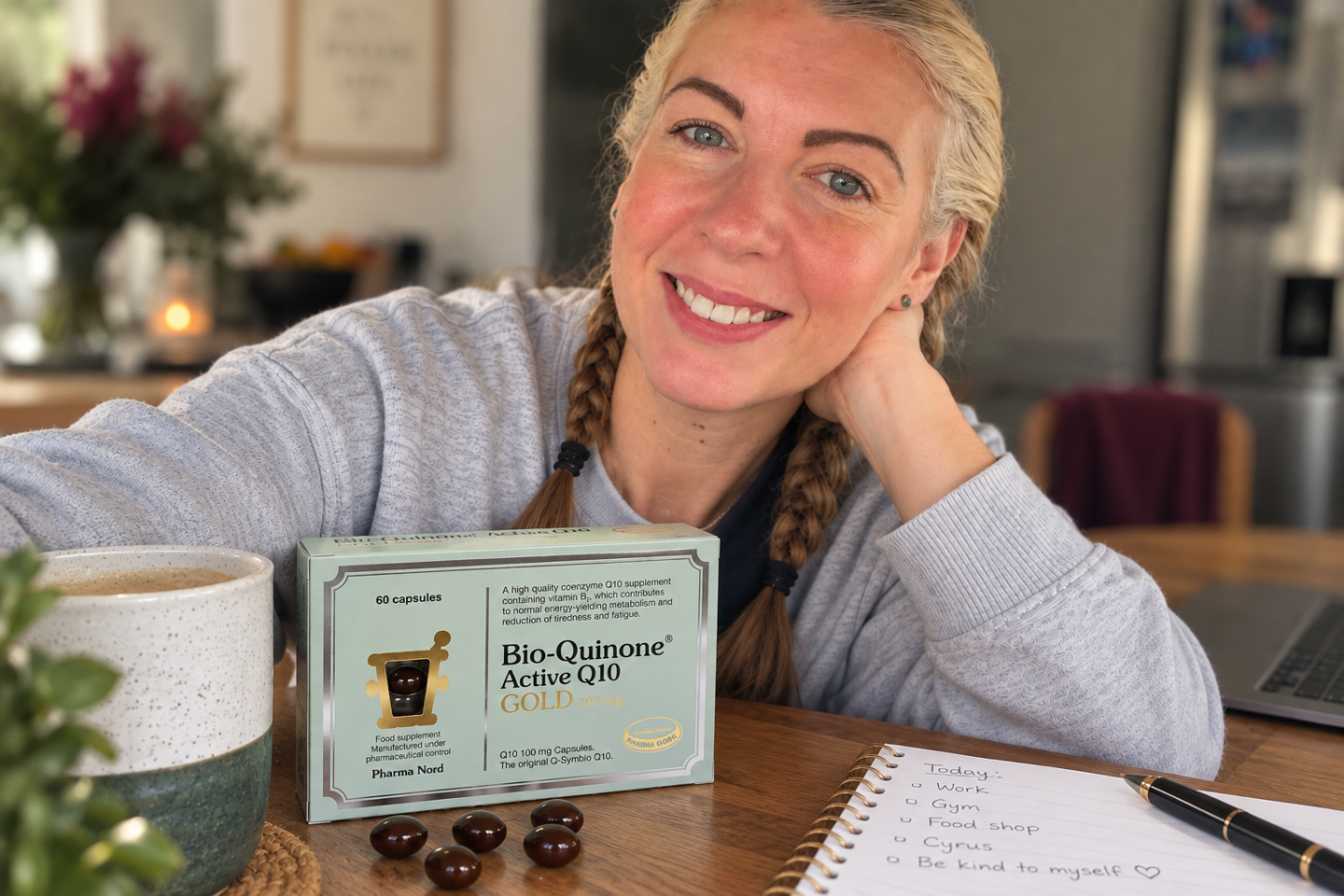
This supplement journey is my personal chronicle. While this post is a collaboration, the opinions and experiences shared here are entirely my own. Supplements are not a substitute for medical advice, diagnosis or treatment. If you are experiencing persistent or unexplained fatigue, speak to a healthcare professional before assuming supplements are the answer.
There comes a point in midlife when you stop expecting your energy to magically return after a good night’s sleep.
“Tired” seems to acquire layers. There’s ordinary tired. Work tired. Parent tired. Hormonal tired. The tired where you have technically slept but wake up feeling as though somebody else used your body overnight.
And then there is the question I keep coming back to: can a supplement genuinely make a difference to midlife energy, or do we want to believe the capsule is doing something?
For me, that question began shortly after becoming a mum at 40.
I adored Cyrus, but motherhood at this stage of life sometimes felt like climbing a hill with a backpack full of dirty washing and responsibilities. I wanted to be energetic. Instead, I was frequently running on adrenaline, coffee and cold burnt toast.
Or do we simply want to believe the capsule is doing something?
Before motherhood, I’d always dabbled with vitamins.
There wasn’t much science behind my approach. A multivitamin here, some Omega oils there, usually influenced by whatever happened to be on offer in the chemist. My bathroom cupboard had all the hallmarks of somebody interested in wellbeing but lacking anything resembling a system.
When I decided to prepare my body for pregnancy, I became more intentional.
I stocked up on supplements with names that sounded reassuringly scientific. One of them was Coenzyme Q10 (CoQ10), a substance naturally produced by the body and involved in cellular energy production.
A few years later, Cyrus was four and I was still tired. I felt as though somebody had turned my internal dimmer switch down.
My workouts felt harder and my patience occasionally evaporated halfway through a sentence. This was when I decided to revisit Q10.
I chose Pharma Nord’s Q10 Gold and started with 200 mg a day. Given my previous experience, I paid far more attention to how I felt rather than assuming that because something came in a supplement box, my body was obliged to appreciate it.
And this time, the experience was different.
Within a couple of weeks, I felt as though my energy was steadier. My thinking seemed clearer. I wasn’t bouncing off the walls, but I wasn’t dragging myself through every day either.
I could work, parent, exercise and still feel as though there was a little of me left afterwards.
I can’t prove that Q10 caused the change. Real life isn’t a clinical trial, and several things can affect energy at once, including sleep, diet, stress, hormones, iron levels and exercise. I just noticed enough of a difference to continue taking it.
This is where my personal experience needs to sit alongside the less glamorous bit: what we actually know.
CoQ10 is found naturally in the body and plays a role in the mitochondria, the structures within cells involved in producing energy.
Levels can change with age and health, but that doesn’t automatically mean every tired woman over 40 needs a Q10 supplement. Nor does feeling exhausted automatically mean you’re deficient in something that can be corrected by buying a bottle of capsules. Midlife fatigue is far more complicated than that.
Perimenopause can affect sleep, mood and energy. So can iron deficiency, thyroid problems, stress, medication, nutrition and simply attempting to conduct several lives simultaneously while answering emails.
This is why I am wary of the wellness industry’s fondness for turning every midlife symptom into a shopping opportunity.
Alongside Q10, I take BioVitamin D3 and Bio-Magnesium, also from Pharma Nord.
I don’t regard them as a magic trio, nor do I expect three capsules to compensate for inadequate sleep, poor nutrition or pushing myself too hard.
They are simply part of my wider approach to looking after myself.
That includes food, exercise, rest, managing stress and becoming much better at noticing when my body is telling me something rather than immediately telling it to be quiet because I have things to do.
I still have tired days.
Of course I do.
But I have become far less interested in chasing endless energy and far more interested in having enough energy.
So what is CoQ10 actually doing?
That distinction matters.
I don’t feel a caffeine-like jolt after taking Q10. There is no dramatic moment when violins play and I bound upstairs carrying the laundry basket.
What I notice is quieter.
I feel more capable.
Whether that is entirely down to the supplement is impossible for me to say. But it is enough for Q10 to have remained part of my routine.
For years, I thought looking after myself properly was something I would get around to once everything else was done.
There is a slight flaw in this plan.
Everything else is never done.
Midlife has taught me that maintenance isn’t defeat. It is simply recognising that a body expected to exercise, work, parent, think, remember passwords and occasionally locate a missing school jumper requires some attention.
And I no longer think that attention has to be glamorous.
Sometimes wellbeing is a gym class.
Sometimes it’s going to bed early.
Sometimes it’s having blood tests rather than assuming every symptom is perimenopause.
And sometimes, for me, it is taking Q10 with breakfast.
For me, I think it can be part of the picture.
That is deliberately different from saying Q10 will give every woman over 40 more energy.
My experience with supplements has taught me the opposite: bodies are annoyingly individual. Something I tolerate well may disagree completely with somebody else. And persistent fatigue deserves proper medical attention, not an internet diagnosis and a large online supplement order.
But I also don’t dismiss supplements in the way I once did.
I see them as one tool among many.
I don’t want the endless energy of my younger self anymore. Frankly, I’m not entirely sure what I did with it when I had it.
I want enough energy for the life I have now.
Enough to lift weights, work, write, laugh with Cyrus, drink a coffee because I enjoy it rather than because consciousness depends upon it, and still have something left in the tank at the end of the day.
Q10 hasn’t made me younger.
That’s rather the point.
I’m not trying to be.
Your related midlife health article
Your related fitness or perimenopause article
Occasional stories, experiments, discoveries and questions from Saffron & Cyrus.
“`
Discover more from Saffron & Cyrus
Subscribe to get the latest posts sent to your email.


Saffron & Cyrus is an independent women’s editorial publication with a recognisable voice, real-life perspective, a defined midlife audience and a commercial model built around useful, relevant partnerships.

It’s nice of you to share your journey, especially as it concerns health supplements. Many may find it useful.
This was really interesting! I am very interested in supplements, but don’t currently take any. It’s so hard to know what you should take, or which ones could cause adverse effects like the ones you described! Glad you found the right mix for you.
I know about supplements because my mum used to take them when I was younger. These days she just goes fresh and natural instead
Thanks for this post! The way I see it is that supplements can’t hurt, right?
This is a great topic to discuss. I feel like many of us overlook the benefits of supplements until we get older. However, it would be a great idea to start them BEFORE you start feeling tired and worn out. Right? I worked with my doctor to have a blood test done, letting me know which vitamins I should be taking. This was based on my own personal levels so that I wasn’t spending money on something that I didn’t need. The result was impressive! I felt such a big difference.
I think it’s important to get regular check ups and blood work to find deficiencies. I started taking vitamin D years ago and it made a HUGE difference in my energy!
This is a very informative post! Thank you so much for sharing!
Thank you for sharing this. I am not really familiar with Q10 but we would love a boost in our health and is thinking about taking additional supplements. Will check this out and consult with my doctor.