
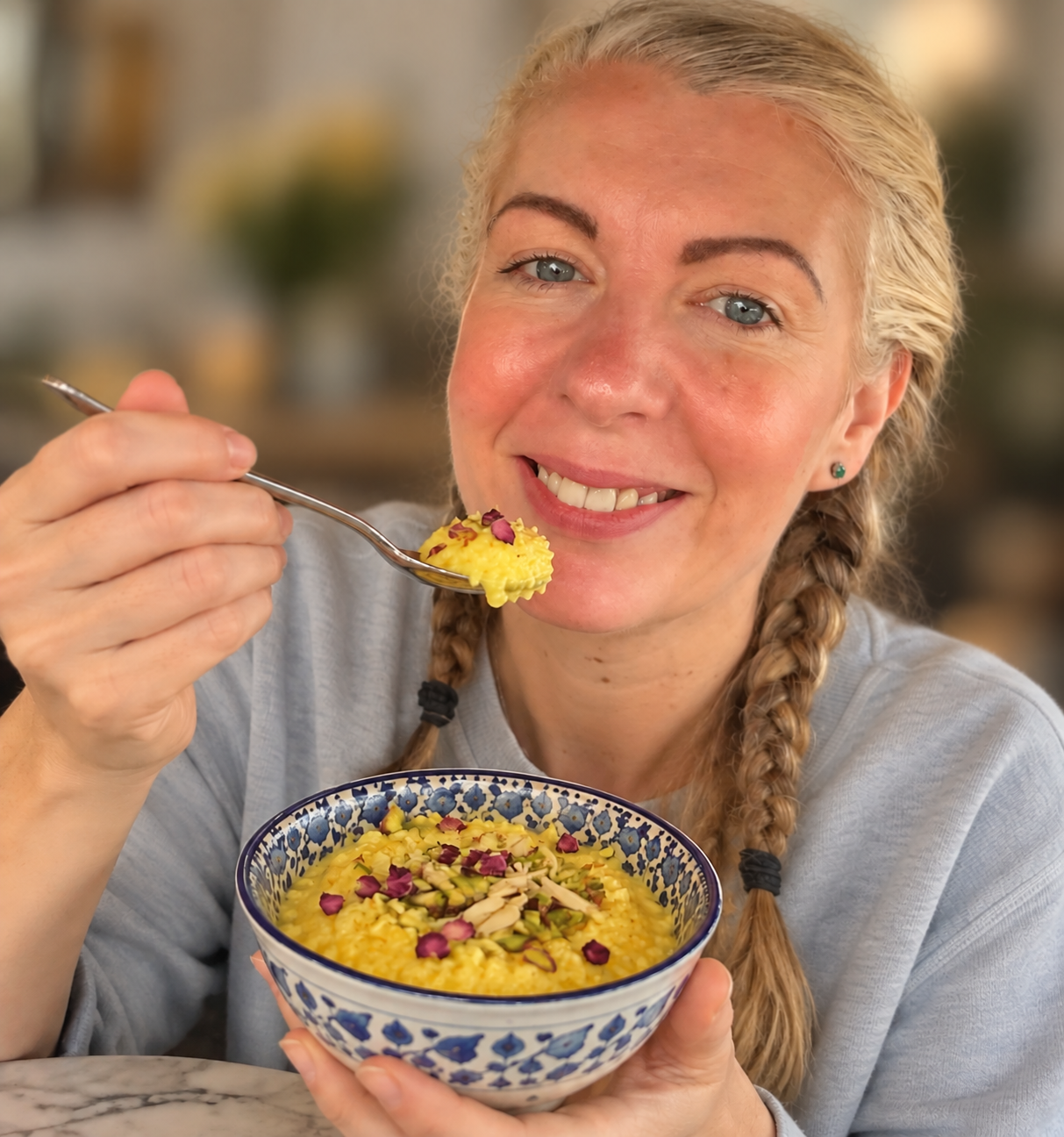
What is Persian kachi pudding and why is it given to women after childbirth?
After giving birth to Cyrus at 40, I was exhausted, anaemic and recovering from a forceps delivery. Then came kachi, a warm Persian pudding made with saffron, rosewater, butter and flour, and a family tradition that offered comfort when I needed looking after.
Why this Persian pudding isn’t just a sweet treat
There is a great deal of attention paid to what women should eat during pregnancy, but rather less conversation about what happens once the baby arrives and the woman who has done all the hard work is left trying to recover.
I discovered that rather painfully after giving birth to Cyrus at 40 following an induction and forceps delivery. I had imagined motherhood beginning with cuddles, sleepless nights and a considerable amount of tea. I hadn’t quite anticipated the physical aftermath, or how exhausting it would feel while recovering from postpartum anaemia.
In Britain, the traditional response to almost any difficult situation seems to involve putting the kettle on and producing toast. In H’s Persian family, however, there was another answer: kachi pudding.
Kachi is a warm, sweet, softly textured Persian dish, somewhere between a pudding and a loose halva. Made with flour, butter or oil, sugar, saffron and rosewater, it has traditionally been prepared for women after childbirth. To somebody unfamiliar with it, the ingredients might sound like the beginning of a cake that never quite made it into the oven. But there is considerably more history behind it.
In H’s family, kachi was associated with warmth, nourishment and looking after women during recovery. The pudding was part of a tradition of care, not simply something sweet to serve after dinner.
A Persian pudding with a long history
Kachi has been prepared in different forms across Iran for generations. Although it is associated with places including Kerman, it isn’t exclusively a Kermani dish. Recipes vary by region and household, with some using wheat flour and others rice flour, while ingredients such as saffron, rosewater and sweet syrup are common features.
The Encyclopaedia Iranica entry on kachi traces its history through Persian dictionaries, literature and traditional cooking. It records the dish’s longstanding association with women who have recently given birth, as well as its use for people recovering from illness.
That interested me because the meaning of the dish extends beyond its ingredients. Someone has to stand at the stove, stir the flour, prepare the syrup and make sure the pudding reaches the right consistency. The new mother, meanwhile, is supposed to be the person receiving care rather than organising everybody else’s meals. It is a rather appealing arrangement, particularly after you’ve just given birth.
Comfort food is not the same as medical treatment
The ingredients in kachi provide energy, particularly from its flour, butter and sugar. It is easy to understand why families have traditionally offered a warm, substantial pudding to women recovering from childbirth. When you’re exhausted and struggling to find time for a proper meal, somebody putting a bowl of food in front of you can feel like an act of generosity.
However, I would be careful about describing kachi as a cure for postpartum anaemia. The NHS guidance on iron deficiency anaemia explains that treatment may involve prescribed iron tablets and addressing the underlying cause. A sweet pudding made primarily with flour, butter and sugar is not a substitute for that treatment.
There is also an important difference between feeling comforted and being medically recovered. NHS England’s guidance on postnatal care recognises the need to assess a mother’s physical recovery, including anaemia, after birth. Persistent exhaustion should not simply be dismissed as part of having a newborn.
For me, kachi belonged alongside the practical and medical care I needed, not in place of it. Its value was also emotional. Somebody had thought about what might make me feel looked after, and the answer came from a Persian family tradition.
How to make traditional Persian kachi pudding
Like many Persian dishes, kachi has several family variations. This is the basic preparation I associate with H’s family, using wheat flour, butter, sugar syrup, saffron and rosewater. The ingredients and method are provided as a traditional outline rather than a precisely measured recipe, because quantities and consistency differ between households.
The method
01 >> Make the syrup. Heat sugar and water together, stirring until the sugar dissolves. Set aside while preparing the flour.
02 >> Cook the flour. Melt the butter in a separate pan and gradually stir in the wheat flour. Cook gently, stirring to prevent lumps or burning.
03 >> Add the flavourings. Gradually incorporate the warm syrup, then add the brewed saffron and rosewater. Stir carefully, as the mixture can bubble when the liquid is added.
04 >> Finish the pudding. Continue cooking over a low heat until the mixture is smooth, soft and spoonable. Serve warm.
- What is it? A warm Persian pudding or soft halva.
- Where is it from? Iran, with regional and household variations.
- Main ingredients: Flour, butter or oil, sugar, saffron and rosewater.
- Traditional association: Caring for women after childbirth and during periods of recovery.
- What does it taste like? Sweet, buttery and aromatic, with saffron and rosewater.
- Medical note: A comfort food, not a treatment for anaemia.
Why Persian puddings carry more than flavour
Kachi wasn’t my first encounter with a Persian pudding that came with a story attached. During pregnancy, H’s family introduced me to sholeh zard, the saffron rice pudding prepared alongside prayers and good wishes. In that instance, the food was shared with others as an expression of hope during an uncertain pregnancy.
Kachi was different because the attention was directed towards the woman who had given birth. Yet both dishes showed me how food can become part of family rituals. A recipe is not always just a list of ingredients. Sometimes it is what people make when they want to express concern, gratitude or affection but cannot find the words.
That is something I have come to appreciate about Persian cooking. There are dishes associated with celebrations, others with family gatherings and some, like kachi, with looking after someone who needs a bit of extra care. The meaning comes as much from the person preparing the food as from what ends up in the bowl.
A Persian tradition worth keeping at the family table
Looking back on those early weeks with Cyrus, I remember how strange it felt to be delighted by my new baby while struggling with the physical consequences of giving birth. Everyone wanted to see him, quite understandably. I needed time to recover too.
Kachi couldn’t solve the anaemia, the sleepless nights or the discomfort following my forceps delivery. But I didn’t need it to perform miracles. I needed something warm to eat and the reassurance that somebody was thinking about me as well as the baby.
Perhaps that is why the pudding has stayed with me. Its ingredients are ordinary enough, but the gesture behind it is rather lovely. After all the attention given to pregnancy and childbirth, it is worth remembering that mothers still need looking after once the baby arrives.
Was it a family recipe, something your grandmother made or simply a plate of toast delivered at exactly the right moment? I’d love to hear about the foods that mean comfort in your family.
Occasional stories, experiments, discoveries and big questions from Saffron & Cyrus.
Discover more from Saffron & Cyrus
Subscribe to get the latest posts sent to your email.


Saffron & Cyrus is an independent women’s editorial publication with a recognisable voice, real-life perspective, a defined midlife audience and a commercial model built around useful, relevant partnerships.

This recipe looks like it makes quite a lot. Can it stored in the fridge and reheated as needed?
Author
Hey Elspeth, you can freeze it! Thanks for reading my post x