
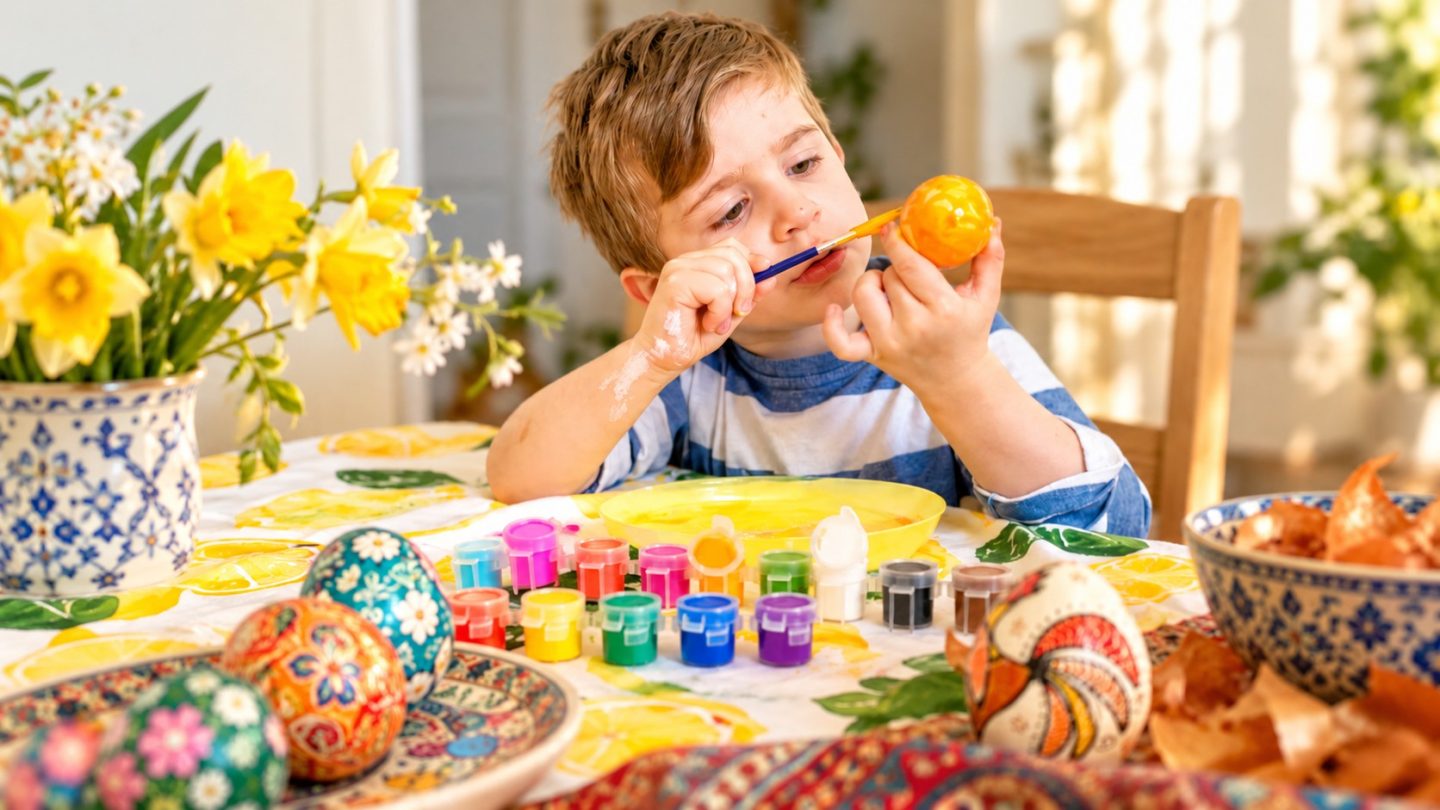
I grew up assuming my gran’s onion-skin eggs were one of those little things our family did at Easter. She wrapped eggs in the papery skins, tied them with string and boiled them with a splash of vinegar until the shells emerged marbled brown, russet and gold. I never questioned where the tradition came from. Children rarely interrogate their grandmothers about cultural history when there are eggs to unwrap, and to me this was Easter, as familiar as chocolate and the prospect of a long weekend.
Then, during lockdown, I mentioned those eggs to H. His response caught me completely off guard because his mamam bozorg, his Persian grandmother, had decorated eggs for Nowruz, the Persian New Year, too. Here we were, from two different countries and cultural backgrounds, both remembering grandmothers who had taken an ordinary egg and turned it into part of a spring celebration.
Eggs, spring, grandmothers and tradition all seemed to point towards some ancient connection between the two customs. Except the more interesting answer turned out not to be about proving that Easter and Nowruz somehow share the same origin.
My gran’s Easter eggs were nothing like the brightly coloured craft versions Cyrus and I were about to make. She boiled real eggs wrapped in onion skins, securing the skins with string before putting them into a pan of water with a splash of vinegar. When they emerged, the shells were mottled with deep browns, rusty reds and flashes of gold. Each one was different, and unwrapping them was part of the excitement because you never quite knew what the onion skins had produced underneath.
I remember the smell almost as clearly as the eggs themselves: vinegar, warm onion skins and that unmistakable boiled-egg aroma filling the kitchen. Some eggs emerged beautifully marbled, while others were rather less impressive, but nobody appeared terribly concerned. There was no coordinated colour palette, no craft tutorial or need for the finished product to photograph well. My gran just knew how to make them, and that was good enough for us.
As a child, I never thought to ask why she did it. Nobody sits you down and announces that an important piece of family history is taking place in front of you. You watch, smell, taste and join in, storing away details that seem completely ordinary until something brings them back decades later.
When I described my gran’s eggs to H, he immediately recognised something familiar. His mamam bozorg had decorated eggs for Nowruz, the Persian New Year celebration that welcomes spring. Decorated and coloured eggs have been documented as part of Nowruz customs, including as gifts and as objects displayed during the celebrations. Today, they are also familiar additions to many Nowruz tables.
It would be tempting to turn that coincidence into a neat story about Easter and Nowruz sharing the same ancient tradition, but the evidence doesn’t give us licence to do that. The celebrations have different histories, meanings and customs. Nor can I confidently tell Cyrus that Persians have been painting Nowruz eggs for precisely 4,000 years because that claim has travelled around the Internet often enough to acquire the appearance of fact.
What interested me was something much more personal. H and I could both remember a grandmother using an egg to help mark spring. Neither grandmother knew the other existed, yet decades later their traditions had somehow arrived at the same dining table in Newcastle. That is one of the things I love about being part of a British-Persian family. The obvious differences are easy to spot, but the similarities tend to creep up on you during a conversation about your gran.
The historical answer is more complicated than I first imagined. Eggs have acquired symbolism within different spring celebrations and cultures, but similarity doesn’t automatically prove a shared origin. Easter and Nowruz remain distinct celebrations, and pretending otherwise would flatten precisely the cultural differences that make both interesting.
In our house, the connection is memory. My gran’s onion-skin eggs remind me of a British childhood; H’s memories of his mamam bozorg belong to his Persian one. Both traditions use something wonderfully ordinary to mark a moment in the year, and both have survived because somebody remembered them well enough to tell the next generation.
That next generation, in our case, was sitting at the table demanding more paint.
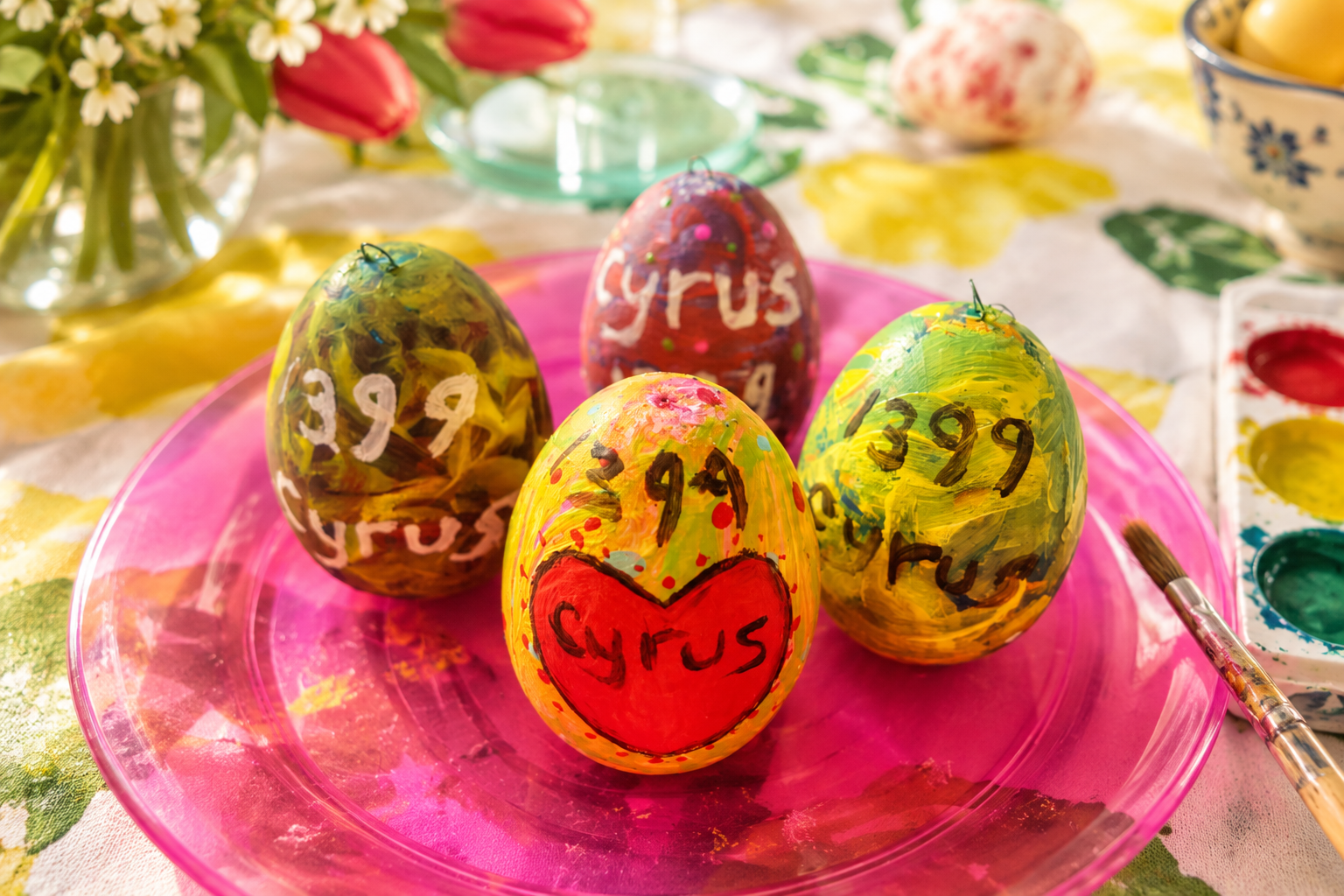
For Cyrus, I took the less traditional route and bought ceramic eggs from Tesco to decorate for both Nowruz and Easter. The kit came with four eggs, an egg-shaped box, three paints and a sheet of decorating ideas. Naturally, I decided three colours were insufficient and produced 18 shades of Crayola washable paint. Apparently even during lockdown I was capable of turning four ceramic eggs into a small production.
Before we started, Cyrus and I looked at Persian art for inspiration. I showed him some of its intricate patterns, floral motifs and extraordinary decorative detail, while accepting that my audience was a small boy armed with washable paint who had not requested an art-history seminar. There had briefly been talk of attempting tiny Persian kings on the eggs, an artistic ambition that exceeded both our equipment and, if I’m being fair, our talent.
Still, I wanted him to understand why we were looking at those designs. Cyrus has British heritage from me and Persian heritage from H, and I want both to be things he experiences rather than simply facts we tell him about. Children understand culture remarkably well when they can eat it, hear it, celebrate it, make it or, occasionally, smear it across the dining table.
Cyrus approached his eggs with impressive concentration. He painted a base coat, waited with varying degrees of patience, then added swirls, dots and different colours. The proposed Persian kings were eventually abandoned when it became apparent that painting miniature royalty onto a curved ceramic surface was ambitious for a professional miniaturist, never mind a small child with a fairly substantial paintbrush. Abstract Persia won.
The finished eggs were bright, and entirely his own. They weren’t replicas of the Persian designs we had looked at, nor did they need to be. What mattered was that he had seen something from his dad’s culture, heard a story about his mum’s childhood and then made his own version of both.
Watching him hold up each finished egg reminded me why homemade things often survive in our memories when bought things don’t. Children are wonderfully uninterested in whether something meets adult standards of good taste. If they made it and they love it, it is a masterpiece. Frankly, there are days when I think the rest of us could learn something from that.
Lockdown made ordinary family activities feel unusually important. Work, school and home had collapsed into the same few rooms, while parents were somehow expected to be employees, teachers, cooks, entertainers and reassuring adults, often simultaneously and preferably before the first coffee had gone cold. Against that backdrop, an afternoon painting eggs was hardly momentous, but it gave us something those strange days badly needed: a little structure, colour and connection.
More importantly, it gave us an excuse to tell Cyrus something about where he comes from. His Easter eggs could sit beside our Nowruz traditions without either cancelling out the other. My memories of my gran could exist alongside H’s memories of his mamam bozorg. Nobody needed to decide which side of the family owned the egg.
The older I get, the more I notice that family history survives in surprisingly mundane places. It isn’t always contained in carefully preserved photographs or important documents. Sometimes it is a smell you haven’t thought about for 30 years, the way your grandmother cooked something or a tradition you assumed belonged only to your childhood until your husband tells you his grandmother, thousands of miles away, did something remarkably similar.
Historically, there isn’t a simple answer, and I’m rather glad I resisted the temptation to manufacture one. The more interesting connection in our family has nothing to do with proving that two ancient celebrations sprang from the same source. It is about what people do with traditions once they inherit them.
My gran had her onion skins. H’s mamam bozorg had her Nowruz eggs. Cyrus had four ceramic eggs, 18 shades of washable paint and a mother with wildly unrealistic ideas about miniature Persian kings. The materials changed, the country changed and another generation took its place at the table, but the instinct to make something together and attach a story to it remained.
Perhaps that is how traditions survive. We don’t keep them alive by freezing them in time or reproducing every detail exactly as our grandparents did. We remember them, adapt them and pass them on, sometimes without realising that is what we are doing.
Did your family have an Easter or spring tradition that seemed completely ordinary when you were a child but means more to you now? If your family brings together more than one culture, I’d love to hear about the unexpected similarities you’ve discovered along the way.
Occasional stories, experiments, discoveries and questions from Saffron & Cyrus.
Discover more from Saffron & Cyrus
Subscribe to get the latest posts sent to your email.

Saffron & Cyrus is an independent women’s editorial publication with a recognisable voice, real-life perspective, a defined midlife audience and a commercial model built around useful, relevant partnerships.
