
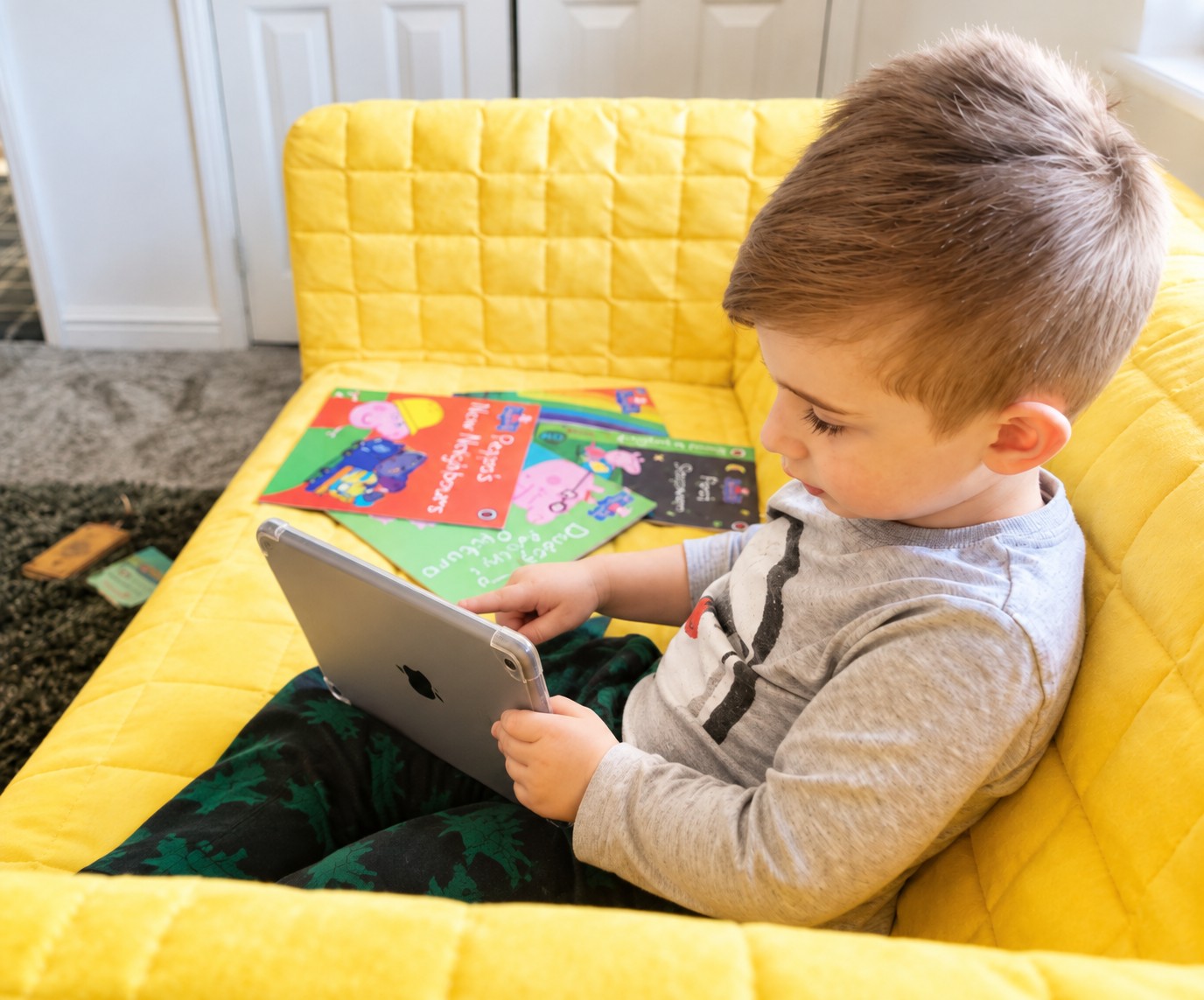
If you were the parent of a small child during lockdown, you probably know the sound I mean: the shriek, the protest, the sudden collapse of civilisation because somebody has removed an iPad from a pair of small hands.
In our house, those hands belonged to Cyrus. One minute he could be perfectly content watching a cartoon. The next, the screen disappeared and he was on the floor, arms flying, apparently experiencing an injustice of historic proportions.
I worried about it. Was he watching too much? Were we taking the easy option? Had we somehow created a child who expected an iPad on demand before he’d even learnt to tie his own shoelaces?
There was, however, a flaw in my concern. H and I were working from home. Our laptops were open, our phones were beside us and work arrived through emails, spreadsheets and video calls. During lockdown, technology wasn’t something happening around the edges of family life. For a while, it became one of the main ways we conducted it.
The rules we’d been given
Before Covid, screen-time advice had seemed relatively straightforward. The World Health Organization’s 2019 guidance recommended no sedentary screen time for one-year-olds and no more than an hour a day for two-year-olds, with less considered better.
Like many parents, I’d absorbed the wider message that screens were something to limit. Books were good. Playing outside was good, but sitting in front of a device for too long was something I was supposed to feel guilty about.
Then lockdown arrived and made everything considerably worse. The iPad wasn’t just entertainment anymore. Screens were how we worked, communicated and kept some form of connection with a world we suddenly couldn’t physically reach. It became much harder to decide exactly where the problem started.
The problem with rationing an iPad
I still wanted some boundaries, not because I believed Cyrus’s brain would turn to mush if he watched another cartoon, but because I’d seen what could happen when it was time to switch the thing off.
So we tried putting the screens away for a while. Reading was one of the easiest alternatives because Cyrus loved books. He would sit beside me listening, then ask for another story when I’d already mentally moved on to whatever I needed to do next.
I can’t prove that reading made him sleep better or transformed his attention span, and looking back I don’t think I need to. It just meant that for a little while, neither of us was looking at a screen, and we were looking at each other.
Then we went looking under rocks
Lockdown also made our world extremely small. There weren’t trips out or elaborate family adventures. Sometimes there was just the garden, and Cyrus didn’t seem troubled by this.
He could find entertainment underneath a rock. There were bugs to inspect, ants to follow and, on one memorable occasion, a hairy caterpillar important enough to need immediate adult attention.
That was about the level of our lockdown excitement. But I remember those moments because they were so ordinary. I didn’t need to manufacture an educational activity or turn the garden into an outdoor classroom. Cyrus noticed things because children do. Mostly, I just had to stop what I was doing and look.
Of course, sometimes the iPad won
This is where any respectable parenting advice article would tell you about consistency and we weren’t particularly consistent.
There were days when work deadlines were looming and Cyrus watched another episode because H and I needed to get something finished. There were times when I knew he’d had plenty of screen time and handed him the iPad anyway and sometimes I felt guilty about it.
But lockdown had created a strange situation for working parents. We were supposed to work, parent, entertain and still keep some semblance of normal family life while confined to the same space.
The part I didn’t notice at the time
Looking back, I think I was concentrating on the wrong screen. I worried about the one in Cyrus’s hands because that was the one I felt responsible for controlling. I thought less about the laptop open in front of me, the phone I checked automatically or the fact that I could tell my child to put down his device while reaching for one of my own.
That doesn’t mean I think screen limits are pointless, but lockdown made the distinction between the “digital world” and the “real world” much harder to keep up with. Cyrus’s fury when the iPad disappeared was extremely real. However, those twenty minutes when another cartoon allowed H and me to finish something we needed to do were real too.
The problem was never the screen, it was what the screen was replacing, and whether sometimes we were asking Cyrus to put his down when we weren’t willing, or able, to put down ours.
Occasional stories, experiments, discoveries and questions from Saffron & Cyrus.
Discover more from Saffron & Cyrus
Subscribe to get the latest posts sent to your email.

Saffron & Cyrus is an independent women’s editorial publication with a recognisable voice, real-life perspective, a defined midlife audience and a commercial model built around useful, relevant partnerships.
