
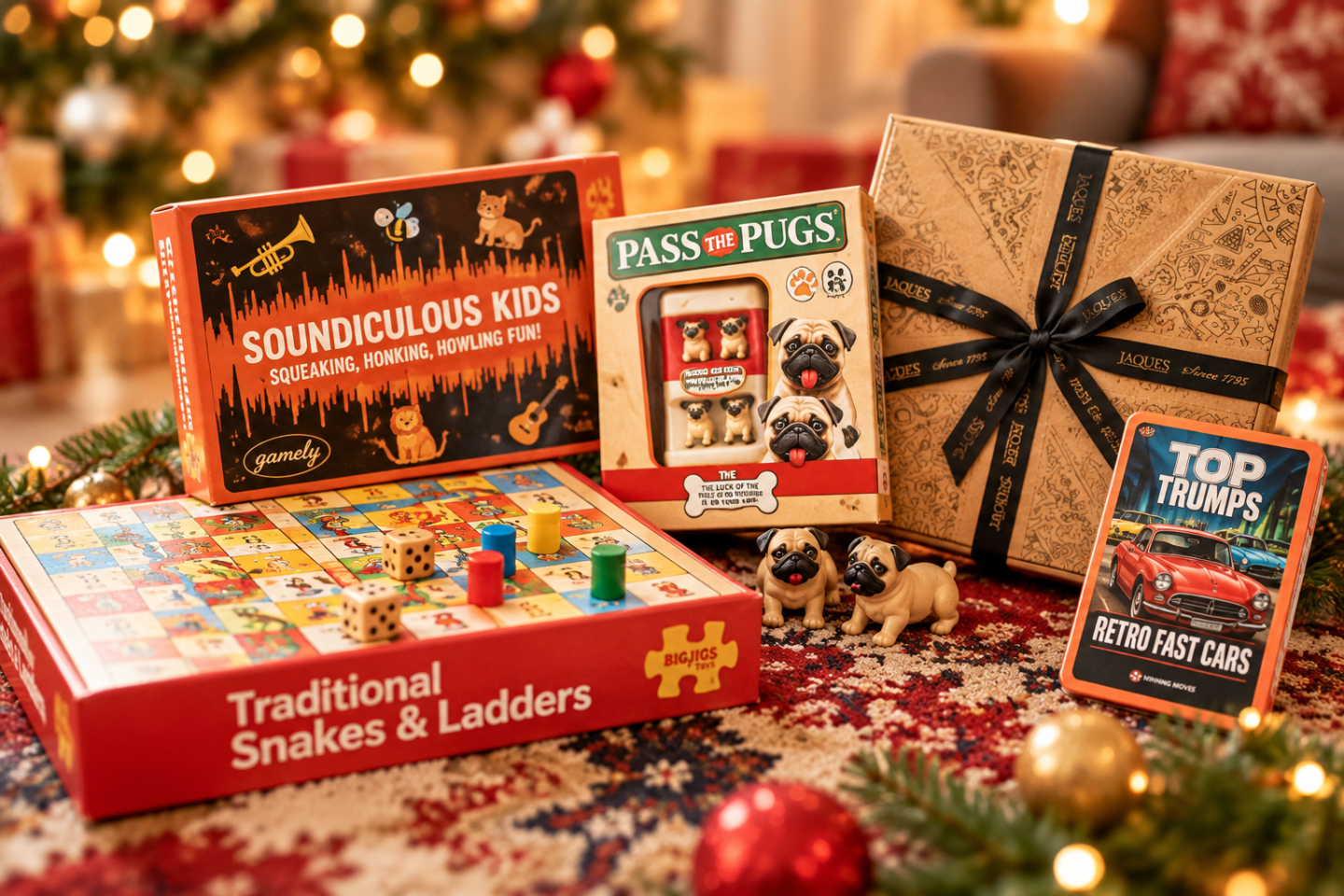
Five childhood games we brought back for Christmas, and why our son loves them.
Forget expensive gadgets and another afternoon staring at screens. From Snakes and Ladders to Top Trumps, these five traditional family games remind me why Christmas entertainment doesn’t need batteries, Wi-Fi or a small mortgage.
When childhood comes back around
There is something about spending more time at home that makes you revisit your childhood. Perhaps it’s the slower pace, the familiar routines or the realisation that keeping a young child entertained doesn’t always need a trip to the toy shop. Sometimes, all you need is a board game, a handful of counters and someone willing to lose … gracefully.
In our house, that last requirement is proving difficult.
H and I grew up in different countries, with different cultures and very different childhood experiences. Yet, when we started reminiscing about the games we played as children, we discovered just how much we had in common. Long before smartphones, tablets and games consoles were part of everyday family life, we both spent hours playing traditional games with friends and family.
I grew up in the North East of England, while H spent his childhood in Iran. Our memories of school, family life and even Christmas couldn’t be more different, but mention Ludo or Snakes and Ladders and suddenly we’re speaking the same language.
Now that we have Cyrus, we’re rediscovering some of those childhood favourites through his eyes. And I have to admit, there’s something satisfying about introducing him to a game that entertained us decades before he arrived.
With Christmas approaching, we’ve picked five family games that deserve a place beneath the tree. Some are old favourites, others are newer discoveries, but all offer something that no amount of screen time can replicate: the opportunity to sit together, laugh and accuse someone of cheating.
Snakes and Ladders: the childhood classic that still causes family arguments
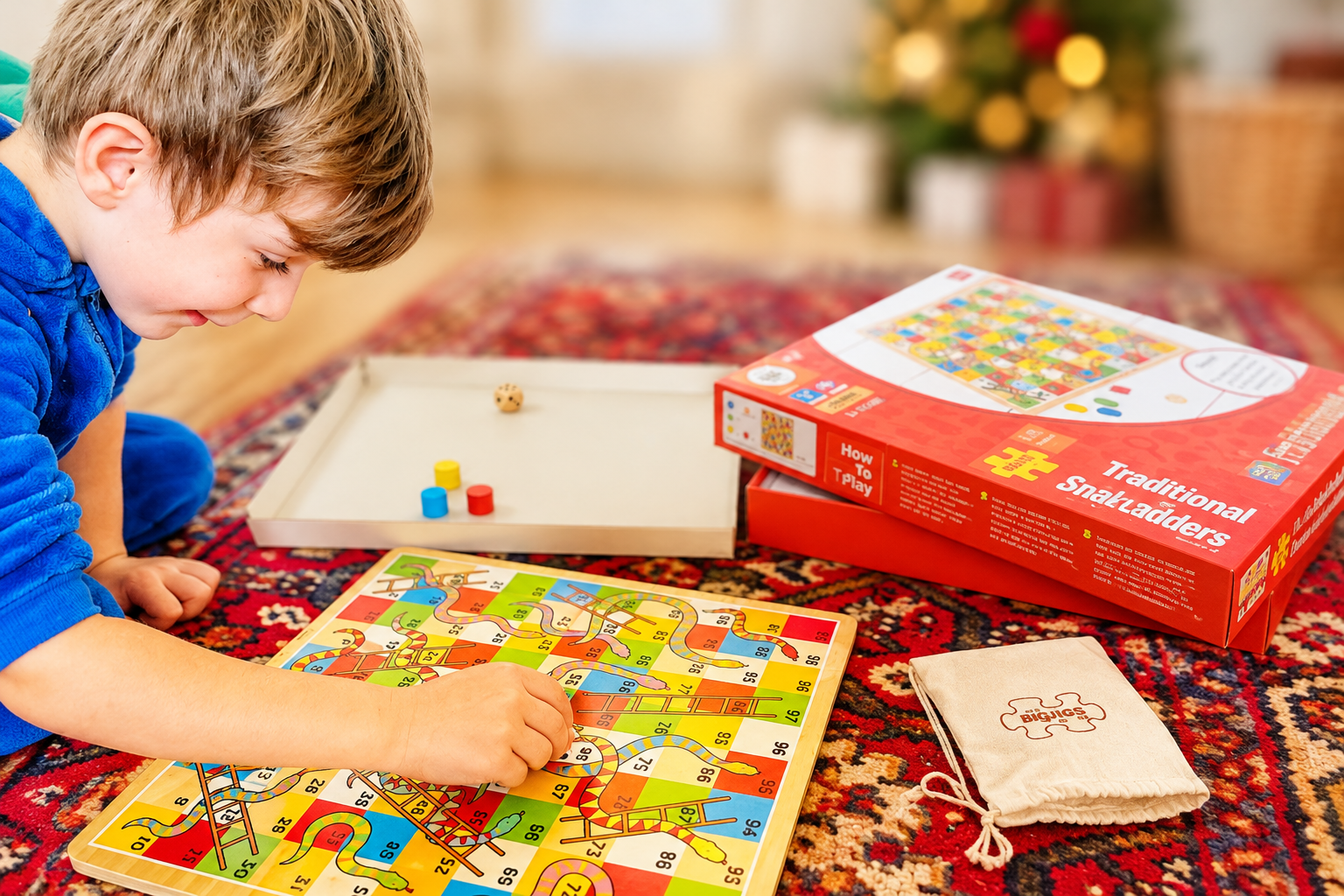
If there’s one game Cyrus can’t get enough of at the moment, it’s Snakes and Ladders. I can see why. Few things are quite as thrilling to a small child as climbing a ladder towards victory, only to watch someone else land on a snake and tumble halfway down the board.
It’s considerably less entertaining when you’re the unfortunate person sliding backwards.
Snakes and Ladders has its roots in India, where earlier versions of the game carried moral lessons about virtues and vices. The ladders represented good behaviour, while the snakes symbolised the consequences of making less admirable choices. These days, in our house at least, the main lesson seems to be how to cope when a roll of the dice doesn’t go your way.
The board features 100 numbered squares, with ladders helping players move forwards and snakes sending them backwards. The first person to reach the final square wins, although getting there can test the patience of even the most composed adult.
We like the colourful wooden version from Bigjigs Toys. It’s sturdy, cheerful and designed to withstand the enthusiastic handling that comes with family game nights. There’s also something lovely about a traditional wooden toy when so many children’s games now involve flashing lights and electronic noises.
Soundiculous Kids: the game that turns the living room into a farmyard
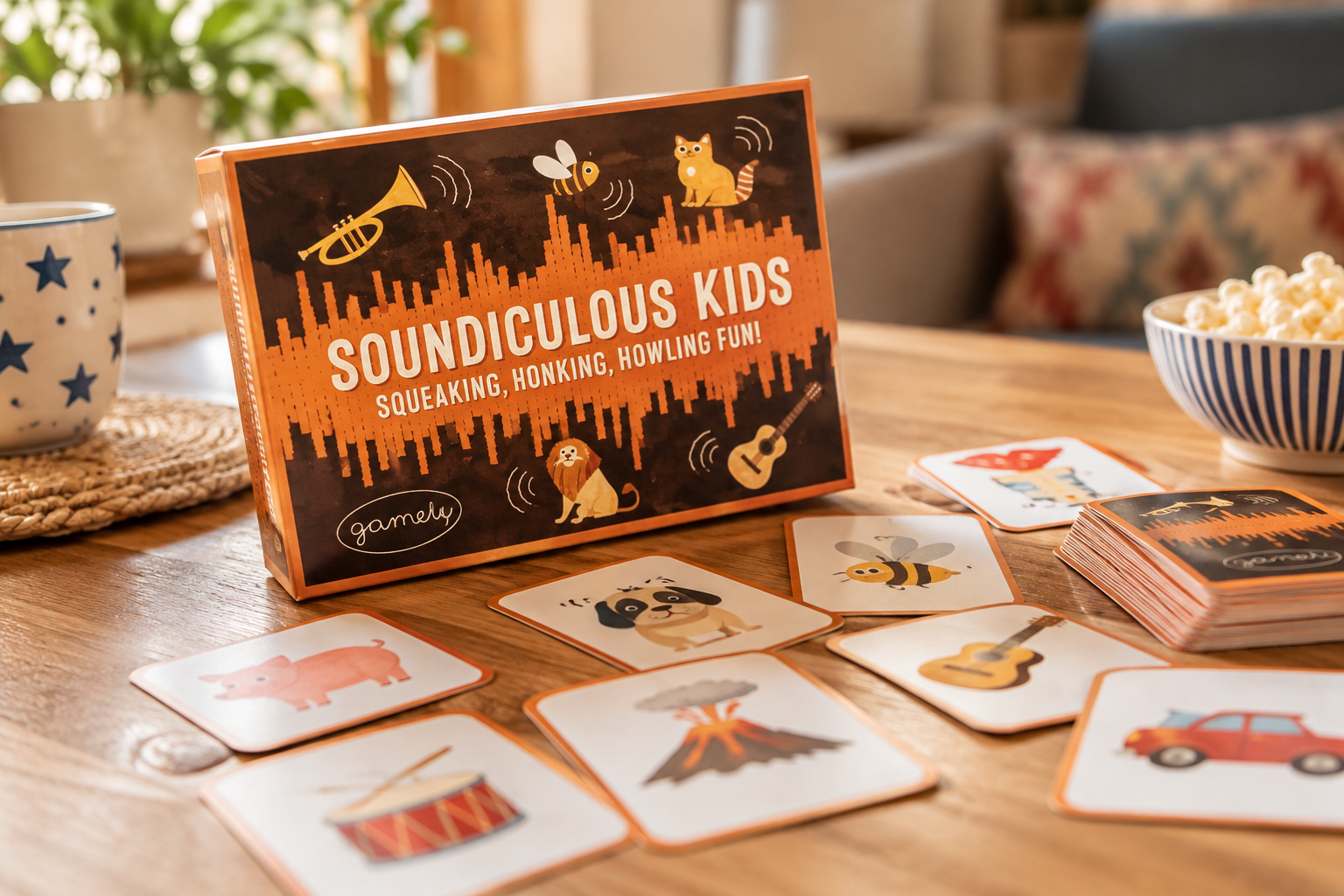
There are things you expect to hear during a family Christmas. The rustling of wrapping paper, the clatter of plates and the occasional disagreement about what’s on TV. What you don’t expect is a grown adult attempting to imitate a volcano while a small child collapses into hysterics. Welcome to Soundiculous Kids.
Created by Gamely Games, this ridiculous card game is essentially charades with the volume turned up. Instead of acting out words in silence, players make noises while everyone else tries to guess what they’re supposed to be. The results can be spectacularly embarrassing.
Designed for children aged three to seven, the game contains 52 illustrated cards featuring everything from pigs and trains to drums and volcanoes. Some sounds are straightforward. Others though take a level of creativity that may make you question whether you’ve ever heard the object in question.
What I like about Soundiculous is that it gives children permission to be silly. There’s no complicated board to assemble and no lengthy rulebook.
For younger children, it’s also an entertaining way to explore sounds, language and imagination. They can experiment with different noises, listen carefully and work out what other players are trying to communicate. It’s the sort of game that gets everyone involved, including family members who initially insist they’re only going to watch. Give them five minutes. They’ll be making farmyard noises with the rest of you.
Pass the Pugs: tiny dogs, but big competition
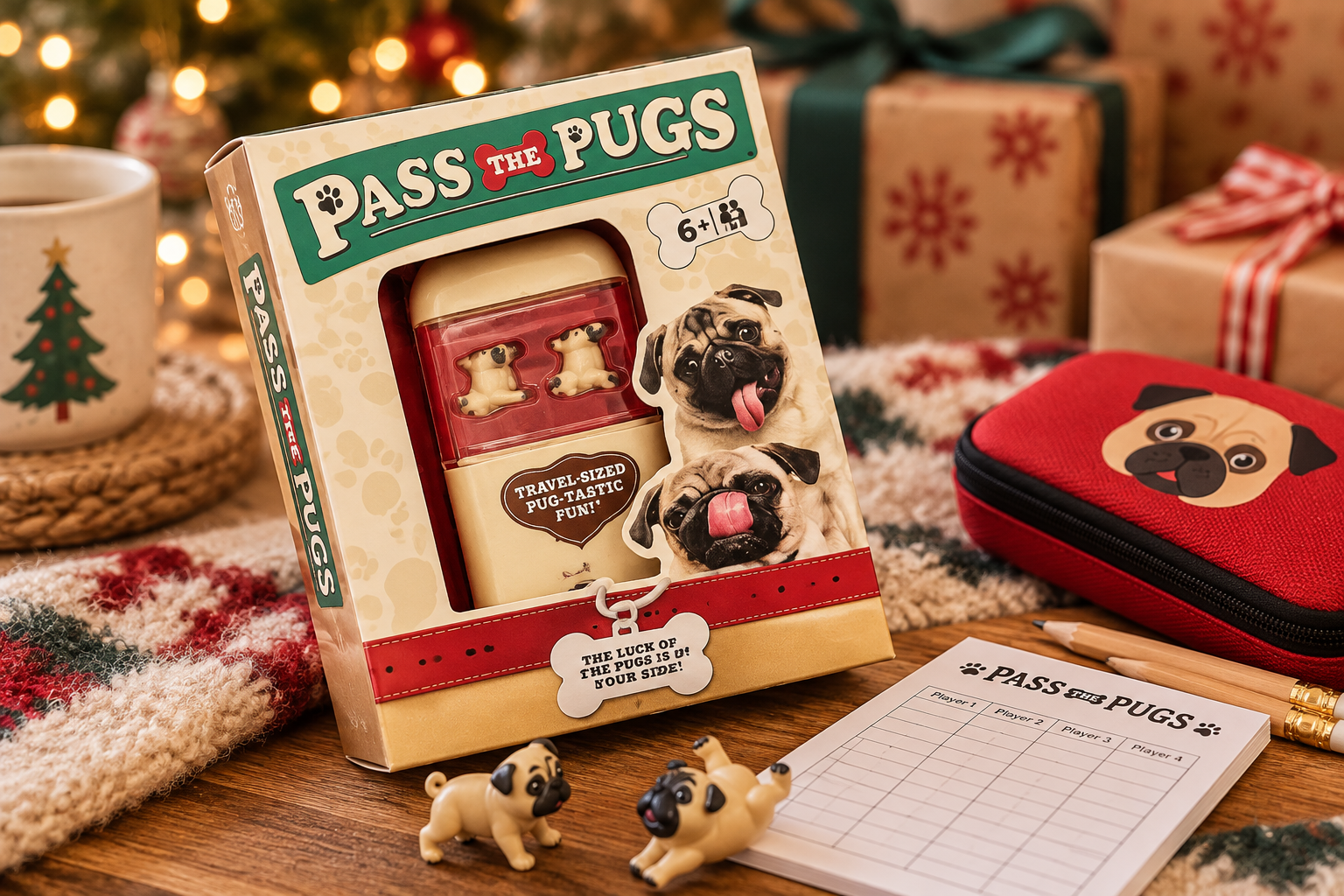
Anyone who remembers Pass the Pigs will probably understand why Pass the Pugs caught our attention. Produced by Winning Moves, this miniature game takes the concept of throwing dice and replaces them with two small plastic pugs.
Yes, you read that correctly. You throw pugs.
The aim is to score points depending on how the little dogs land. Different positions earn different scores, and players must decide whether to keep going or stop before risking their points. It sounds easy enough, but it’s actually competitive about watching two miniature dogs tumble across a table.
The set includes two pugs, a scoring pad, two pencils and a carrying case, making it handy for taking on holiday or visiting family. Although the recommended age is seven and upwards, Cyrus enjoys joining in with us under supervision. The pieces are small, so it’s one of those games that needs a little extra care around younger children.
What makes Pass the Pugs appealing is its simplicity. There’s no elaborate preparation, and no need to clear the dining table before you begin. You can take it out, play a few rounds and pack it away again. Assuming that you can persuade everyone to stop playing.
We originally thought it would be ideal for packing in our suitcase if we managed to get away on holiday in 2021. Even when travel plans were uncertain, it gave us another excuse to enjoy a little family competition at home.
Ludo: the game that connects my English childhood with H’s Persian one
Of all the games on our Christmas list, Ludo probably holds the most nostalgia for H and me. It’s years since either of us played, but the moment we started talking about it, the memories came flooding back. It’s great how something as ordinary as a board, a dice and four coloured counters can transport you back to childhood.
Growing up as an only child, I found traditional games a way to make friends. It was reassuring about having a shared activity when you were trying to find your place among other children. You didn’t need to be the loudest or most confident person in the room. You just needed to know whose turn it was.
H remembers playing traditional games during his childhood in Iran, and I love that something so familiar to me was also part of his world thousands of miles away.
Ludo is derived from Pachisi, an ancient Indian game, and is still one of the simplest board games to learn. Two to four players race their coloured tokens around the board, relying on a combination of dice rolls, timing and a little strategy to reach home first. Naturally, there’s always someone who takes it far too seriously.
What I appreciate most about Ludo is that everyone starts on equal terms. Children can compete with adults, grandparents can join in and nobody needs to master complicated instructions before the fun begins.
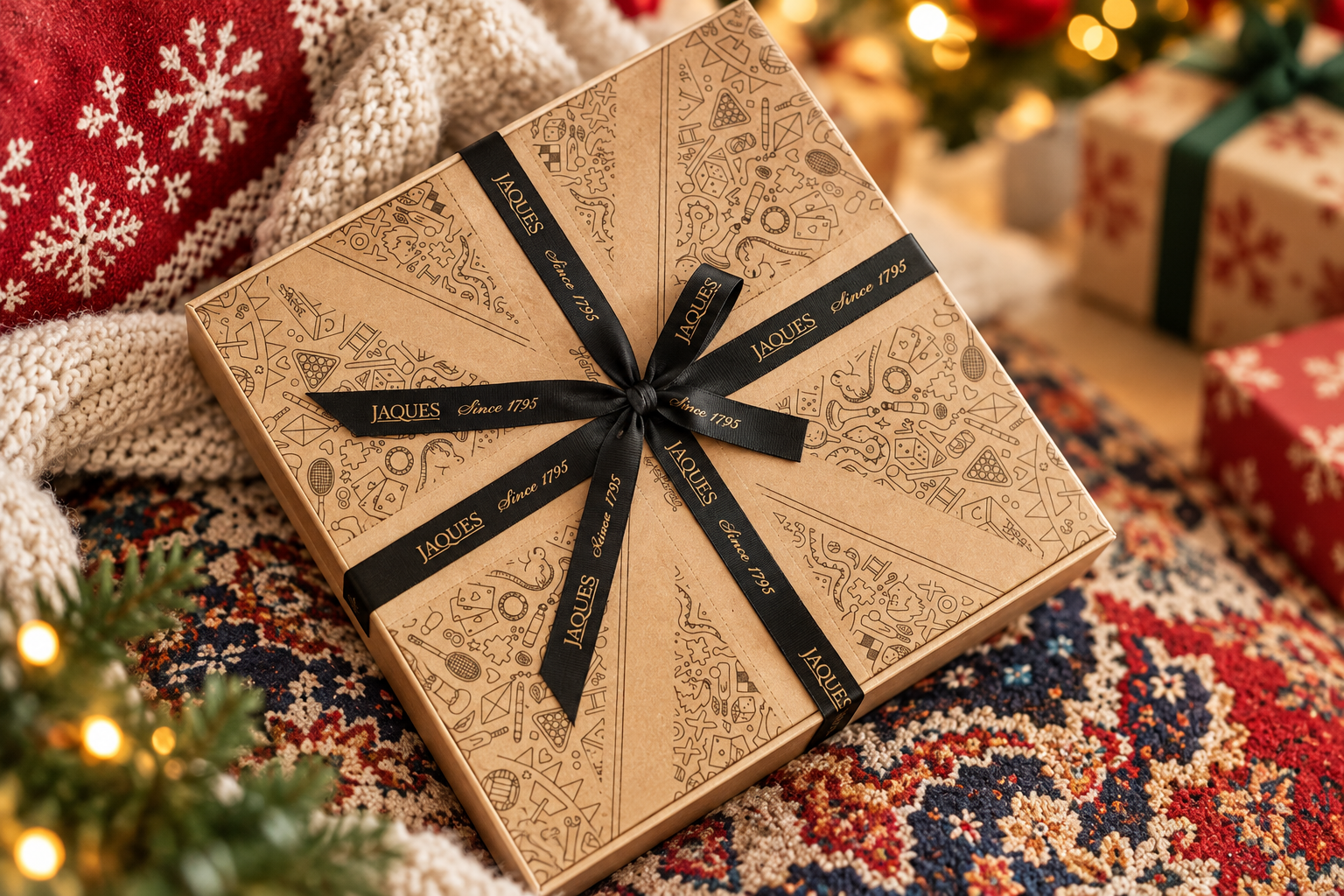
We like the wooden edition from Jaques of London, with its colourful playing pieces and traditional design. It feels like the sort of game you could keep for years rather than something destined for the back of a cupboard after Christmas. And in a world where children’s entertainment can cost a small fortune, there’s something good about a game that doesn’t take subscriptions.
Top Trumps: a Christmas surprise for our little car enthusiast
Now, here’s where H and I differ. Top Trumps wasn’t part of my childhood, but H remembers playing it, and he’s pleased that the game is still around.
For anyone unfamiliar, Top Trumps is a card game in which players compare statistics and characteristics to try to win their opponents’ cards. Each pack follows a theme, from animals and dinosaurs to famous vehicles and sporting legends.
It’s simple enough for children to understand, but there’s also an element of strategy involved in deciding which category gives you the strongest chance of winning. And if there’s one subject guaranteed to capture Cyrus’s attention, it’s cars.
We’ve secretly bought him a pack of Retro Fast Cars Top Trumps from Winning Moves, featuring iconic models that should appeal to his growing enthusiasm for anything with four wheels and a powerful engine.
He doesn’t know about them yet, of course, although I suspect he’ll be far more interested in identifying the fastest car than listening to me explain the finer points of the rules.
What I like about Top Trumps is that it encourages children to compare numbers, read information and make decisions without feeling as though they’re doing schoolwork. It’s also wonderfully portable. A pack of cards can slip into a handbag, suitcase or coat pocket, ready to rescue a rainy afternoon or a long journey. Unlike some Christmas presents, it won’t require H to spend half of Christmas morning assembling something with an Allen key.
Why I’m bringing traditional family games back into our home
The more games we play together, the more I realise that the appeal has very little to do with winning. As parents, we’re constantly encouraged to find activities that help our children learn, develop and achieve. There’s a place for all of that, of course, but sometimes I think we forget the value of simply having fun together.
Traditional board games offer opportunities to practise taking turns, following rules, counting, communicating and coping with disappointment. They also create space for conversation, laughter and the sort of family memories that don’t need to be photographed and shared with the world.
For me, there’s another reason these games matter. Growing up, I didn’t have siblings to compete with over the board or accuse of moving their counters when nobody was looking. Games gave me a way to connect with other children and, occasionally, the confidence to join in when I might otherwise have stayed on the sidelines.
Now I get to watch Cyrus enjoy some of those same experiences with H and me. I also love the cultural connection. H and I may have grown up in different countries, but games such as Ludo and Snakes and Ladders remind us that childhood has more similarities than differences. The rules might vary, the names might change and the memories belong to different places, but the pleasure of playing together is remarkably universal.
Of course, I’m not suggesting we ban screens or pretend modern technology doesn’t have its place. Cyrus enjoys his digital entertainment as much as the next child, and I’m hardly in a position to lecture anyone about spending time online.
Sometimes the simplest gifts are the ones that bring everyone together. And if a £10 board game can keep us entertained and give us something to laugh about over Christmas, that’s money well spent in my opinion. Even if I do end up at the bottom of another snake.
What childhood games would you bring back?
I’d love to know which games you remember playing as a child. Were you a Ludo enthusiast, a Snakes and Ladders champion or the person nobody wanted to play Monopoly with because you took it far too seriously?
After all, Christmas shouldn’t just be about what we buy our children. Sometimes it’s about sharing a little of the childhood we remember with the people we’re raising.
More from Saffron & Cyrus
Occasional stories, experiments, discoveries and questions from Saffron & Cyrus.
Discover more from Saffron & Cyrus
Subscribe to get the latest posts sent to your email.

Saffron & Cyrus is an independent women’s editorial publication with a recognisable voice, real-life perspective, a defined midlife audience and a commercial model built around useful, relevant partnerships.
