

Ad | Gifted products. We received the two Geomag sets free of charge for review. The opinions and experiences described are our own.
We tried the Geomag Classic Panels and Confetti sets when Cyrus was five. H wanted to explain structural stability, while Cyrus wanted to open the boxes and get on with it.
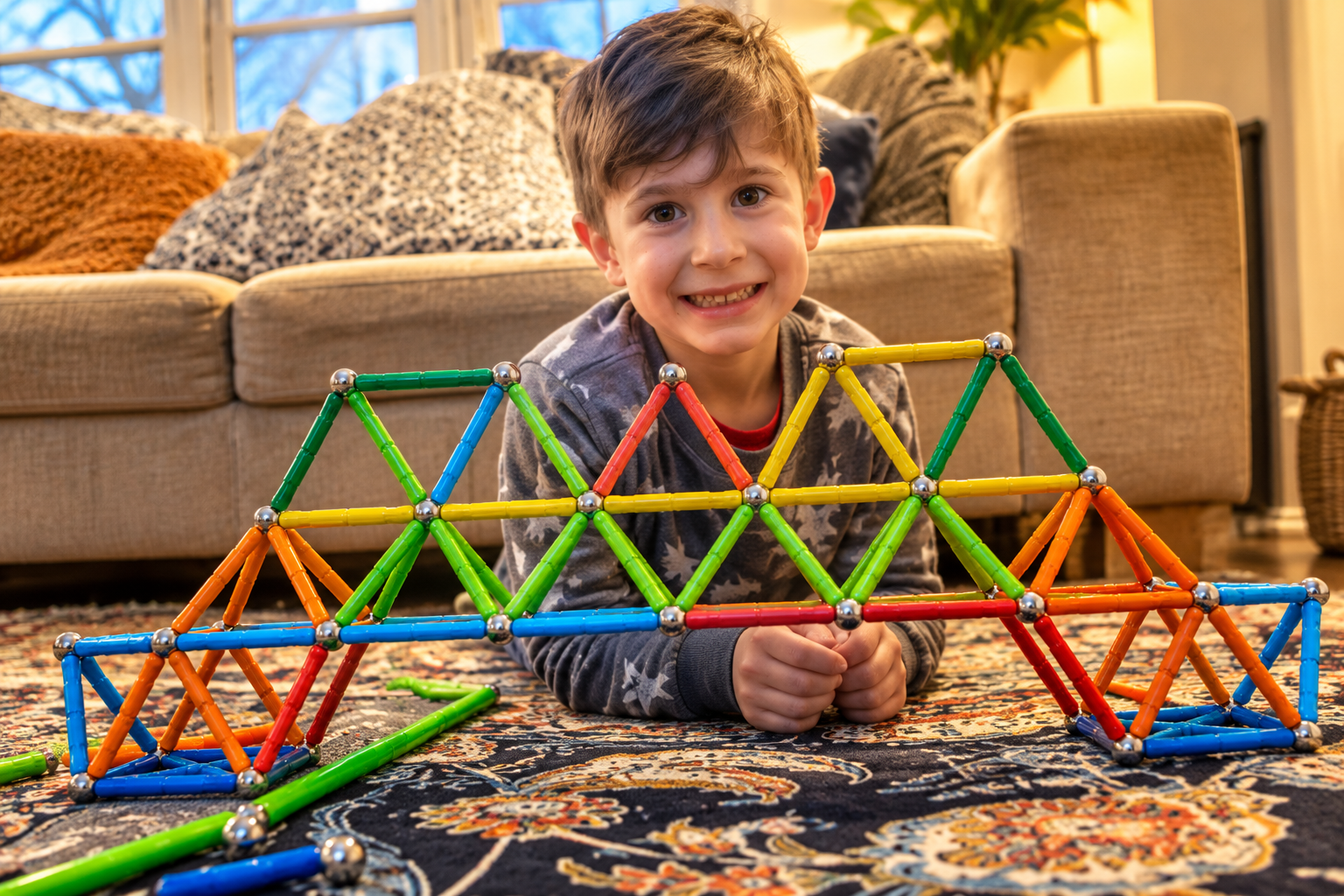
When Cyrus’s bridge collapsed, I reached forward to help and H wanted to establish why it had failed. Cyrus listened before rebuilding it to his own specifications, unconvinced that a qualified engineer necessarily knew better.
The Persian word mohandes means engineer, a profession that commands considerable respect in H’s family. He is one himself, so Cyrus has a father who understands how things work and sometimes feels compelled to explain why. I appreciate this when something expensive breaks. As I’ve found since marrying into a Persian family, H takes his engineering seriously, although Cyrus was five when we tried these sets and had no interest in choosing a career.
What do you get with Geomag Classic?
Geomag Classic uses magnetic rods and steel balls, with panels in selected sets, to make three-dimensional structures. It falls under the STEM label, which stands for science, technology, engineering and maths. Cyrus could explore shapes and magnetic connections as he played, with the immediate challenge of making something that stayed upright.
We received Classic Panels, a 35-piece set, and Classic Confetti, with 83 pieces. Prices and availability vary, so compare the exact set before buying. The manufacturer’s Confetti range page lists the different sizes.
We had explored construction play before with Hape Domino Robot Factory and Strictly Briks, when Cyrus was younger. These sets gave him a different way to experiment, using magnetic connections to make a structure taller than his father’s coffee mug.
Bridges, collapses and advice from Daddy
Cyrus studied the illustrated instructions and positioned the rods and steel balls with the concentration of someone entrusted with a building contract. Newcastle has the Tyne Bridge and we had the living room floor, although his bridges did not always survive the addition of another rod.
He asked H for advice when he wanted it, but generally preferred his own methods. When a structure fell, he examined the pieces and started again, sometimes making a small adjustment and sometimes reconsidering the whole design. Nobody was marking his work or insisting that the finished model matched the picture on the box.
The experiments extended beyond construction when Cyrus discovered that the rods attracted certain household objects. He tried the fridge, coins and other items, and H explained why the results differed. To his credit, he kept the discussion suitable for a five-year-old instead of an engineering undergraduate.
Cyrus started this investigation himself, without a worksheet or an instruction to identify magnetic materials. It reminded me of our visit to Newcastle’s Discovery Museum, where he also had the chance to explore how things work. At home, he could pursue whatever caught his attention.

We had tried a different kind of construction challenge with the DesignNest MagnetCubes marble run, which needed a working route for a moving marble. With Geomag Classic, Cyrus could concentrate on the structure itself.
I’ve written about my uneasy relationship with school maths in our separate Geomag Magicube Maths Builder review, so watching Cyrus approach shapes without that anxiety was encouraging. I can’t say whether these sets improved his schoolwork. What I saw was a child working through a problem and trying a solution of his own.
Age guidance and magnet safety
Check the age rating and warnings on the exact set you buy. Cyrus’s age in this review is not a recommendation that every Geomag product suits a five-year-old. Small parts present a choking risk, and swallowed magnets can cause serious internal injury. Read the government’s magnet safety advice, keep small or loose magnets away from young children and stop using damaged pieces.
If you think a child has swallowed a magnet, NHS advice is to call 999 or take them to A&E straight away.
What about recycled plastic?
Geomag lists a Classic Panels Recycled range, but I don’t have a verified recycled-plastic percentage for the sets we received. Check the specification of the exact product if recycled content is part of your buying decision.
The pieces can be used for different designs, with a bridge becoming a tower or something even H struggles to identify. Whether that amounts to years of play depends on the child. I’ve bought enough toys to know that a cardboard box can provide more entertainment than its expensive contents.
Is Geomag Classic worth buying?
Both sets impressed us, with Classic Panels providing a manageable introduction and Confetti offering more scope for larger designs. Neither needed batteries or complicated preparation. They suited Cyrus because he enjoyed making things and was willing to rebuild when they fell apart.
H enjoyed sharing something connected to his profession and I enjoyed watching them together on the floor. Whether Cyrus becomes a mohandes is his decision, although if he invents a machine that makes Persian kebabs without covering the kitchen in marinade, I won’t complain.
When a construction collapses, does your child ask for help or start again with a design of their own?
More family experiments
A different set, with magnetic cubes and a focus on numbers, alongside my own memories of school maths.
Another family construction project, this time with a marble’s route to work out.
Come along for the ride.
Occasional stories, experiments, discoveries and questions from Saffron & Cyrus.
Discover more from Saffron & Cyrus
Subscribe to get the latest posts sent to your email.


Saffron & Cyrus is an independent women’s editorial publication with a recognisable voice, real-life perspective, a defined midlife audience and a commercial model built around useful, relevant partnerships.
