
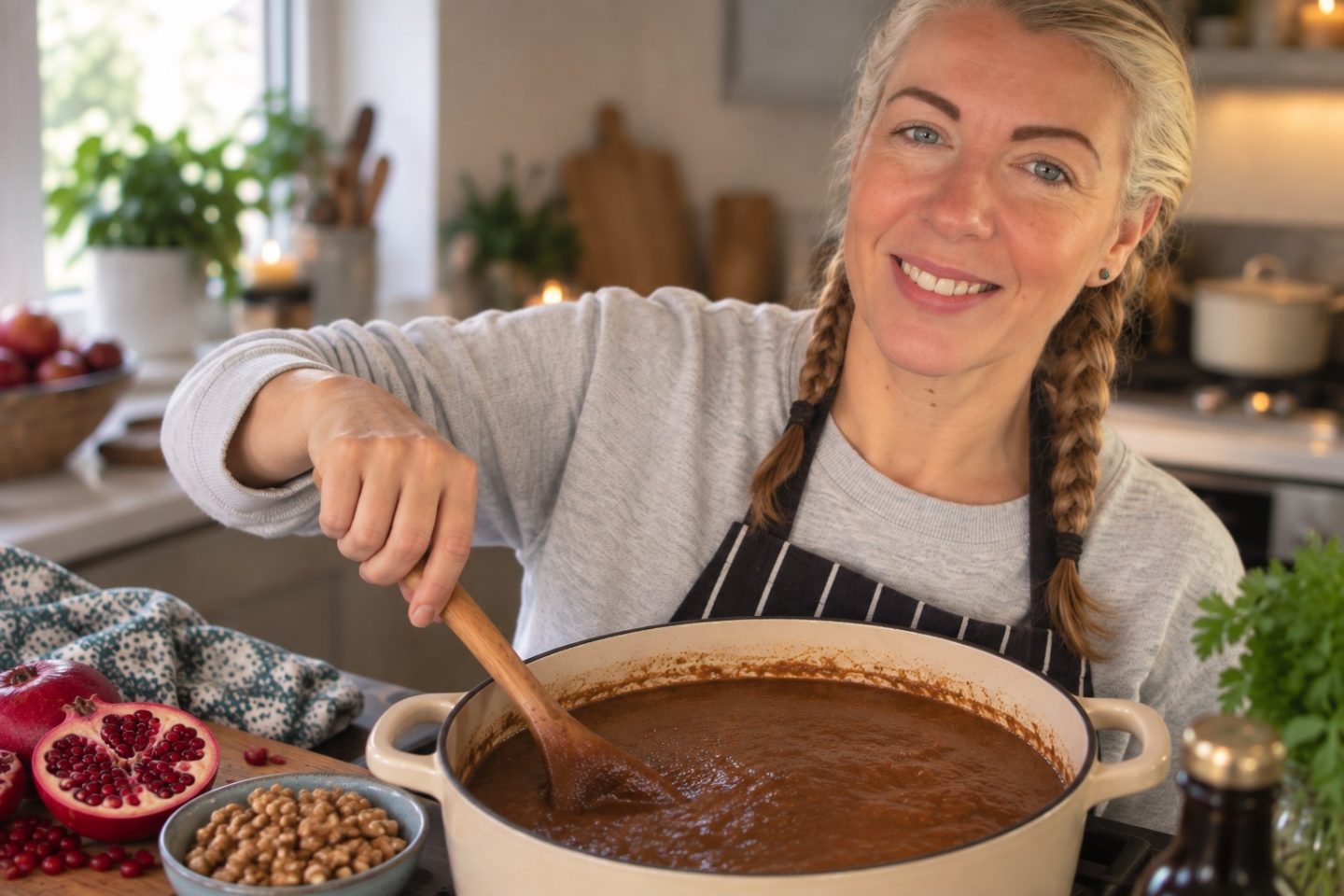
Khoresht-e Fesenjan: Never judge a Persian stew by its colour
The first time H ordered Fesenjan for me, I took one look at the brown Persian stew and decided I wasn’t eating it. One spoonful changed my mind, and somehow led to Persian aunties competing to cook it for me, a sparking hand blender and a son who now loves grinding the walnuts.
There is no tactful way of saying this: Fesenjan is brown.
Not glossy chocolate brown. Not Instagram-friendly caramel brown. Proper, dark, what-on-earth-have-you-ordered-for-me brown.
Many years before Cyrus arrived, when H and I were newly dating, we went for dinner at Taste of Persia in Newcastle.
H knew Persian food. I didn’t. So when he recommended Khoresht-e Fesenjan from the menu, who was I to disagree?
Then it arrived.
I looked at the bowl and thought: I’m not eating this.
Why was I judging dinner before I’d even tasted it?
Fesenjan, or Khoresht-e Fesenjan, is a Persian stew traditionally built around ground walnuts and pomegranate molasses. The combination creates the distinctive dark sauce I’d just been presented with.
I knew none of this as I stared suspiciously at my dinner.
H told me to try it.
Suddenly, I was back at the Sunday lunch table with my mam, prodding vegetables around my plate while she told me to eat my greens.
Some childhood experiences never quite leave you.
I closed my eyes, put the tiniest amount onto my spoon and tasted it.
This was my dish.
There was no gradual adjustment to the sweet-sour flavour. No learning to appreciate the walnuts. I loved it immediately.
The rich nuttiness, the sharp pomegranate, the thick sauce soaking into the rice, everything clicked.
Unfortunately, H told his family.
Then the Persian aunties found out
By the time I made my first trip to Iran, word had apparently spread that H’s British girlfriend loved Fesenjan.
This turned out to be important information.
His mum’s sisters started making it for me.
I had Fesenjan for lunch.
I had Fesenjan for dinner.
Some days, I had Fesenjan for lunch and dinner.
And after each version came the question.
Was this the best one?
Of course it was.
Every single auntie made the best Fesenjan I had ever tasted.
I may have been relatively new to Persian culture, but I already possessed enough survival instinct to understand that ranking aunties according to their cooking was unlikely to end well.
Then one auntie raised the stakes.
I didn’t witness the incident myself. I found out while I was eating that the chicken in my Fesenjan had recently been wandering around her yard.
She had used a freshly plucked chicken.
There are moments when you realise somebody is taking hospitality extremely seriously.
She was not going to be outdone.
And, between us, she had a point.
Sweet or sour? This is where Fesenjan gets personal
One of the things I have learned about Persian food is that knowing the name of a dish does not necessarily tell you exactly what will arrive.
Families cook differently.
Fesenjan can be sweeter or distinctly tart depending on the cook, the pomegranate molasses and family preference.
Fortunately, H and I agree on this.
We prefer ours on the sour side.
H has a particular loathing of anything overly sugary, so the chances of a very sweet Fesenjan becoming our household version were always slim.
I prefer the pomegranate to retain its sharpness against the richness of the walnuts.
That balance is what makes the dish interesting to me.
It also taught me something important about learning Persian cooking: there isn’t always a single definitive version waiting to be discovered.
Sometimes the right version is simply the one your family likes.
Loving Fesenjan was easier than making it
Eventually, of course, I wanted to make it myself.
This is where my confidence rather exceeded my equipment.
The walnuts need to be ground very finely so they can cook down into the sauce and release their oils.
I had a hand blender.
I also had optimism.
The blender had other ideas.
As I attempted to work the walnuts into a smooth paste, sparks started flying from it.
Actual sparks.
“At some point in learning another culture’s cooking, you have to consider whether authenticity is worth setting fire to your kitchen.”
The hand blender was retired and we ended up buying a bigger, better machine capable of dealing with the walnuts.
Problem solved.
Unfortunately, there was still the rice.
My Persian rice intervention
My early rice tended to come in one lump or two.
Persian rice is supposed to have beautifully separate grains. Mine had apparently decided solidarity was more important.
H’s cousin eventually bought us a rice cooker.
He didn’t directly criticise my rice.
He didn’t need to.
I think he was trying to tell me something very politely about my efforts.
The rice cooker helped, but somewhere along the way something else happened.
I learned.
Now I can make a pan of Persian rice myself.
No Uncle Ben’s bagged rice for me.
There is something satisfying about being able to cook food that once seemed completely outside my own culinary vocabulary. Not because I have somehow become Persian by mastering a saucepan, but because these dishes are now part of our ordinary family life.
What I wish I’d known about making Fesenjan
Fesenjan taught me that patience matters more than culinary bravado.
The walnuts need time to cook. The sauce needs time to darken and develop. Pomegranate molasses should be added with some respect because brands vary considerably in sweetness and sharpness.
And you need to taste.
That sounds obvious, but it matters with a dish such as Fesenjan because the balance is personal.
We like ours sourer. Another family may add more sweetness.
Neither needs to win.
Although I wouldn’t necessarily tell the aunties that.
The other thing I would tell my younger self is not to panic about its appearance.
The darkening sauce is precisely what you want.
Brown, in this particular kitchen, is not an emergency.
Why saffron rice belongs beside it
For me, Fesenjan belongs with Persian rice.
The separate grains give the rich sauce somewhere to go, while saffron adds fragrance and colour without fighting with the pomegranate and walnuts.
And, naturally, tahdig changes everything.
I have spent enough years around Persian tables now to understand that the crispy rice from the bottom of the pan isn’t merely a side effect of cooking dinner.
It is territory.
People have opinions.
Pieces are assessed.
Negotiations take place.
My own relationship with Persian rice has certainly travelled some distance from the days when H’s cousin felt compelled to buy us specialist equipment.
Now Cyrus grinds the walnuts
This is perhaps the part of the story I like most.
I didn’t grow up eating Fesenjan.
Cyrus is.
He loves it.
More than that, he loves helping to make it, particularly grinding the walnuts.
I sometimes watch him doing something that once defeated my unfortunate hand blender and think about that first date with H in Newcastle.
I had stared at this strange brown stew and already decided what I thought of it.
Cyrus doesn’t see strange food from somebody else’s culture.
He sees dinner.
His dinner.
Our dinner.
And perhaps that is how family food changes over generations. Not through grand declarations about heritage or identity, but through ordinary repetition.
Someone cooks it.
Someone else learns.
A child stands in the kitchen grinding walnuts.
And eventually nobody remembers that it was ever unfamiliar.
Never judge a meal by its colour
So, how did a Persian stew I had already decided I wouldn’t eat become one of the foods that feels like mine?
It started with H saying, try it.
I closed my eyes and reluctantly lifted a spoon to my mouth.
One bite took me from a restaurant in Newcastle to family tables in Iran, where a succession of aunties cooked their best Fesenjan for me and I wisely informed every one of them that hers had won.
It survived my sparking hand blender.
My rice survived an intervention.
And years later, Cyrus stands in our kitchen helping grind the walnuts for a dish I once refused to taste because I didn’t like the look of it.
I didn’t grow up with Fesenjan.
Cyrus will.
Somewhere between Newcastle and Iran, between my mam telling me to eat my greens and a Persian auntie serving me a chicken that had recently been wandering around her yard, somebody else’s familiar food became part of my own family story.
So, should you judge Fesenjan by its colour?
Absolutely not.
In my case, it only took one spoonful to prove me wrong.
What food did you once refuse to try that eventually became one of your favourites?
Discover more from Saffron & Cyrus
Subscribe to get the latest posts sent to your email.


Saffron & Cyrus is an independent women’s editorial publication with a recognisable voice, real-life perspective, a defined midlife audience and a commercial model built around useful, relevant partnerships.
