
It started with a film. I watched Limitless and, as tends to happen when I watch anything about someone suddenly becoming a sharper, brighter, more capable version of themselves, I started thinking about my own brain..
That’s when I wondered what if I could make mine work better by reaching for a few delicate threads of saffron.
I’m not talking about turning into Bradley Cooper, obviously. Although I wouldn’t completely rule it out! I mean just feeling a bit sharper, more focused and a bit more motivated to do stuff. Maybe even a little happier in myself. The sort of feeling where your brain and your body are finally on the same team rather than having what feels like a daily disagreement.
I recognise the feeling of having far too many thoughts competing for my attention at times. Some days my brain is firing on all cylinders and oher days I can walk into a room and immediately forget why I’m there. So when I’m feeling a bit down, I start looking for things that might help, and this is where my slightly obsessive love of anything natural comes in.
I’m a sucker for it. Give me a plant, a flower, a spice or something that has been used for centuries and I’ll want to know what it does. I’m not gullible. At least, I don’t think I am … but I like the idea that something grown in the ground might have a useful little secret hiding inside it.
Which brings me to saffron.
I have a tiny glass jar of it in the kitchen, filled with those delicate red threads. They don’t look particularly impressive until you realise what you’re looking at. Saffron comes from the Crocus sativus flower, with just three red stigmas harvested from each bloom. Three. That’s an extraordinary amount of work for such a tiny thing.
I also love the fact that saffron has been part of my life through my Persian family. It’s not some fashionable wellness ingredient that has suddenly appeared in a glossy packet. It’s been used in Persian cooking for generations, colouring rice, stews and desserts and turning the most ordinary-looking dish into something golden and fragrant.
I started putting a few threads into hot water and drinking it as tea and I liked it. That sounds ridiculously simple, but sometimes that is exactly what I’m looking for. There are days when I’m tired, distracted or just a little bit flat and I want something that might make me feel better. Just a small lift.
So naturally, I started wondering whether the saffron was actually doing anything because I’ve read the claims. Saffron has been studied for its possible effects on mood and wellbeing, and there are some genuinely interesting findings. But the Internet is also full of things that apparently fix everything from brain fog to ageing if you take them before breakfast and I’m sceptical of that sort of thing. Although I’m also equally hopeful.
That’s the truth of why I keep coming back to saffron tea, I like the possibility that something so small might make a difference. Maybe it’s the saffron, warmth of the tea, the ritual of making it. Or maybe I’m simply very good at convincing myself that five quiet minutes and a golden cup of tea are medicinal. I’m willing to investigate!
We have
I think part of me wanted saffron tea to be the answer. Not the answer to everything, obviously, because I’m not expecting a cup of tea to sort out my entire life. But when you’re feeling a bit down, or not quite yourself, you can become surprisingly invested in the possibility that you’ve found something small that might help.
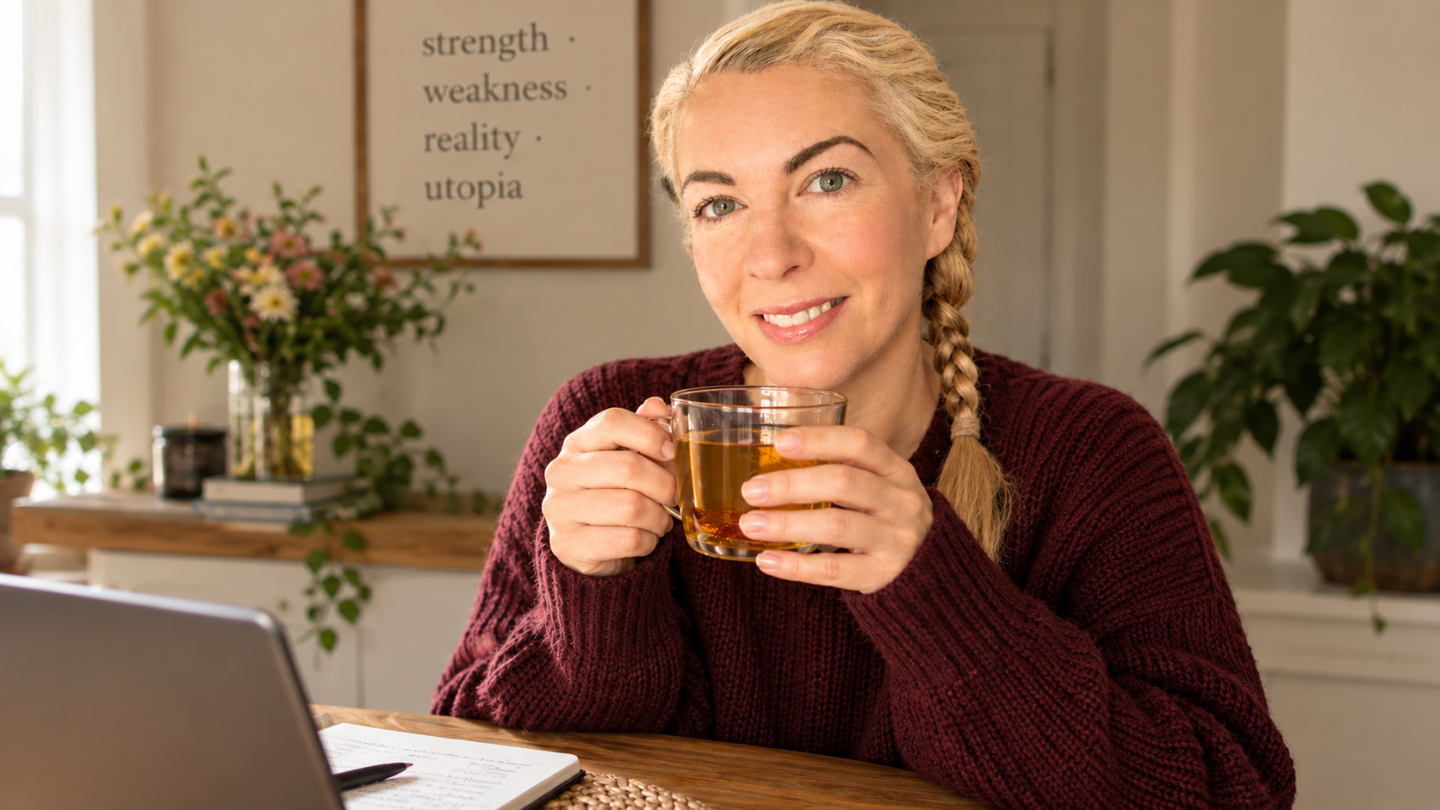
But then I started wondering whether I was giving the saffron too much credit. There is something about making the tea that I genuinely enjoy. Taking those tiny red threads from the jar, dropping them into hot water and watching the colour slowly spread through the cup feels like a tiny interruption to everything else going on. I have to wait for it. I have to stop. And for someone whose brain can be busy with ten things at once, five minutes of doing absolutely nothing is probably not a bad thing.
So the question isn’t simply whether saffron works. I needed to separate the saffron from everything that comes with it. Was there actually something in those delicate crocus threads that could explain why I kept reaching for the tea when I was feeling a bit down, or had I simply fallen in love with the ritual? I wanted to find out, because there’s a big difference between discovering a natural little magic potion and discovering that what I really needed was permission to sit down with a cup of tea for five minutes.
I started drinking saffron tea years ago, after marrying into a Persian family where saffron is practically the same as telling someone you love them. It was one of those things I gradually became familiar with rather than something I deliberately set out to learn about. Saffron was everywhere, in the kitchen, in the food, in the rice my husband grew up eating, in stews and desserts and all those little family meals that become part of your life without you really noticing when it happened.
There is a particular way saffron is treated in Persian cooking that I love. It isn’t thrown in as an afterthought. Those little red threads are precious, and you learn to use them carefully. A few threads can transform a dish completely. You crush or grind them, let them release their colour and aroma, and suddenly something that looked fairly ordinary becomes golden. There is something precious about it, and I think I became fascinated by that long before I started wondering whether I could drink it.
I’d seen saffron used in tea, but it wasn’t something I’d grown up drinking. So one afternoon, partly because I was having one of those days when I wanted something to make me feel a little better, I decided to try it myself. I dropped a few delicate filaments into my tea and watched them float around in the cup. Then the water started to change.
The colour slowly spread through it, first a pale yellow and then deeper and warmer, until the whole cup had that beautiful golden glow. The smell came next. Saffron is difficult to describe if you’ve never smelled it. It’s earthy and slightly sweet, with something almost honeyed about it. It doesn’t smell like the sort of thing that should come from a tiny red thread.
I remember thinking how strangely calming the whole thing was. There was no great revelation and I didn’t suddenly feel like I’d unlocked the secrets of my brain. I just stood there with my cup, watching the saffron bloom, breathing in the smell and enjoying the fact that, for once, I wasn’t rushing to the next thing.
Even Cyrus, usually in a permanent state of motion, seemed to settle for a moment. There was something about the smell filling the kitchen that made the whole room feel different. I remember thinking, ah, this is what peace smells like. And that is why I kept making it.
The tea became associated with a feeling for me, not happiness exactly, and certainly not some dramatic transformation. More like a little shift. When I was feeling flat or overwhelmed, making saffron tea gave me something small and comforting to do. I could take a few minutes, watch the colour develop and drink something warm and fragrant instead of immediately trying to fix whatever was bothering me.
The more I drank it, the more I became interested in the saffron itself. What was actually in those tiny threads? Why had saffron been valued for so long? And were all the things I’d started hearing about its effect on mood and wellbeing actually based on anything, or was I just enjoying a beautiful ritual that happened to taste good? I wanted the answer to be saffron.
I wanted to believe that somewhere inside those tiny crimson threads was a little bit of the magic I had been looking for.
Saffron isn’t some new wellness ingredient, it has been used for centuries, particularly in Persian culture, and it has always been much more than something you sprinkle over rice because you want dinner to look pretty.
Saffron is special and valuable. You don’t waste it, you use a little and you let it do its thing. And there is a long history of saffron being used traditionally for things including digestion and mood, which is probably one reason I was so intrigued when I started looking into what modern research actually says.
There are now a number of clinical trials and systematic reviews looking at saffron and mental health. Researchers have been particularly interested in depression, anxiety and mood, and the results so far are surprisingly encouraging. A 2019 meta-analysis of 23 studies found that saffron supplementation was associated with improvements in depressive and anxiety symptoms compared with placebo, although the researchers also flagged publication bias and the need for more research.
More recently, a 2026 systematic review and meta-analysis brought together 34 randomised controlled trials involving 1,769 adults. It found improvements in some measures of depressive and anxiety symptoms, but not across every clinical measure, and the authors were clear that better-quality research is still needed. That matters, because “promising” is not the same thing as “proven”.
Some of the earlier studies are particularly intriguing. Research has compared saffron extracts with antidepressant medication and, in some trials, found similar improvements in depressive symptoms. But there’s an important little asterisk here: these studies generally used measured doses of saffron extract, often in capsules, rather than the few threads I was dropping into my teacup.
This is exactly where my natural-remedy optimism can get ahead of itself. I could read “saffron may help with mood” and immediately translate that into “excellent, my tea is basically therapy”. It isn’t. The research is interesting, but it doesn’t prove that my homemade saffron tea is going to treat depression, anxiety or anything else. It also doesn’t mean I should swap proper medical treatment for a cup of something golden.
What it does tell me is that my little experiment isn’t completely fanciful. There is enough research behind saffron’s potential effects on mood to make me wonder about what I’m actually experiencing when I drink it. Researchers are still trying to work out exactly how it might work, with compounds including crocin, crocetin and safranal among those being investigated.
The question isn’t whether scientists have proved that saffron tea is a magic potion, they haven’t. It’s whether there is something worth paying attention to. And, the more I read, the more complicated it became.
The first thing I notice when I make saffron tea isn’t the taste. It’s the smell.
Once the saffron hits the hot water, the smell starts to travel around the kitchen, and I can usually tell before I’ve taken the first sip that I’m going to enjoy this.
Cyrus knows it too. He knows the smell means mummy is making her tea. Sometimes he’ll wander into the kitchen and say, “Mummy’s tea time,” which is his way of acknowledging that, for the next few minutes, I might not be available to help with Lego, find a missing toy or answer whatever extremely important question has just occurred to him. He’s my child, but there is something quite lovely about having a small ritual that he recognises as mine.
I watch the saffron threads sitting in the cup as they slowly release their colour. The water changes gradually, from clear to pale yellow and then to that deep golden shade that makes the whole thing feel a little bit special. It takes a few minutes. That’s probably one of the reasons I keep doing it.
My natural instinct is usually to hurry. My brain is already on to the next thing before I’ve finished the one I’m doing. I can be drinking my tea while thinking about an email, wondering what we’re having for dinner and remembering something I was supposed to do yesterday. Sitting still doesn’t necessarily come naturally to me, but saffron tea doesn’t really reward impatience.
You put the threads in. You have to wait and eventually, you drink it.
I have come to appreciate more as I’ve got older. We spend so much time trying to make everything quicker – quicker replies, quicker results, quicker fixes for whatever we think is wrong with us. I don’t always need a quicker fix.
Sometimes I just need to sit down with something warm and give myself a few minutes before I decide what needs fixing in the first place. And if I’m trying to work out whether saffron actually makes me feel better, that’s going to matter.
There are probably much more sophisticated ways of making saffron tea, but I’m not interested in turning this into another thing I have to get right.
My version is very simple. I take two or three saffron threads and put them into a cup of hot water. Sometimes I’ll add them to black or green tea if that’s what I’m drinking. I leave them to steep for about five minutes, watching the colour slowly change, and then I’ll add a little drizzle of honey. If I’m in the mood, I’ll add a pinch of cinnamon too. That’s it.
No expensive equipment, or complicated measurements. No wellness guru telling me I have to drink it at precisely 7.14am while standing barefoot on a yoga mat. Just saffron, hot water, sometimes a little honey and cinnamon, and five minutes.
And that simplicity is part of what appeals to me. If something is going to become part of my life, it has to be realistic. I’m not looking for another health project to manage. I’m looking for something I might actually reach for when I’m having a rubbish day.
So this became my little experiment.
When I was feeling a bit flat, I made the tea. I tried not to do anything else while it was steeping. I drank it slowly rather than knocking it back and I paid attention to what happened afterwards.
Did I feel different? Was my mood any better? Did I feel calmer or more focused? Or was I simply pleased that I’d stopped for five minutes and made myself something lovely? I didn’t really know. That was what made me want to keep going.
We talk about “wellbeing” as though it’s something you can order online. A nice candle, a weighted blanket, a box of supplements, perhaps a £90 treatment that promises to make you feel like a completely different woman.
And I do like some of those things. I’m not going to pretend I don’t. But the older I get, the more I realise that feeling better isn’t always about finding another product to buy. Sometimes it’s about having the time and permission to stop and that isn’t easy.
For a lot of women I know, rest comes after everything else. After the children have been fed, the emails have been answered. After the washing has been put on, the shopping. After work and after we’ve checked everyone else is alright. By the time we get to ourselves, we’re often too tired to enjoy it.
I’ve become increasingly aware of how often I feel I should be doing something. Even when I’m sitting down, part of my brain is making a list. I can be watching television and thinking about the things I haven’t done. I can be having a cup of tea and mentally reorganising tomorrow. That’s why I think my saffron tea has become more important to me than the drink itself.
Nobody has to need anything from me for those few minutes. I’m not productive, I’m not learning anything and I’m not answering an email or sorting out a cupboard. I’m just making a cup of tea and drinking it. It’s a small act of rebellion in a culture that is very good at telling women that there is always something else they could be doing.
We are constantly encouraged to improve ourselves, sleep better, eat better, exercise more, look younger, be calmer. Optimise the brain, the body, the bloody lot. Sometimes I wonder when we’re supposed to actually live.
So yes, I still want to know whether saffron itself is doing anything. I’m still interested in whether those tiny crocus threads contain something that genuinely affects mood. But I’ve also realised that the experiment has uncovered something I wasn’t really looking for. I don’t always need another thing to improve me.
So, did the saffron work?
I wish I could give you a wonderfully satisfying answer and tell you that I found my natural little magic potion. That I drank the tea and suddenly felt sharper, happier and completely on top of my life. I didn’t.
What I did find was something more useful. I found a drink I genuinely enjoy, with some interesting research behind saffron and its potential effects on mood. I also found a reason to stop for a few minutes when my head is busy and I’m feeling a bit down.
Some women have yoga. Some run half marathons. Some like me disappear into a bath and don’t come out until everyone in the house has worked out how to fend for themselves. I also steep saffron. I’m quite happy with that.
There will still be washing in the machine and something I have forgotten to do. Dinner will still occasionally be something I remember about halfway through the evening news. The saffron doesn’t fix any of it. But when I sit down with that golden cup, I do feel as though I’ve pressed pause for a moment.
I’ve been looking for a little lift, a little comfort and a few minutes when I don’t have to be better than I was yesterday. Saffron has not transformed me into the woman from Limitless. I’ve not discovered a secret ingredient that will finally make my brain behave.
I just make myself a cup of tea, sit down and feel a little bit better. Tomorrow I’ll probably make another one.
Join the conversation:
Do you have a small ritual that helps you reclaim calm? Share your thoughts in the comments below.
This site uses Akismet to reduce spam. Learn how your comment data is processed.
Discover more from Saffron & Cyrus
Subscribe to get the latest posts sent to your email.


Saffron & Cyrus is an independent women’s editorial publication with a recognisable voice, real-life perspective, a defined midlife audience and a commercial model built around useful, relevant partnerships.

Leave a Reply