
I don’t remember being that bothered about germs in my twenties. I washed my hands, obviously, but I wasn’t inspecting door handles or wondering how many people had touched the supermarket trolley before me. I definitely didn’t spend my evenings researching handwash. Then I had Cyrus at 40, and things changed.
By my late forties, I could hear a child coughing from the other end of a nursery corridor and immediately start wondering how long it would be before the rest of us came down with something. Our house had already been through the usual winter collection of colds, sniffles and coughs. One would disappear, only for another to arrive before we’d finished the tissues.
Coronavirus was still being mentioned at school pick-up, too. After everything we’d been through during the pandemic, I was more conscious of hand hygiene than ever. The disinfectant was never far away, and I seemed to spend an unreasonable amount of time wiping things that had already been wiped.
The problem wasn’t getting me to wash my hands. It was getting my five-year-old to wash his properly, rather than treating the bathroom tap as something to visit briefly on his way to more interesting things.
I could wash my own hands without thinking about it. Getting Cyrus to do the same, properly and with soap, was not easy.
Anyone who has taken a child to nursery during winter will know what I’m talking about. You walk through the door and hear coughing from one corner, sneezing from another and a parent explaining that their little one was perfectly fine yesterday. Everyone looks tired. Someone is clutching a coffee. Another parent is trying to persuade a child to put their coat away while looking as though they could do with going straight back to bed themselves.
Meanwhile, Cyrus was touching everything. The door handle, the handrail, the wall and, if I wasn’t quick enough, whatever another child happened to be holding. Then his fingers would head straight towards his mouth. I’d tell him to keep his hands away from his face, and he’d stop for three seconds before carrying on.
I didn’t want to be the mum who followed her child around with antibacterial wipes, but I could feel myself heading in that direction. We’d already had chickenpox doing the rounds, and there always seemed to be another cold waiting for its turn.
At five, Cyrus was interested in everything except spending 20 seconds washing his hands. He’d turn on the tap, give his fingers a quick splash and announce that he’d finished. Sometimes the soap remained completely untouched. I tried explaining that germs could make him poorly, but how do you explain something invisible to a child who wants to know why he can’t have another biscuit?
We started with the usual advice. Sing “Happy Birthday” twice while washing your hands. It sounded simple enough, although after several days I was beginning to wish we’d chosen a different song.
We tried colourful soap, special towels and making the whole business into a game. There were stickers involved at one point, too. I wasn’t especially keen on rewarding someone for washing their hands, but I was willing to negotiate if it meant he actually used the soap. But sometimes he’d lose interest halfway through and walk off, leaving me standing beside the sink wondering why such a basic task required so much discussion.
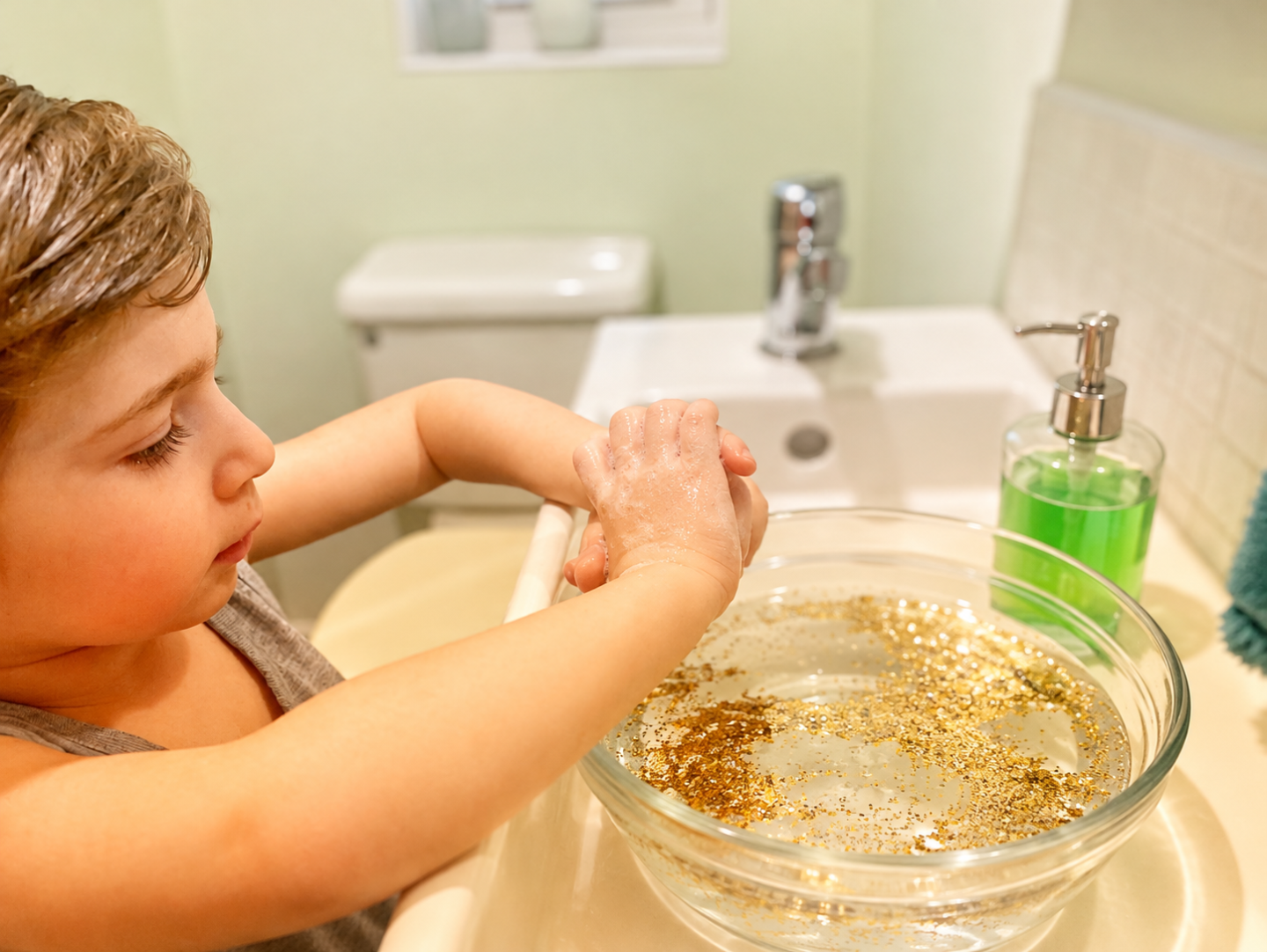
Then one of the nursery workers introduced us to a glitter experiment. The idea was to show children something they could see, rather than keep talking about germs they couldn’t. It involved water, glitter and soap, three things we already had in the house, although I wasn’t as enthusiastic about getting the glitter out again.
The experiment involved filling a shallow bowl with water, sprinkling glitter across the surface and asking your child to imagine that the glitter represents germs. First, they touch the water with a clean finger. Then you put a little washing-up liquid on their fingertip and ask them to touch the water again. The glitter moves away from the soap.
Now, before anyone writes in to tell me that germs don’t run away from washing-up liquid, I know. The glitter moves because the soap changes the surface tension of the water. It’s a science experiment, not a microscopic recreation of what happens in the bathroom sink.
But try explaining surface tension to a five-year-old when you’ve spent the previous fortnight reminding him not to put his fingers in his mouth. The point was to get him interested enough to ask questions about soap and handwashing, and that, I thought, was worth trying.
That evening, I found a bowl, filled it with water and dug out the craft glitter left over from Christmas. I don’t know why I still had it. Glitter has an annoying habit of surviving every attempt to clear out the craft cupboard.
Cyrus came over to see what I was doing, which was encouraging. Usually, the mention of washing hands was enough to send him in the opposite direction. I sprinkled the glitter onto the water and asked him to imagine they were germs. He leaned over the bowl and watched as I showed him what happened when a little washing-up liquid met the surface.
The glitter scattered, and Cyrus was delighted. He shouted that the germs were running away and immediately wanted to try it again. Apparently, watching glitter move across a bowl of water was considerably more interesting than listening to his mother talk about hygiene.
I explained that real germs don’t behave like glitter and that washing our hands with soap helps remove them. Whether he understood all the science was beside the point. He was listening, asking questions and, most importantly, interested.
By the time we’d finished, there was glitter on the table, glitter on my hands and glitter on the floor. I found some more the following morning. It was probably the least tidy hygiene lesson we could have chosen, but for once we hadn’t spent the evening arguing about washing his hands.
I think adults forget how much we expect children to accept without question. We tell them to brush their teeth, wash their hands, put on a coat and stop picking things up off the floor. Most of the time, we’re in such a hurry that we don’t have the patience to explain why. And even when we do explain, it doesn’t necessarily mean they’ve understood.
Germs are difficult because children can’t see them. You can point to mud on their fingers or chocolate around their mouth, but bacteria and viruses are another matter. The glitter gave Cyrus something to watch, and it also gave him something to talk about afterwards. Instead of me repeating the same instructions, we could refer back to what we’d done together.
I didn’t want him growing up frightened of germs. Children need to play outside, touch things, get muddy and come home looking as though they’ve been digging for potatoes. Having a baby at 40 made me a little more cautious than I might otherwise have been. I worried about things I couldn’t control, especially when Cyrus was small, but I didn’t want every trip to nursery or the playground to become an exercise in avoiding illness.
Teaching him to wash his hands properly seemed a much more sensible place to start. I couldn’t prevent every cold, and I certainly couldn’t stop him touching every interesting object within reach, but I could help him develop a habit that might reduce the chances of bringing quite so many germs home.
You don’t need anything complicated. We used a shallow bowl, water, a little craft glitter and washing-up liquid. If you’re trying it now, I’d suggest biodegradable glitter or a reusable alternative, mainly because ordinary glitter isn’t particularly kind to the environment.
Fill the bowl with water and sprinkle a small amount of glitter over the surface. Ask your child what they think will happen when they touch it. Let them try with a clean finger before adding a tiny drop of washing-up liquid to their fingertip.
When they touch the water again, the glitter should move away from the soap. It’s a good opportunity to explain that soap changes the way the water behaves. You can then talk about how washing our hands properly helps remove dirt and germs.
Just make sure children don’t put the glitter or washing-up liquid in their mouths or eyes, and supervise the activity. The experiment doesn’t prove that hands are clean, so finish by showing them how to wash properly with soap and running water. I’d also recommend doing it somewhere that’s easy to clean. I learned that part afterwards.
The NHS recommends washing hands with soap and water for at least 20 seconds. That means rubbing your palms together, cleaning between your fingers, washing the backs of your hands and remembering your thumbs and fingertips.
Children should wash their hands after using the toilet, before eating, after coughing or sneezing into their hands and whenever they’re visibly dirty. It’s also a good habit after playing outside or handling animals.
The NHS handwashing guide explains the technique if you need a reminder. I found that showing Cyrus what to do worked better than simply telling him to wash his hands and hoping for the best.
The glitter experiment is only a bit of fun. It doesn’t show germs being killed, and it certainly doesn’t replace proper handwashing. But it helped us have a conversation that wasn’t another round of me telling him what to do.
I wish I could say that after our little science lesson, Cyrus washed his hands perfectly every time. He didn’t. He was five, and there were still occasions when I had to send him back to the sink because he’d forgotten the soap. But he remembered the glitter, and that was the difference.
When I reminded him about washing his hands, we had something to refer to. He’d seen what happened in the bowl, asked his questions and enjoyed being part of it. I wasn’t expecting him to become an expert in microbiology, just to understand that soap had a purpose beyond making bubbles.
I also realised how often I expected him to do something simply because I’d asked. I’m his mother, so naturally I assume my instructions should carry some weight. Unfortunately, five-year-olds don’t always share that view. Sometimes they need to work things out in their own way, even if that involves turning the kitchen into a craft disaster.
As for the glitter, I was still finding it days later. So much for my obsession with keeping the house clean. Still, at least Cyrus had learned something, and I’d managed to get through a handwashing lesson without losing my patience.
Occasional stories, experiments, discoveries and questions from Saffron & Cyrus.
Discover more from Saffron & Cyrus
Subscribe to get the latest posts sent to your email.


Saffron & Cyrus is an independent women’s editorial publication with a recognisable voice, real-life perspective, a defined midlife audience and a commercial model built around useful, relevant partnerships.
