
The cardboard box problem
Christmas shopping for a preschooler can be a frustrating business. You spend weeks choosing presents, reading reviews and convincing yourself that something will keep your child entertained for months. Then Christmas morning arrives, the wrapping paper comes off and your child decides the cardboard box is far more interesting than the toy inside. I’ve watched Cyrus do that. It’s enough to make you wonder why you bothered buying the contents.
As Christmas approaches in 2020, I’m paying more attention to what goes under our tree. We’ve accumulated a large number of toys over the years, some of which have barely been played with. There are things with missing pieces, things that no longer work and things that need batteries we never seem to have. I’m not against plastic toys, and not going to pretend our house is free of them, but I do wonder whether we need quite so many.
I’m also becoming more conscious of what happens to children’s toys when they’re no longer wanted. Some can be passed on, sold or donated, but others are difficult to recycle because they’re made from several different materials. When something breaks, replacing it is often easier than repairing it, especially when the replacement costs only a few pounds.
I’d rather buy Cyrus something he genuinely enjoys and uses regularly than another toy that spends most of its life at the bottom of a cupboard. So I’ve been looking at six brands offering alternatives to conventional children’s toys this Christmas. Some use renewable materials, others incorporate recycled resources, and a few have found different ways to encourage imaginative play. Whether they’re worth buying is another question.
The materials matter, but so do the number of years a toy lasts and whether a child wants to play with it.
Most parents have probably stood in a toy shop wondering how something so small can take so much packaging. There’s the cardboard box, the plastic window, the moulded tray and the little plastic ties that take an age to remove. By the time you’ve finished opening it, there’s often more packaging on the floor than toy in your hands.
Many contain a mixture of plastics, metals and electronic components, which can make recycling difficult. Even when individual materials are technically recyclable, that doesn’t necessarily mean local recycling facilities will accept them.
Packaging manufacturer Smurfit Kappa raised this issue when it launched its ekolife range in December 2019. The company estimated that British consumers would spend around £5 billion on toys over Christmas and claimed that a large proportion would be made from plastic and other materials that are difficult to recycle. Those were the company’s estimates, rather than independently verified figures, but the wider problem is familiar to anyone who has cleared out a child’s toy cupboard.
What interests me is whether manufacturers can produce toys that children still want to play with while using fewer virgin materials, incorporating recycled content or making products easier to pass on when they’re no longer needed.
There’s a lot of marketing around sustainable toys, and not all of it stands up to scrutiny. Bamboo grows quickly, but it still has to be processed and transported. Sugarcane can replace some fossil-derived raw materials in plastic production, but the resulting toy isn’t necessarily biodegradable. Cardboard is easier to recycle than many mixed-material products, although it may not last as long.
I don’t expect every manufacturer to have all the answers, but I would like to see more honesty about what makes a product environmentally preferable. For parents, there’s another consideration that matters just as much. Will the child actually play with it?
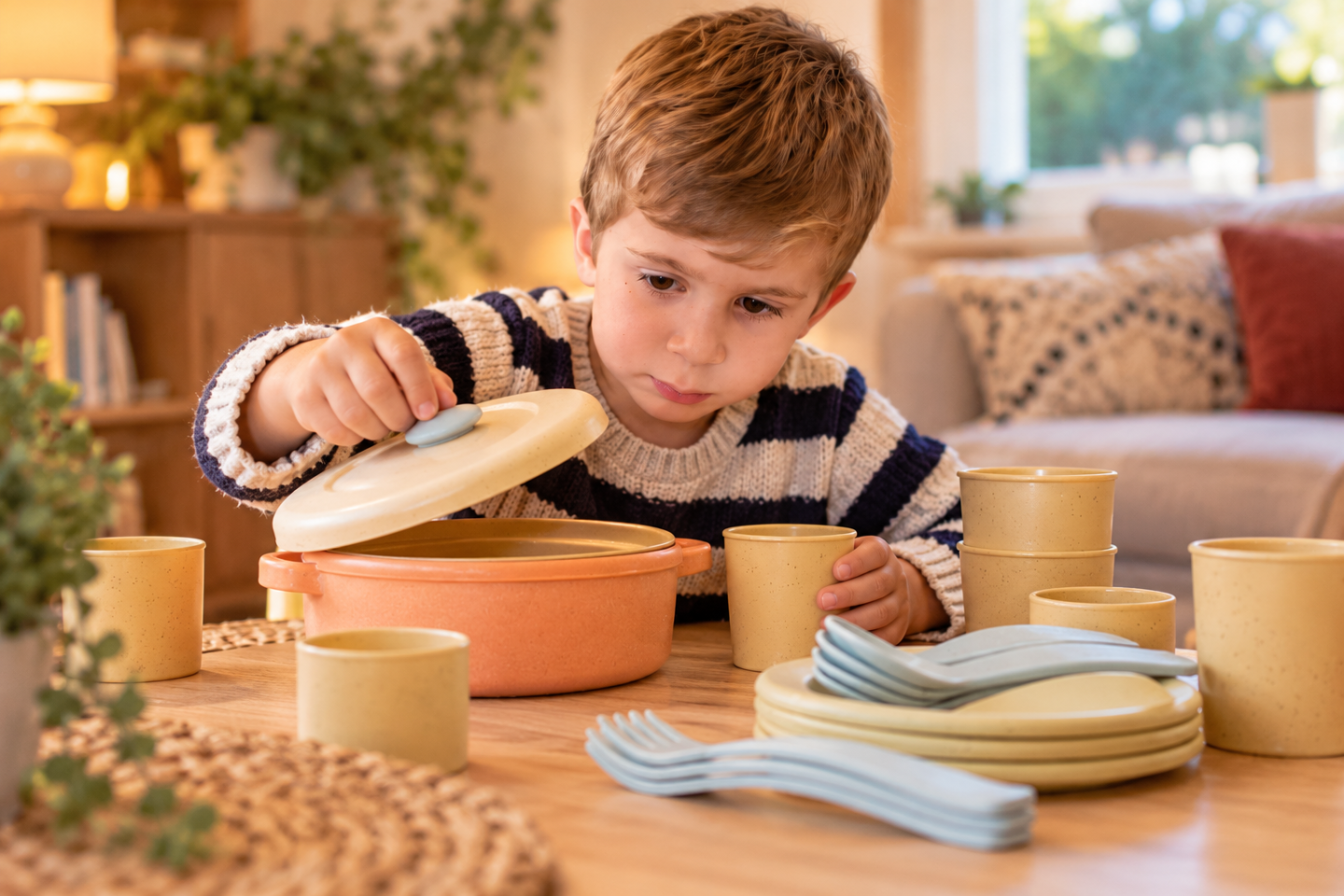
Dantoy Bio Dinner Set: A teddy bears’ dinner party
Cyrus enjoys organising meals for his cuddly toys. Everyone gets a plate, somebody has to pour the drinks and there’s usually a great deal of discussion about what we’re supposed to be eating. I’m sometimes invited to join them, although the teddy bears generally receive better service.
Danish manufacturer Dantoy makes a range of toys using bioplastic derived from sugarcane. Its Bio collection launched in 2018 and includes a 22-piece dinner set with plates, cups, cutlery and a cooking pot.

Cyrus recently tried Dantoy’s Bio dinner set with a few of his furry friends, and it kept him occupied for a good while. He arranged the plates, poured imaginary drinks and prepared meals for everyone. The teddy bears appeared satisfied, although I’m not sure they were given much choice.
The pieces feel sturdy and are a good size for small hands. They’re also designed for contact with food and can be cleaned in the dishwasher, which is useful when pretend tea parties become real ones.
What I like about this sort of toy is how much children can do with it. Cyrus decides who’s coming for dinner, what they’re eating and who gets served first. He’s practising conversations, sharing and making decisions without needing somebody to organise the activity for him.
Dantoy says the bioplastic used in its Bio range contains at least 90% sugarcane-derived material. It’s an interesting alternative to conventional fossil-based plastic, although it shouldn’t be confused with something that will naturally biodegrade after use.
Shop the Dantoy Bio dinner set on Amazon
The following toys caught my attention for their materials, design or approach to play. Unlike the Dantoy dinner set, these are editorial recommendations rather than products Cyrus has personally tested.
1. Dantoy Bio Gardening Kit: For children who like getting muddy
Age: 2+ Original price: £29
Dantoy’s 11-piece gardening kit contains a watering can, shovel, rake, two flowerpots, three pretend carrots, two plant markers and stickers. It’s designed for young children who enjoy planting, watering and helping in the garden.
I like encouraging Cyrus to get involved outdoors, although his enthusiasm for digging doesn’t always extend to putting the soil back where he found it. This looks like the sort of kit he’d enjoy, particularly because children can use the pieces for pretend gardening indoors as well as helping with simple jobs outside.
The kit uses sugarcane-derived bioplastic, which Dantoy says reduces its reliance on fossil-based raw materials. The company says the sugarcane is grown in central and southern Brazil under agricultural zoning measures. Renewable crops still need land, water and energy to grow and process.
2. ekolife: Cardboard castles and rocket ships
Original prices: £9.99–£24.99
Launched by packaging manufacturer Smurfit Kappa in December 2019, ekolife’s cardboard toy collection includes racing cars, planes, colouring canvases and larger play spaces such as the Hut, Rocket Ship and Fortress. The original collection featured 12 products, with the larger structures designed to accommodate up to three children.
I particularly like the Rocket Ship. Cyrus has always enjoyed making things, and I can imagine him spending an afternoon decorating his own spacecraft before announcing that he’s off to the moon. I’d probably be expected to provide the refreshments.

The toys are made from paper-based materials, which the manufacturer describes as recyclable and biodegradable. They won’t necessarily survive the same treatment as a sturdy plastic playhouse, but children can decorate them and recycle suitable cardboard when they’re finished. At launch, the Pick-Me-Up Planes and racing cars were £14.99 to £19.99, larger play spaces £19.99 to £24.99 and three colouring canvases £9.99. Three-in-one puzzle and game party packs were £19.99.
Morgan Webster, ekolife’s general manager at launch, said the collection was intended to encourage traditional imaginative play away from screens. The idea makes sense to me. Children can decide whether a cardboard structure is a rocket, a shop or somewhere to hide from the grown-ups.
3. Hape: Three bamboo games for curious children
Original prices: £21.99–£28.29
Cyrus enjoys working out how things fit together. Give him a construction toy and he’ll often spend longer examining the pieces than following the instructions. Sometimes he builds what he’s supposed to. Other times he comes up with something entirely different.
Hape makes a selection of games and construction kits using bamboo, a fast-growing plant that can be harvested and regrown relatively quickly compared with many timber species. The material is an interesting alternative to conventional plastic, although the environmental impact still depends on how the bamboo is grown, processed and transported.
Flexistix Multi Tower Kit
Age: 4+ Original price: £25.74
The Flexistix Multi Tower Kit combines bamboo sticks with silicone connectors so children can build towers and other three-dimensional structures. The kit includes instructions for recreating famous towers, but children can also use the pieces to invent their own designs.
I can imagine Cyrus attempting to build something enormous, only to discover that the structure needs rather more support than he originally thought. That’s part of the attraction. Children can experiment, make mistakes and work out how to improve what they’ve built. The activity encourages spatial awareness, problem-solving and an understanding of balance and stability.
Shop Hape Flexistix Multi Tower Kit
Pallina Ocean Rescue
Age: 3+ Original price: £28.29
Pallina Ocean Rescue is a game in which turtles and whales are trapped inside a fishing net. Players must carefully remove bamboo sticks to release the animals without allowing the wrong pieces to fall. It sounds simple, but children have to think about which stick to remove and what might happen next. The game can also be adapted for different levels of difficulty.
I like the marine theme because it gives parents an opportunity to talk about the dangers discarded fishing equipment poses to wildlife. Children don’t need a complicated explanation to understand why a turtle shouldn’t be trapped in a net. I suspect Cyrus would be more concerned about rescuing the animals than developing his fine motor skills.
Shop Hape Pallina Ocean Rescue
Skinny Legs Toss
Original price: £21.99
Skinny Legs Toss is a throwing game designed for one to four players. Each person chooses a colour and collects three spiders, then takes turns tossing them onto a web. The aim is to make as many spiders as possible stay in place. You can also give different sections of the web a points value to make the game more challenging.

I like games that get everyone involved, particularly when children can play alongside adults without needing complicated rules. Throwing and catching also help develop coordination, and taking turns is something most preschoolers benefit from practising. Losing gracefully is another matter. I know a few adults who could do with some practice there too.
4. Planet Buddies: Headphones with a wildlife message
Original prices: £19.99–£24.99
Cyrus enjoys music, although we don’t always agree on what we should be listening to. I’m quite happy with Persian music playing around the house, while he has his own preferences. Children’s headphones can be useful for travelling, listening to stories or enjoying music without everybody else having to hear the same song repeatedly.
Planet Buddies makes children’s headphones featuring characters inspired by endangered and threatened animals, including Pepper the Penguin, Olive the Owl, Noah the Whale and Milo the Turtle. The range includes wired animal headphones and Colour and Swap headphones that children can personalise using 24 character cards and four crayons.

They’re designed for ages three and over and feature an advertised volume limit of 85 decibels, although parents should still supervise volume and listening time. The Colour and Swap set was originally £24.99 and came with a reusable travel case. The animal character wired headphones were £19.99 with an eco-hemp travel case.
I like the wildlife education element, particularly the stories explaining why different animals need protecting. These are still electronic products, though, so the conservation message shouldn’t be mistaken for proof that the headphones themselves have a lower environmental impact.
5. Carapau: Ian the Elephant
Original prices: £55–£110
I’ve always had a soft spot for beautifully made cuddly toys. There’s something lovely about a favourite teddy that follows a child everywhere, gradually looking more worn and bedraggled as the years go by.
Portuguese toy brand Carapau creates handcrafted soft toys inspired by traditional craftsmanship and wildlife. Founded by designers Rita Faria and Tiago Couto, the brand takes inspiration from Portuguese toy making. Ian the Elephant caught my attention because he looks like the sort of cuddly companion a child might keep for years.

The company says it donates 3% from each purchase to wildlife conservation programmes. It’s a worthwhile initiative, although the donation doesn’t, by itself, establish the product’s environmental credentials. The range was available through luxury homeware retailer Amara, and the price puts it firmly in the occasional-treat category.
6. Bigjigs Toys: Buckets, spades and flying discs
Original prices: £2.99–£9.99
Taking a small child to the beach requires an extraordinary amount of equipment. By the time you’ve packed towels, spare clothes, snacks, drinks, buckets and spades, there’s barely enough room for the people. Then you get home and discover half the beach has come back with you in the car.
We’ve had our share of cracked beach buckets over the years, so the flexible silicone version caught my attention. It can be folded or squashed into a bag without permanently losing its shape, making it particularly useful for holidays.
Bigjigs’ wheat-fibre composite spades originally cost £2.99, its flexible silicone flying discs £4.99 and its activity buckets £9.99. The range was advertised for children aged 18 months and over, although parents should check the guidance for individual products.
Wheat-fibre composites may still contain plastic, while silicone isn’t biodegradable under normal conditions or widely accepted by household recycling schemes. A bucket that lasts through several holidays could nevertheless be preferable to repeatedly replacing broken ones. The flying disc also offers a simple game that everyone can join in, provided Cyrus manages to throw it in the intended direction.
Since the original Christmas 2020 guide, Dantoy has introduced Blue Marine, a collection of sand and water toys manufactured using recycled maritime materials, including fishing nets, ropes and trawls. The company processes these materials at its factory in Hobro, Denmark, turning them into products such as boats, buckets and construction vehicles.
Dantoy also introduced Green Bean in 2020, using plastic waste from its own production, and a Take Back Strategy in 2021 to collect damaged toys for material reuse. The Blue Marine Boat & Sand Set was originally priced at £22 and the Dumper at £19.
Recycling fishing nets into toys doesn’t remove the need to tackle marine pollution, but it’s an interesting use for materials that might otherwise be discarded.
View the Blue Marine Boat & Sand Set
Looking through these products has made me think about how much we buy for children at Christmas. There’s pressure to make the day special, and it’s easy to get carried away when you’re choosing presents for somebody you love.
I understand that. I had Cyrus at 40, and I’m very aware of how quickly these early years are passing. I enjoy buying him presents and seeing his excitement when he opens them. I also know that Christmas isn’t made better simply by having more things under the tree.
Some of the toys he’s enjoyed most have been remarkably ordinary. A few cups, some pretend food, a box to sit inside or something he can build and take apart. What matters is what he can do with them, particularly when somebody takes the time to play alongside him.
I don’t think buying sustainable toys needs to become another source of parental guilt. Most families already own plenty of plastic, and there’s little environmental benefit in throwing away perfectly good toys simply to replace them with something marketed as greener.
Keeping toys for longer, repairing them where possible, buying second-hand and passing things on when children outgrow them are all sensible options. Sometimes the best purchase is deciding that you don’t need to buy anything at all.
Our Christmas certainly won’t be plastic-free. There will be wrapping paper everywhere, toys that need batteries and probably something that makes an irritating noise until Boxing Day. But I’d like to think we’re becoming a little more selective about what we buy and whether Cyrus will still enjoy it once the excitement has worn off.
And if he spends Christmas morning playing with the cardboard box again, perhaps I’ll just let him get on with it.
Occasional stories, experiments, discoveries and questions from Saffron & Cyrus.
Editor’s note: Originally written for Christmas 2020, with a separately dated 2022 update. Original prices and availability may have changed. Only the Dantoy Bio dinner set was personally tested by Cyrus; the other products are editorial selections.
Discover more from Saffron & Cyrus
Subscribe to get the latest posts sent to your email.


Saffron & Cyrus is an independent women’s editorial publication with a recognisable voice, real-life perspective, a defined midlife audience and a commercial model built around useful, relevant partnerships.
