
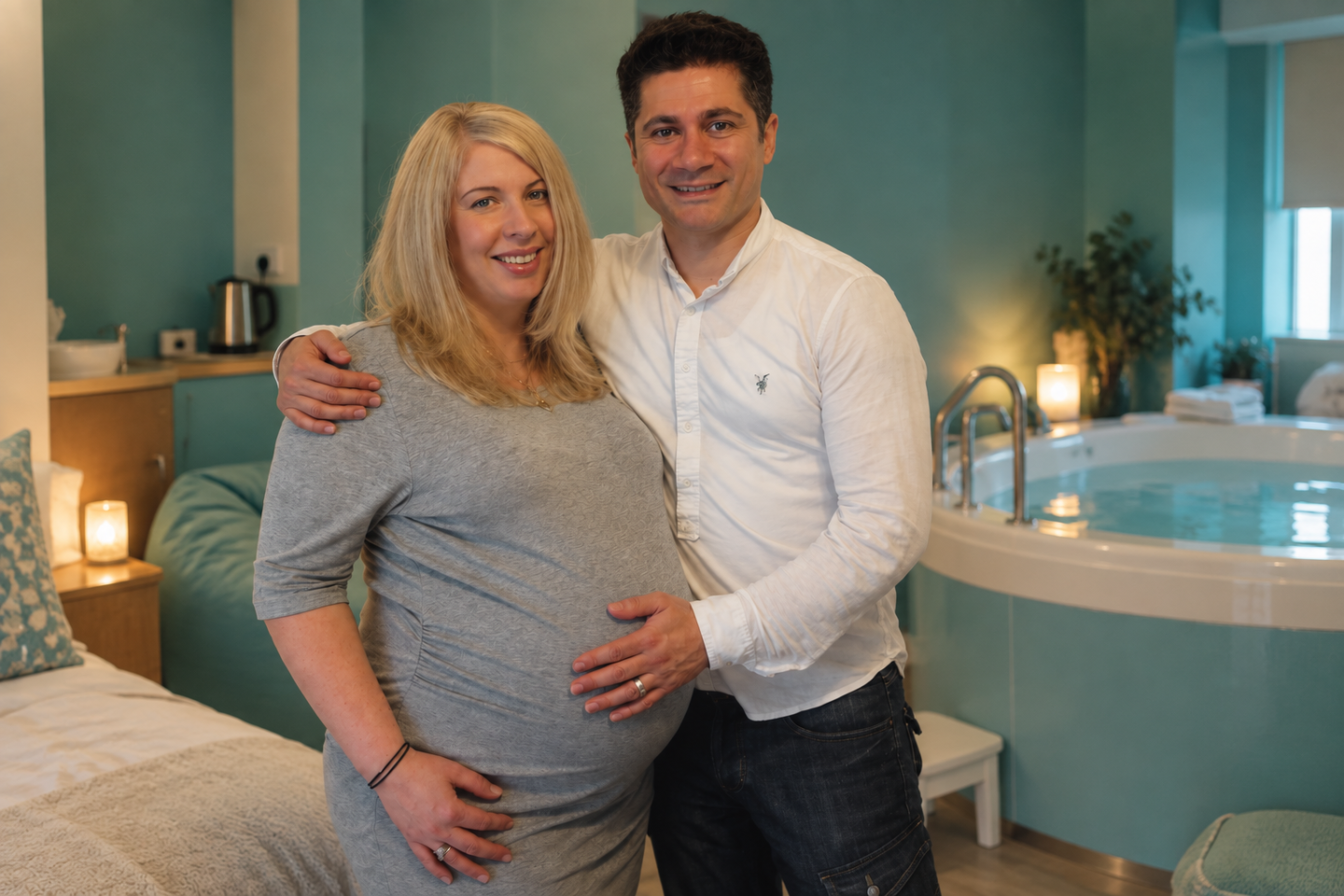
I went into childbirth at 40 armed with a birth plan, every episode of One Born Every Minute and visions of a birthing pool in a beautiful midwife-led suite. Then came the induction, the epidural, the forceps and, for reasons that will become clear, a Persian clay cooking pot.
Can you really prepare for childbirth?
I thought I had.
I was 40, but I didn’t think of myself as an older mum. In my eyes, I wasn’t old. I had also watched what felt like every episode of One Born Every Minute, which gave me the slightly misplaced confidence of someone who had observed an awful lot of other women giving birth from the safety of her sofa.
I knew births didn’t always go to plan. Naturally though, I still had a plan.
Mine involved turquoise walls and something resembling a Jacuzzi
The midwife-led unit was immaculate.
Its individual suites had turquoise walls and reassuring names such as Wedgwood. There were double beds, beanbags and little kitchen areas with their own kettle and microwave.
Then there were the birthing pools, and to me they looked more like spa Jacuzzis than places where babies emerged. This was where I imagined having mine. I had decided warm water would soothe the aches and pains of childbirth.
In retrospect, this may have underestimated childbirth slightly.
I had planned the room, the pool and even H’s role as chief sweat-wiper. Then a doctor showed me a graph.
The graph I couldn’t unsee
I had hoped to wait for labour to begin naturally.
Instead, a doctor talked me through the risk of stillbirth if my pregnancy continued beyond my due date at my age. I remember the graph more than I remember the conversation around it. It scared me.
Suddenly my lovely plan involving turquoise walls and warm water was competing with something much bigger. I would rather have waited, but after seeing those risks presented in front of me, waiting no longer felt like much of a choice. So I put my hand up for the induction.
Why might induction be discussed?
Induction is the artificial starting of labour. It may be offered when a pregnancy continues beyond its due date or where doctors believe continuing the pregnancy could carry additional risk for the mother or baby.
Decisions about induction are individual. This is my experience of the conversation I had when pregnant with Cyrus, not a recommendation about what another woman should choose.
From birthing pool to Pitocin
The immaculate midwife-led suite disappeared from the story before labour had really begun.
Instead, I found myself on a clinical ward. The contrast was hard to miss. Gone were the turquoise walls, double beds and spa-like pools. Here, curtains hung from poles around beds and everything felt colder, brighter and unmistakably medical. Then came the Pitocin drip. Soon there were monitors attached to my stomach and machines beeping around me.
There is something unnerving about watching a medical screen when everybody else in the room appears to understand what it means. So you start watching the people instead.
Gamaj, gamaj, gamaj
Then came the epidural. An apprentice was tasked with administering it. She was gentle, but also visibly nervous.
I knew people had to learn and I knew she was supervised. Rational thought becomes somewhat less persuasive, however, when someone is making several attempts to place an epidural into your back while you are having contractions. Then something hit a nerve. Eventually, a consultant intervened. Somewhere in the fear and pain, my brain found its own coping mechanism.
Gamaj. Gamaj. Gamaj.
It was a word I had picked up while spending time with H’s family in Iran.
In Rasht, brightly coloured traditional clay pots had caught my eye in the shops. I learned they were called gamaj. Except H and I had another use for the word.
We had also learned it could be used to mean “stupid”, so outside Iran it became our private code word. We could say it to one another and nobody around us would have the faintest idea what we meant. So while somebody listening in that delivery room might reasonably have wondered why I was repeatedly invoking Persian cookware, H knew better.
“Forget breathing affirmations. What I needed to get through an epidural was covert marital swearing via a Persian clay cooking pot.”
Then the monitor changed
At some point, the sticky pads monitoring Cyrus started coming away from my stomach. I remember them falling off. Then I remember seeing his heart rate change on the screen.
A nurse noticed too and rushed out to get a doctor. Nobody made a dramatic announcement. Nobody told me they were worried, but something in the room had changed. So the consultant reappeared. Then came the word I hadn’t planned for: forceps.
They showed me the instruments before the procedure. I remember looking at them and thinking how astonishingly old-fashioned they appeared. After months imagining warm water, turquoise walls and a pool resembling a Jacuzzi, I was now staring at metal instruments that looked as though they belonged in a torture chamber.
Oddly, I wasn’t thinking about what they might do to me. I wasn’t thinking about possible injury to Cyrus either. By that point, my thoughts had narrowed to one thing.
Get him here safely.
What are forceps?
Forceps are smooth, curved metal instruments designed to fit around a baby’s head during an assisted vaginal birth. Forceps or a ventouse may be recommended when a baby needs help to be born, depending on the circumstances of the labour and the wellbeing of mother and baby.
This feature describes my personal birth experience. Anyone with questions about induction or assisted birth should discuss their own circumstances with their midwife or doctor.
And then there was Cyrus
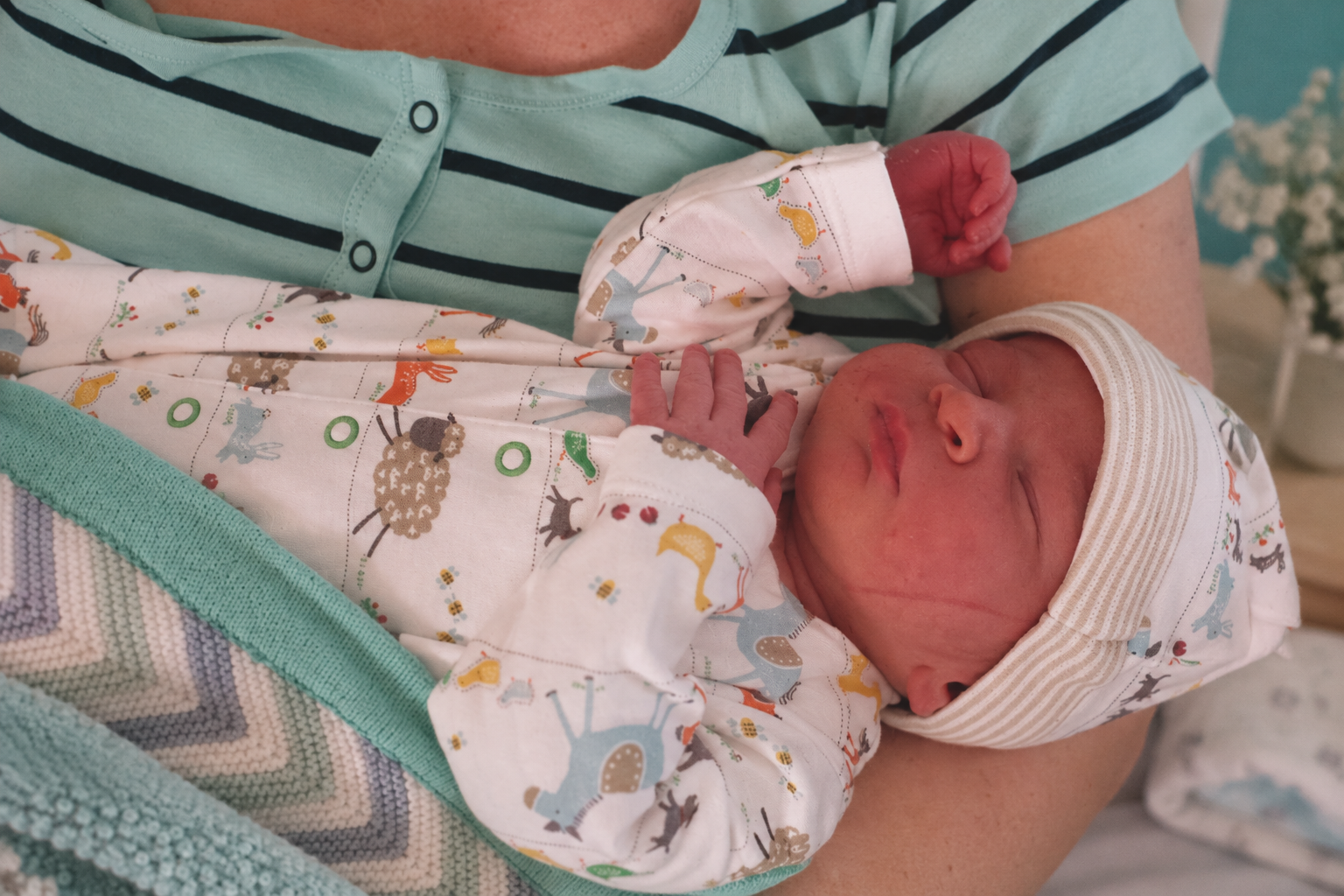
He arrived with the help of forceps, and he was bleating. Not crying in quite the way I had imagined newborn babies cried. Bleating like a tiny sheep. After the monitors, contractions, needles and worry, there he was with a wonderfully chubby, round little face.
I held him first and I was in love with him on sight. He was everything I had imagined. He looked at me so innocently that, for a moment, everything else in that room seemed to disappear. I can’t remember what H and I said. We were both too overwhelmed for the dialogue to have survived in my memory. I remember Cyrus. That was enough.
Meanwhile, Tehran was calling
Within minutes, H called his mum in Tehran. Yes, I was still being stitched up.
And no, after the day we’d just had, neither of us seems to have considered this an inappropriate moment for an international family video call. There she was on the screen, radiant, emotional and praying in Farsi.
There I was in Britain, exhausted, holding her new grandson while a doctor continued attending to the rather less photogenic consequences of his arrival. My Farsi was limited then. I couldn’t understand everything being said, but I didn’t need to. I knew they were happy.
H’s sister later saw Cyrus’s little round face in his passport photograph and christened him Shah baloot, king hazelnut. It suited him perfectly.
What do you buy a woman who’s just given birth?
H’s cousin wasn’t far behind. He rushed to the hospital to meet Cyrus, although as a single man from Iran, his knowledge of what one should take to a woman who had just given birth was based largely on whatever useful information life had supplied so far.
Apparently, life had supplied compote, the Persian term we used for fruit preserved in syrup. More specifically, tinned peaches. He had heard they were exactly what a woman needed after childbirth and was fully prepared to arrive at the hospital bearing fruit.
H intervened. He gently suggested that, after an induction, an epidural and a forceps delivery, his wife might appreciate chocolate rather more than a tin of peaches. And the new baby would definitely prefer a teddy bear. So chocolate and a teddy bear it was.
I still love that story because the instinct behind the peaches was completely right. He wanted to look after me. He just wasn’t entirely sure what that looked like. But H was also correct, I wanted the chocolate.
Cyrus was safe. I wasn’t immediately fine.
Birth stories have a habit of ending when the baby arrives. Mine didn’t.
I was enormously grateful that Cyrus was safely in my arms, but the forceps delivery affected me physically and emotionally for months afterwards. Sitting hurt. Walking hurt. I was tearful, frightened and shaken by what had happened. I replayed the delivery in my head.
For a long time I think we have been rather good at asking whether the baby is all right and rather less consistent about asking the same question of the woman who gave birth.
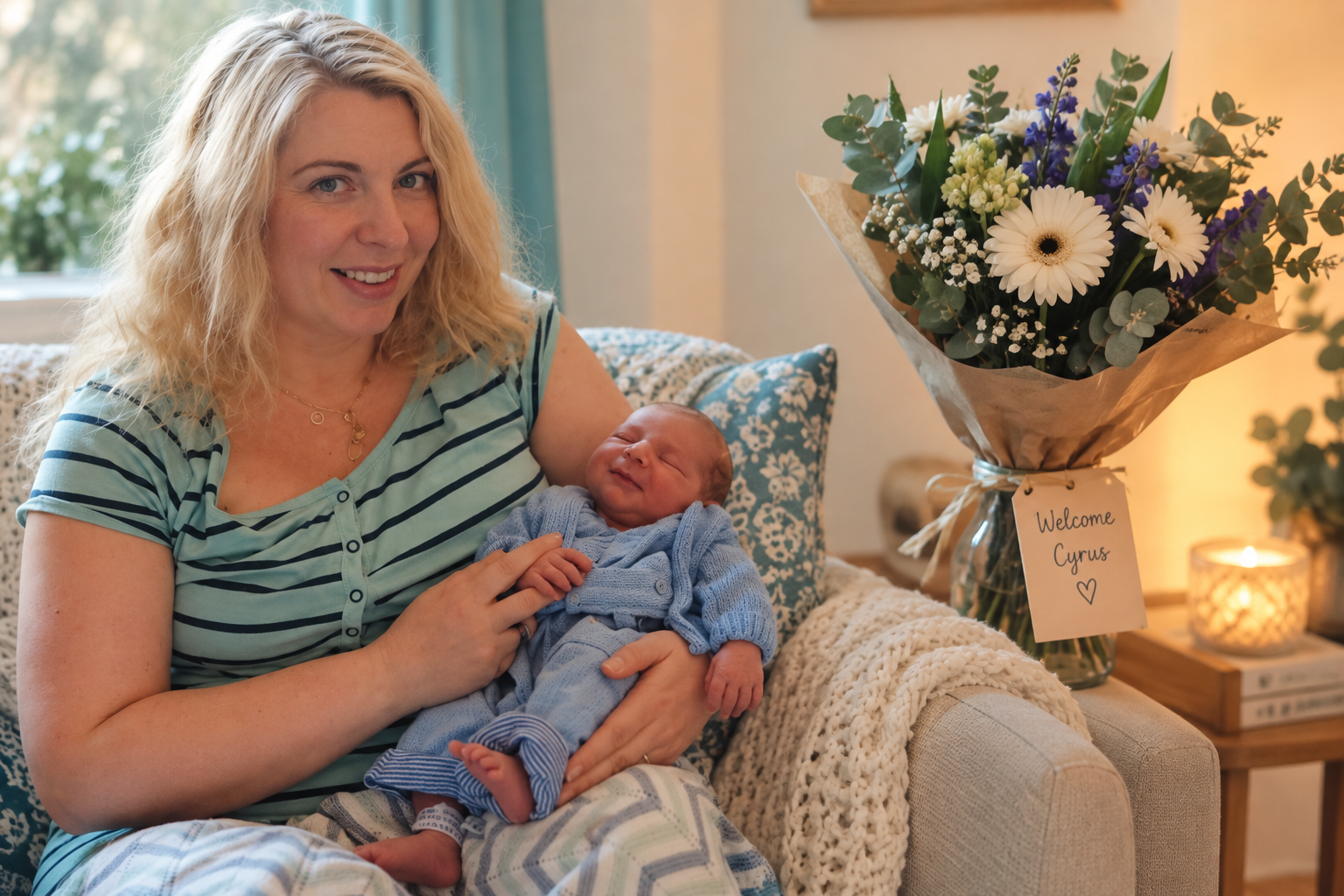
I adored Cyrus from the moment I saw him. I was also recovering from something that had frightened and hurt me. Both things could be true at once.
Preparation and control are not the same thing
Years later, I can still picture those turquoise rooms, the double beds and the beanbags. The immaculate little kitchen and that Jacuzzi-like birthing pool where I apparently thought warm water and determined breathing would see me through. I didn’t get any of it.
But that doesn’t mean making the plan was pointless. It means the plan was a preference, not a promise.
If I could speak to the 40-year-old woman holding that birth plan, I wouldn’t tell her to throw it away. I’d let her plan the pool. I’d let her picture the turquoise suite. I’d even let her continue believing that watching every episode of One Born Every Minute counted as meaningful preparation.
I’d just tell her to ask questions, understand what she can and trust the process when circumstances change. And I’d tell her that a birth going differently from the one she imagined isn’t a failure.
Make the plan. Just don’t mistake it for a contract.
I went into hospital with a picture of how I would give birth.
Instead, I got an induction I hadn’t particularly wanted, a clinical ward, an epidural that didn’t go smoothly and the forceps delivery I hadn’t imagined.
I also got H beside me, professionals who helped get Cyrus here safely, a mother-in-law praying from Tehran, a cousin who nearly arrived bearing tinned peaches and a chubby baby bleating like a sheep in my arms.
When every carefully laid plan had disappeared, I had gamaj. A Persian clay cooking pot, a private joke and, rather unexpectedly, exactly the word I needed.
Did your birth follow the plan you had imagined, or is it the completely unplanned moment that you remember most?
This site uses Akismet to reduce spam. Learn how your comment data is processed.
Discover more from Saffron & Cyrus
Subscribe to get the latest posts sent to your email.

Saffron & Cyrus is an independent women’s editorial publication with a recognisable voice, real-life perspective, a defined midlife audience and a commercial model built around useful, relevant partnerships.

Leave a Reply