
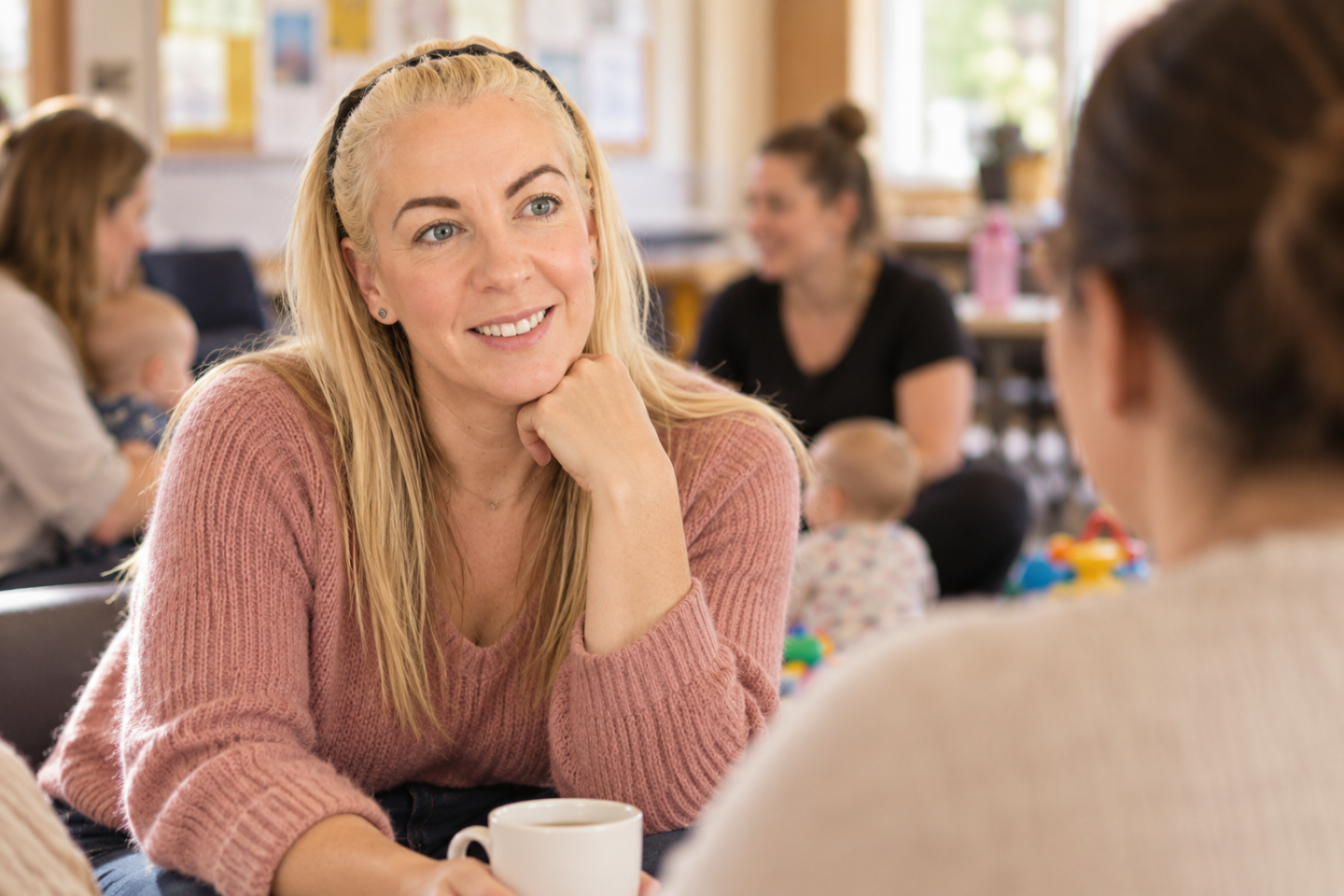

Guest story: This feature includes the personal pregnancy and birth experience of mum-of-three Lindsay Hamberg. Her experience is individual and should not be read as medical advice.
There is something about new motherhood that makes complete strangers discuss astonishingly intimate subjects within minutes of meeting. Birth, breastfeeding, sleep, weaning, the contents of nappies and whether you really need half the paraphernalia marketed to new parents can all become perfectly reasonable conversation with a woman whose surname you have yet to learn.
I first met Lindsay Hamberg at a trial Baby Boot Camp session run by KeepFit Mammy. Somewhere between exercising with babies in tow and comparing notes on motherhood, we started talking. Lindsay was a mum of three, while I was navigating life with baby Cyrus after becoming a mother again at 40. Before long, we were dissecting birth experiences, swapping ideas about weaning and discussing teething remedies.
What struck me was how comforting it felt to talk to another mum who was in the thick of it. There was no need to explain why a decent night’s sleep had become a luxury or why choosing a baby cup could occupy more mental bandwidth than decisions that once seemed far more important. She understood because she was living it too.
Later motherhood can bring an unexpected social shift. While you are beginning again with nappies, feeding and sleepless nights, many of the women you already know may have teenagers, secondary school and an entirely different stage of family life.
One thing I had not properly considered before having Cyrus was the gap between my experience of new motherhood and that of many of my existing friends. By the time I was changing nappies and wondering whether one small baby really needed quite so much equipment, many women my age had children well into their teens. They had survived teething, weaning and sleepless nights years earlier. I was starting again.
That could feel surprisingly isolating. I was standing in shops staring at walls of baby products. Which pushchair? Which bottle? Which steriliser? What did I genuinely need, and what was clever marketing dressed up as parental necessity?
I did not need another online list telling me the “10 newborn essentials every mum must own”. What I wanted was another mum to look at something and say, “I bought that. Don’t bother.” There is a big difference between information and experience, and in those early months I began to appreciate the latter.
My local community became more important than I had expected. Going to groups and activities introduced me to mums I probably would never have met otherwise. We were different ages, came from different backgrounds and approached parenting in different ways, but babies have a remarkably efficient way of demolishing social barriers. Nobody cares when somebody’s child has just been sick on their jumper.
Those conversations gave me something the Internet could not: context. A recommendation from another parent came with all the useful bits that polished parenting advice often leaves out, including what worked, what failed and what seemed important at 2am but less so after coffee.
Lindsay was one of those women. Her story interested me for another reason, too. She had conceived her third child naturally at 39, an age when conversations about pregnancy can begin to change and words such as “risk” start appearing rather more frequently.
Lindsay already had two children when she and her husband, James, discovered they were expecting Harry. She was 39 and remembers being considered low risk during the pregnancy. She also recalls being told that reaching 40 would have affected the way her pregnancy was categorised.
That detail stayed with me because women who become pregnant in their late 30s and early 40s quickly discover how much age can feature in conversations about maternity care. Of course, clinical decisions are more complicated than a birthday alone, with individual health, pregnancy history and other risk factors all playing a part. But when you are the woman sitting in the room, it can sometimes feel as though the number written beside your date of birth has suddenly become one of the most interesting things about you.
For Lindsay, the pregnancy was largely straightforward. She needed iron supplements at around six months and physiotherapy later in pregnancy, but otherwise continued working until Harry decided it was time to make an appearance.
At the time, Lindsay was also running a small sideline selling Forever Living aloe vera products alongside family life. She told me the additional income had helped with household expenses, including renovations and a family holiday. Then labour began while she was attending one of the company’s meetings, proving once again that babies have very little respect for calendars.
Despite some understandable nerves, Lindsay remembers Harry’s labour positively, with partner James beside her. Harry eventually arrived weighing an impressive 9lb 10oz. She recalls a brief delay during the birth because of his size before he was delivered with the assistance of the midwives caring for her.
For Lindsay, the experience challenged her own assumptions about what pregnancy at 39 might look like.
Her view comes from three pregnancies at very different stages of her life. Her first, at 24, involved fetal distress. Her second, at 31, went overdue. Her third, at 39, proved comparatively straightforward.
“At 24, my first pregnancy involved fetal distress. At 31, my second went overdue. But at 39, everything aligned.”
One uncomplicated pregnancy at 39 does not tell us that maternal age is medically irrelevant, just as a difficult pregnancy at 24 would not tell us that younger women are destined to experience complications. Pregnancy risk is individual, and age is one factor clinicians consider alongside a much wider picture of maternal health.
What Lindsay’s experience does challenge is the idea that a woman’s age can tell us everything about how her pregnancy will unfold. It can’t.
Looking back, what stays with me most about meeting Lindsay is not whether 39 should be considered young or old for motherhood. It is how much I needed that conversation. Becoming a mother at 40 occasionally felt as though I had arrived late to a party where everybody else already knew the rules. Some of my friends had moved on to secondary schools and teenage dramas while I was back at nappies and night feeds.
Finding women who were living through that stage alongside me mattered. We did not have to parent identically, agree about everything or have matching birth stories. What mattered was having somebody who understood the peculiar intensity of those early months without requiring a lengthy explanation.
Motherhood can become remarkably isolating when you believe everybody else knows what they are doing. The reassuring discovery, once you start talking properly to other parents, is that most of us are working things out as we go.
Sometimes the most useful thing another mother can give you is not advice at all. It is the quiet reassurance that she has stood somewhere similar, wondered about the same things and muddled through them too. A cup of tea, a conversation after an exercise class or a five-minute chat at a community centre can seem insignificant at the time. Years later, I think those small encounters are part of how we build our villages.
That is something missing from the usual conversation about later motherhood. We talk about fertility, pregnancy risks and maternal age, all of which matter. We talk less about the social side of starting again when many of your peers have already moved into another stage of family life.
Having a baby later can mean building a new circle just when you are tired, vulnerable and not particularly inclined to make sparkling conversation with strangers. Yet occasionally one of those strangers sits down beside you, starts talking about teething, and makes the whole business feel considerably less lonely.
Did you become a parent later than your friendship group? Did motherhood lead you to build a new circle? I’d love to hear what happened.
Occasional stories, experiments, discoveries and questions from Saffron & Cyrus.
“`
Discover more from Saffron & Cyrus
Subscribe to get the latest posts sent to your email.

Saffron & Cyrus is an independent women’s editorial publication with a recognisable voice, real-life perspective, a defined midlife audience and a commercial model built around useful, relevant partnerships.
