
At 39 weeks, I walked into my consultant’s office feeling rather pleased with myself. I had made it through pregnancy at 40, Cyrus was nearly here and I was thinking about the final part of the process: giving birth. I had ideas about that too. I wanted a vaginal birth with as little intervention as possible and I hoped to avoid stitches. I had concerns about my pelvic floor and bladder. I had, in other words, constructed the sort of birth plan that makes perfect sense before you’ve experienced childbirth.
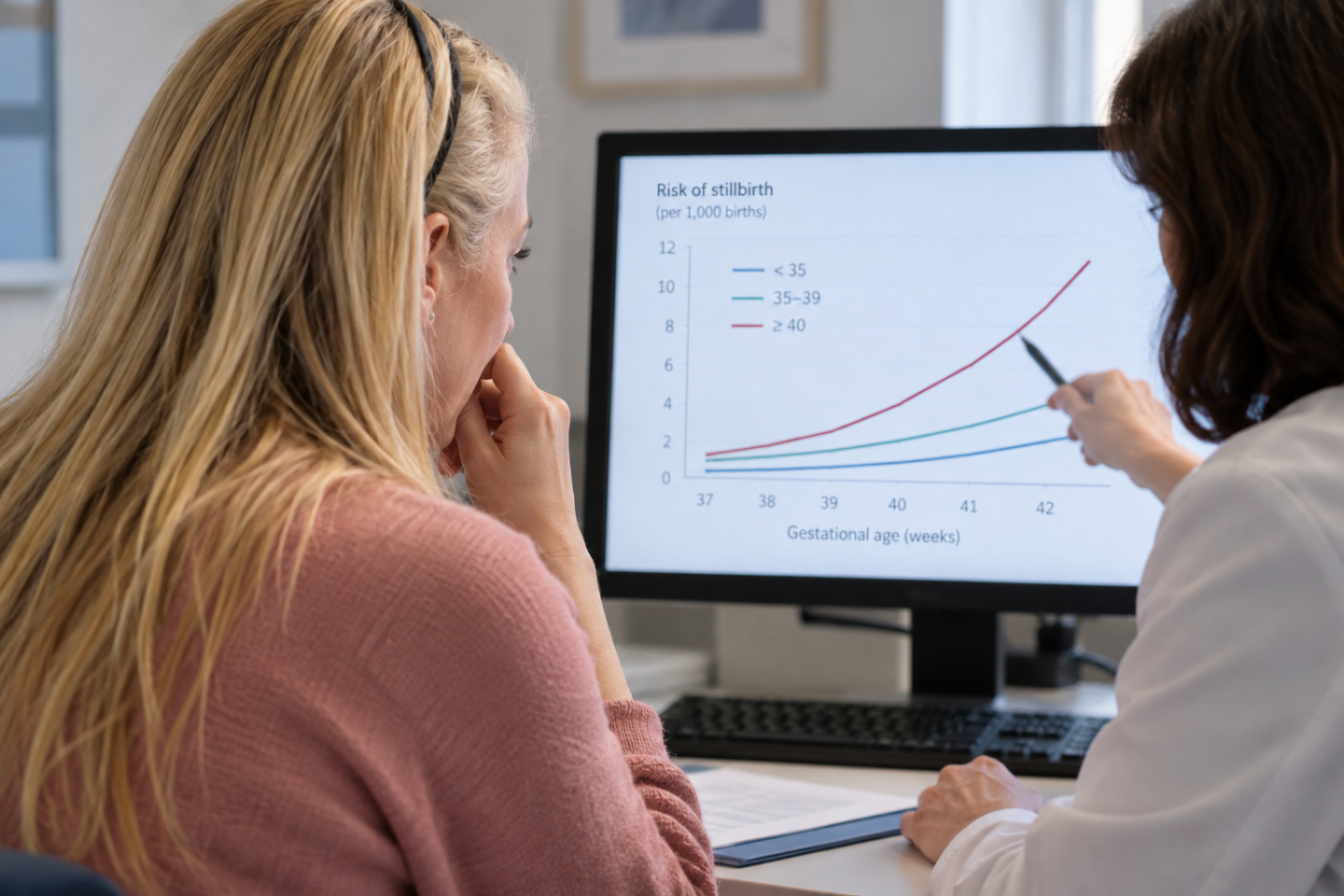
Then the consultant showed me a graph.
The statistics mattered. What I have questioned since is whether I understood what they meant for me.
The graph I still remember
It showed the risk of stillbirth rising towards the end of pregnancy as maternal age increased. I can’t remember every number on it now, but I can remember how it made me feel. Until that point, being an older mother had been something discussed throughout my pregnancy, but suddenly age felt less like one factor among many. I had spent months growing a healthy baby and suddenly now I was looking at a line on a graph and thinking about the possibility of losing him.
The risk wasn’t invented. Maternal age is associated with an increased risk of stillbirth, and RCOG has previously examined whether inducing women aged 40 and over at 39 to 40 weeks could reduce some of the risks associated with continuing pregnancy. Its paper was published in 2013, so I wouldn’t treat its figures as today’s stillbirth rates. But there was a genuine medical reason for my age to be part of the conversation.
I wasn’t being frightened with a risk somebody had invented, but there is a difference between being told about a risk and feeling that you understand what that risk means for you. I left the hospital teary and stunned.
What happened to my birth plan?
I sought a second opinion and remember that conversation as kinder and more reassuring, but I couldn’t unsee the graph. Once I’d been shown a statistical risk involving the possibility of losing my baby, I couldn’t just file it away and carry on as before. Induction was suggested, and this is the point at which my memories of what I wanted and what I feared become tangled together.
I wanted Cyrus to arrive safely and I also wanted the birth I had imagined. Faced with a graph about stillbirth, it became increasingly difficult to separate the medical decision I was making from my fear of making the wrong one.
Current NICE guidance on induction puts considerable emphasis on information and shared decision-making. Women should be told why induction is being offered, its risks and benefits and the alternatives if they choose not to proceed. They should also have the opportunity to ask questions and time to think about their options.
I find that important when I look back at my own experience. The question isn’t whether induction was medically reasonable. It is whether I felt I had enough space, information and perspective to understand the decision I was making.
Then childbirth took over
Once the induction began, my carefully imagined birth became considerably less relevant. Much of the labour has blurred over the decade since. I remember the induction, the contractions and eventually the epidural, but I don’t remember every conversation or every decision in sequence. What hasn’t blurred is the end. In the final ten minutes, everything seemed to accelerate.
Cyrus was delivered with forceps. The low-intervention vaginal birth I had pictured became an assisted birth, and the stitches I had hoped to avoid became part of my recovery.
For a long time afterwards, it was tempting to draw a straight line through the whole experience: I was 40, so my age affected how risk was discussed; I was offered induction; I had an epidural; and I ended up with a forceps delivery. The problem is that childbirth doesn’t allow me to make that conclusion quite so neatly.
I can’t say the induction caused the forceps birth
That is probably the biggest thing I understand differently now. I know the sequence of events because I lived it. I don’t know what would have happened in the alternative version of my pregnancy where I declined induction and waited for labour to begin naturally.
I would have had precisely the birth I imagined, but would I still have needed forceps? Maybe something different would have happened. Evidence reviewed by RCOG did not support the assumption that induction at term in older mothers increases operative delivery, but population-level evidence can’t tell me what would have happened during my individual birth.
The part that bothers me isn’t the statistic
For years I thought what troubled me was being treated differently because I was 40. I’m no longer sure that’s right. There were legitimate reasons for my age to be part of things. Pretending otherwise would make this a much shorter story. If being 40 increased a risk to Cyrus, I needed to know about it.
What I needed alongside the graph was context. How large was my individual risk and what were the benefits of induction? What were the disadvantages? What would happen if I waited? What monitoring might be available? How much of the recommendation was based on my pregnancy and how much on my date of birth?
Some of those conversations happened and fear drowned parts of them out. Memory after a decade is imperfect, and I don’t want to reconstruct certainty I don’t have. What I do remember is that graph.
I don’t regret the decision I made
This isn’t a story about wishing I’d ignored medical advice. Cyrus arrived safely, and I will never know what would have happened if I’d made a different decision. But I also think there is room to say that a safe outcome doesn’t erase everything a woman felt on the way towards it.
Relief and gratitude can coexist with questions, and you can be thankful for medical intervention and still wonder whether you understood your choices. You can know that statistics matter and still dislike the feeling of becoming one. That’s the part of becoming an older mother that I understand better now. Age shouldn’t be ignored, but neither should the woman attached to it.
The graph contained information about risk. It couldn’t tell anybody what giving birth would feel like for me.
Occasional stories, experiments, discoveries and questions from Saffron & Cyrus.
Discover more from Saffron & Cyrus
Subscribe to get the latest posts sent to your email.

Saffron & Cyrus is an independent women’s editorial publication with a recognisable voice, real-life perspective, a defined midlife audience and a commercial model built around useful, relevant partnerships.
