
When you lose your mum in midlife, you lose your map too.
What happens when you lose your mum, then reach the stages of life when you need her in entirely new ways? I lost mine just as I was becoming a mother. Nearly a decade later, motherhood, perimenopause and the ordinary business of growing older keep giving me new questions I still want to ask her.
What happens when you lose your mum, then keep needing her?
I used to think losing someone happened once.
There was the phone call. The funeral. The paperwork and then the awful practical business of sorting through a life that had suddenly ended. What I didn’t understand was that I would lose Mum again at different stages of my own life.
Good news, bad days, random thoughts. The sort of question that doesn’t warrant a Google search because you already know exactly who you’re going to ask. Mam was my first dial and she had been for as long as I could remember.
There were bedtime stories that stretched well beyond bedtime, surprise holidays on birthdays and the day I smashed my two front teeth after bumping into a boy in the playground. Later came teenage heartbreaks and all the small dramas that feel enormous when you’re young. Whatever the crisis, the solution was usually Mam.
That doesn’t mean ours was one of those conveniently uncomplicated mother-daughter relationships that grief can sometimes persuade us existed. It wasn’t. We were close, but my teenage years left their marks. She didn’t always agree with the path I chose, and I didn’t always appreciate her opinions about it. We could frustrate each other. But when something happened, she was still the person I wanted to tell. I didn’t know it then, but that was my map.
I thought she’d simply be there
I never had an elaborate vision of Mam as a grandmother. I didn’t have a list of school plays I expected her to attend or imagine her providing childcare every Tuesday. I wasn’t mentally drawing up a grandmother job description for Cyrus. I just assumed she’d be there.
I thought she would watch him grow and I wanted her to love him. And, selfishly perhaps, I wanted her there for me. Not to take over or to tell me what to do. I just wanted the listening ear I’d had all my life.
When I became a mother at 40, there was suddenly an entirely new collection of things I wanted to talk to her about. I assumed we’d have years to do it. We didn’t.
She met my little boy, but she never really got the chance to know him.
The fall that changed everything
Mam was 63 when she fell down the stairs and broke her femur.
At first, I didn’t understand that phone call as the beginning of anything. She had broken a bone. There would be hospital appointments, surgery and rehabilitation. Then, I assumed, recovery. Except Mam never really recovered. Her health deteriorated over the next two years.
Dad increasingly became her carer, helping her between the bed and sofa as the woman I’d always regarded as formidable became increasingly frail. Somewhere in the middle of all that, I became a mother myself. Cyrus arrived when I was 40, and Mam did get to meet him. For that I will always be grateful, but she died roughly a year later.
She didn’t get to discover his personality or get to watch the baby become the boy. And Cyrus was too young to build memories of her. I hadn’t expected anything extraordinary from their relationship, I just wanted her to love him and I wanted him to know her.
Sometimes answers leave you with more questions
By the end, Mum was barely recognisable as the woman I’d known. Her skin had yellowed. Her clothes hung from a body that seemed to be disappearing inside them. Her GP, a woman Mam had known for many years, told me that Mam didn’t want me to know the full details of what was happening. I respected that and I assumed, wrongly, that she had cancer.
Then came the call at 4 a.m. After she died came another piece of information I hadn’t been prepared for. I learned about haemochromatosis from the coroner. Until then, I hadn’t understood that this was part of Mam’s medical story and neither had she. You might imagine finally knowing would provide some sort of explanation, but it didn’t. Instead, it gave me more questions.
Why hadn’t it been identified earlier? Could it have been treated? Would anything have been different? I still don’t have answers, and I’m wary of inventing them because uncertainty is uncomfortable. But finding out after she died was tough. Grief already leaves enough empty spaces and medical uncertainty added a few more.
What is haemochromatosis?
Haemochromatosis is an inherited condition in which the body can gradually build up too much iron. Over time, excess iron can damage organs. Symptoms can be non-specific and may include fatigue, weakness and joint pain.
This is general context only. It cannot explain exactly what happened in Mam’s case or answer the questions I was left with about her care.
Then I opened her purse
There is an administrative side to death that rarely makes it into sentimental quotations about grief.
There was a funeral to arrange. Paperwork. Belongings. A house containing an entire life that suddenly had to be handled by the people left behind. While other new mums were navigating sleepless nights and first milestones, I was trying to work out what stayed, what went and how on earth you reduce somebody you love to decisions about possessions.
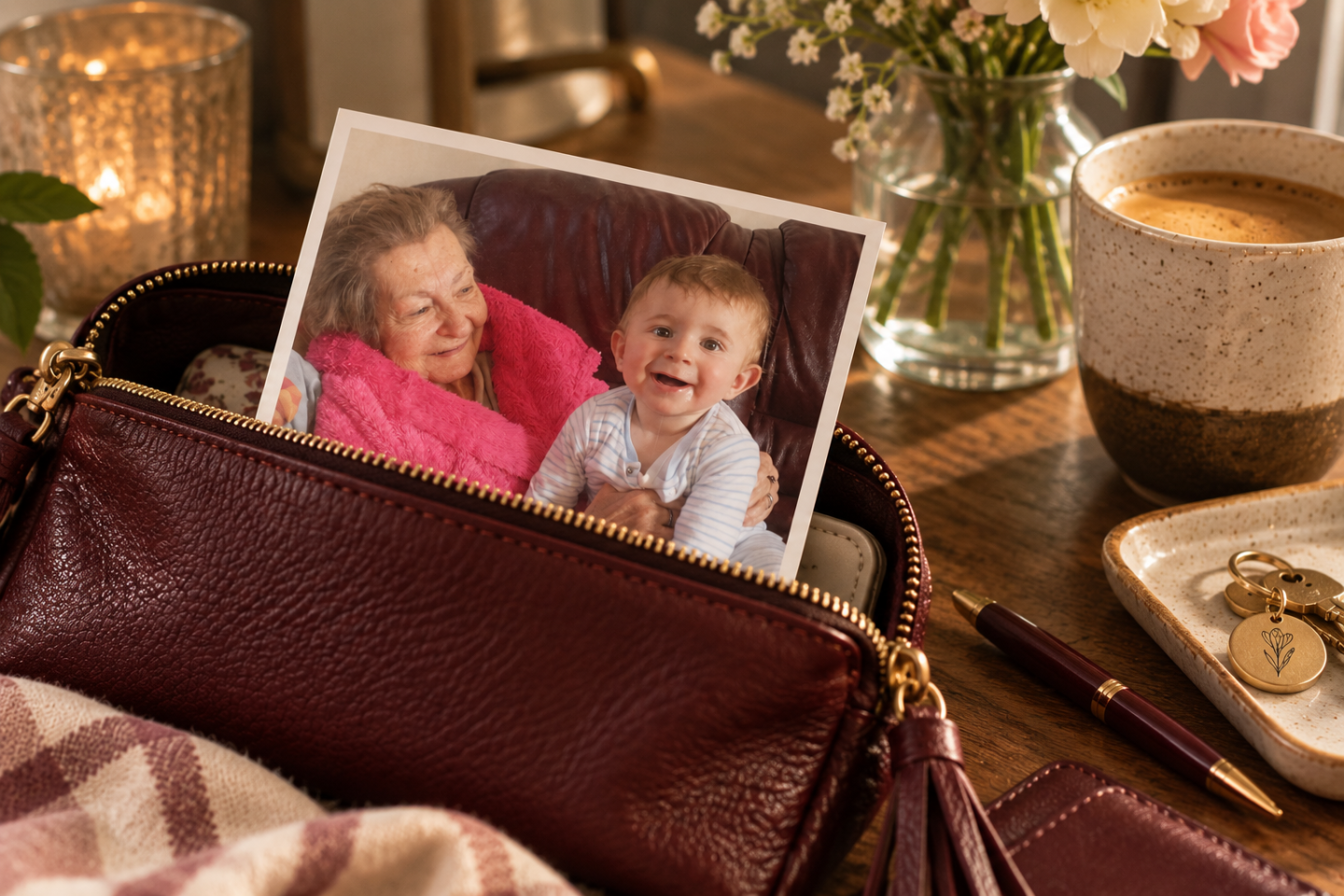
Then I opened Mam’s purse. Inside was a photograph of me as a little girl. That stopped me. I was a grown woman. I had jobs and relationships behind me and I had become somebody’s mother myself.
Yet this was the version of me Mam had chosen to carry around with her. The little girl. That’s one of the strange things about losing your mother. To everyone else, you grow up and you become increasingly competent at performing adulthood. You work, pay bills, have children and develop strong opinions about things.
But somewhere, to your mother, you are also still the child in the photograph. And now I had Cyrus, barely a year old, while the person who remembered me at that age was gone.
“To everyone else, you grow up. To your mam, some part of you remains the little girl in the photograph.”
I’m the mam now. I still want mine.
This is the bit about grief I didn’t understand when Mam died.
It doesn’t stay the same age.
It grows up with you.
There are the obvious anniversaries, birthdays and Mother’s Days. But there are also new losses that appear years later because you’ve reached another part of life and suddenly need something from the person who isn’t there.
At 50, perimenopause has become one of mine. There are questions about my own body that I would have taken straight to Mam.
Did this happen to you?
When did it start?
Were your periods like this?
Did you feel like this?
What was menopause like for you?
I can’t ask her. I can talk to doctors and I can read research. I can look up symptoms and try to understand what is happening physiologically. But none of it can tell me what happened to my mam.
And when you’re trying to understand your own changing body in midlife, family history stops feeling like an abstract box on a medical form. It suddenly becomes a conversation you desperately wish you’d had. That’s when I understand what losing my map really means. It isn’t that Mum would necessarily have known the answer. She probably wouldn’t.
It’s that I no longer have the person I would have asked first.
Grief has changed the way I want to age
Losing Mam relatively young has changed the way I think about my own health. It has made me want more ageing, not less. I can’t guarantee how long I get with Cyrus. None of us can.
But I know what it feels like to lose a mother before you’re ready. And I know what it feels like to look at your own child and realise your mam didn’t get enough time to know him.
So looking after my health now has a different purpose. The gym. Strength training. Moving my body. Paying attention when something doesn’t feel right. Trying to understand what’s happening to me in perimenopause rather than simply putting up with it. None of it is really about refusing to get older.
I want the privilege of ageing.
I want the wrinkles and birthdays and mildly alarming conversations about whatever Cyrus is doing when he’s 25. I want to embarrass him and I want to disagree with some of his choices, just as Mam disagreed with some of mine.
I want him to think I’m hopelessly out of touch occasionally. It seems only fair. Mostly, though, I just want to be there. I want to watch him grow.
So, do you ever find your map again?
I think you do. Just not in the way I once expected. Mam still turns up in small ways. There are books I read to Cyrus because she once read them to me. I have her ring. There is coffee, of course.
And there are words. Mam loved them too, which may be why writing about her feels less like putting her into the past and more like allowing her into the present for a while. Cyrus gets to know pieces of the grandmother he was too young to remember through me.
And I increasingly recognise that motherhood is another way of carrying things forward quietly.
I didn’t lose the whole map after all
When I cleared Mam’s things after she died, I found that photograph of myself as a little girl tucked inside her purse. I think about it differently now.
Cyrus will grow up. He’ll become more independent. He’ll make choices I don’t understand and probably some I don’t agree with. There may be times when he thinks I know absolutely nothing. I rather hope there are because that’s part of growing up.
But I hope I get to be there for it.
Mam met Cyrus, but she died before she really knew the little boy who changed my life. I can’t alter that ending. What I can do is look after myself as well as I reasonably can and hope for something she didn’t get enough of.
Time.
So, what happens when you lose your mam and then reach the stages of life when you need her in entirely new ways?
You learn that grief doesn’t finish. It changes with you. You find new questions you wish you could ask. And eventually, you realise the person who gave you the map also taught you enough to start drawing the next bit yourself.
Some of mine was tucked inside Mam’s purse and some of it is in the stories I tell Cyrus. And some of it, I realise now, is in me.
Have you lost a parent and found yourself needing them differently as you’ve grown older? What is the question you wish you could still ask them?
4 responses to “When you lose your mum in midlife, you lose your map too”
-
Rachel
Bug hugs and my thoughts are with you. I can completely understand why Mother’s Day would be tough xx
-
Mother’s Day can certainly be tough when yours is no longer with us. My thoughts are with you!
-
I am so sorry you lost your Mum so young and totally understand why Mother’s Day is hard for you.
-
You are right it is one of those things we all just hope for that our parents get to old age. I have many friends who have lost a parent on their teens and 30s. I feel very blessed to have both still with me.


This site uses Akismet to reduce spam. Learn how your comment data is processed.
Discover more from Saffron & Cyrus
Subscribe to get the latest posts sent to your email.

Saffron & Cyrus is an independent women’s editorial publication with a recognisable voice, real-life perspective, a defined midlife audience and a commercial model built around useful, relevant partnerships.

Leave a Reply