
Life has an irritating habit of ignoring the plans we make for it. By the end of 2015, I knew that better than I wanted to. I had experienced miscarriage and, although I was pregnant again, pregnancy after loss did not feel like a clean page. Every hopeful thought seemed to arrive with a nervous little footnote attached.
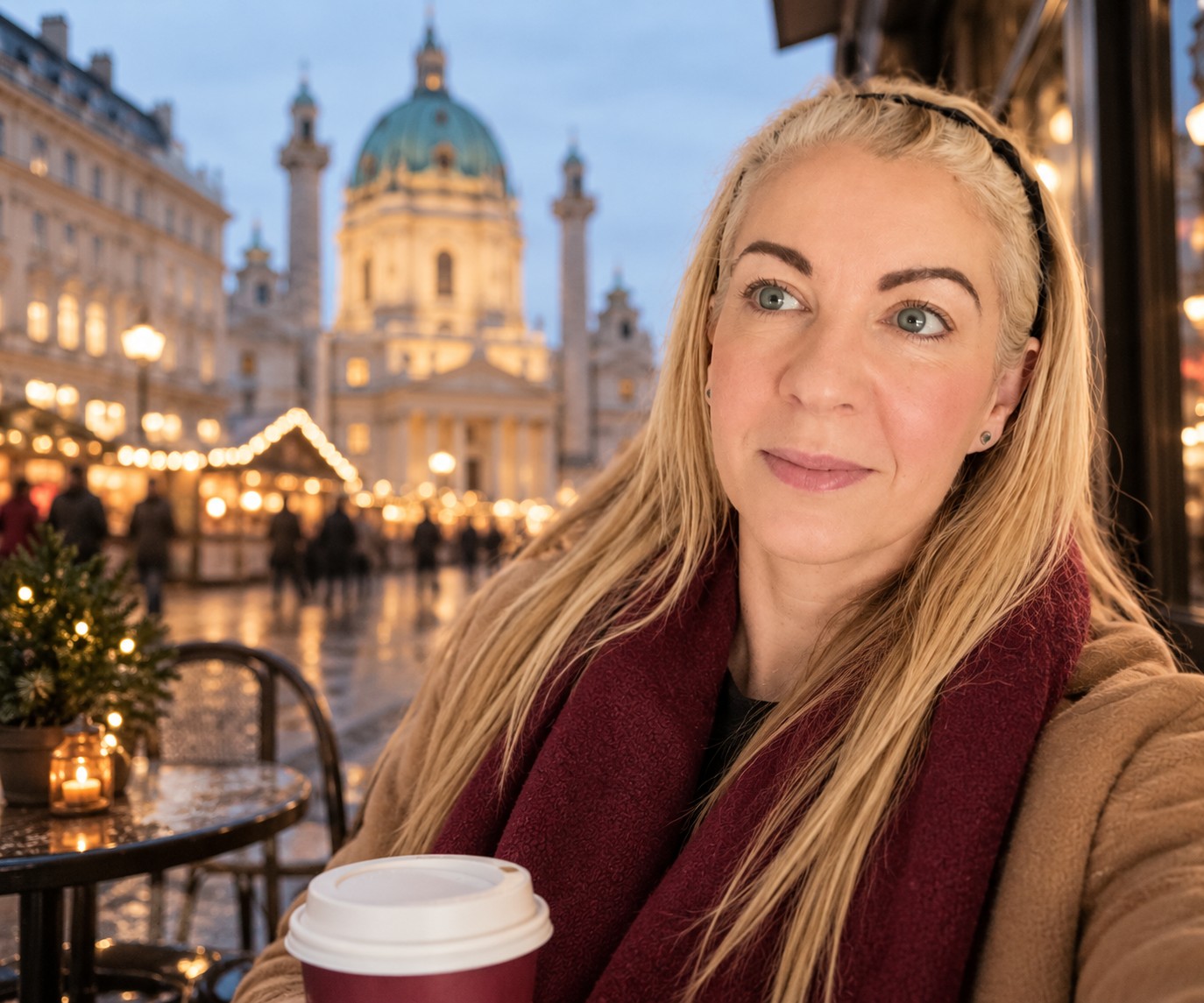
As 2016 approached, I was 39, around 12 weeks pregnant and caught somewhere between excitement and dread. H and I booked a last-minute trip to Vienna over Christmas and New Year. From the outside, it probably looked wonderfully indulgent: Christmas markets, grand buildings, hotel breakfasts and two people disappearing to Vienna because Newcastle in December wasn’t festive enough.
The photographs could not show what was happening in my head. We weren’t escaping ordinary life so much as finding somewhere beautiful to wait while we wondered what our ordinary life was about to become.
After miscarriage, I wanted to believe this pregnancy would be different. The difficult part was accepting that hope could not give me any guarantees.
Earlier in the pregnancy, at around six weeks and while we were in Iran, I’d had a scan and been told there appeared to be nothing there. I came back to the UK carrying that sentence with me, only to discover that the pregnancy was continuing after all.
It should have been uncomplicated good news. It wasn’t. After miscarriage, I had already learnt how quickly excitement could become fear. I did not need Google to supply me with worst-case scenarios. My brain was perfectly capable of producing those without assistance.
So Vienna became less a holiday from reality and more a temporary holding place. We could walk, eat, look at Christmas lights and behave like two people enjoying a festive break while the question followed me around: would this pregnancy continue?
We always see somebody else’s smiling holiday picture and instinctively write the missing story ourselves. A couple on holiday are carefree. A pregnant woman is excited. A smiling woman beside a Christmas tree must surely be happy. I was all of those things in flashes, but I was also frightened and trying desperately not to become too attached to an outcome I couldn’t control.
I used to think being positive meant believing everything would be all right. I don’t anymore. There are times when telling somebody to “stay positive” is just not the right course of action. Fear does not disappear because somebody has found the right quotation on the internet.
What helped me was less photogenic. I took long baths and I tried to interrupt the thoughts that carried me too far into what might happen next. I repeated phrases to myself, including “inhale confidence, exhale fear” and “the past holds no power over me”.
At the time, they gave my mind somewhere else to go. I wasn’t using positivity to deny what had happened to me. I was trying to stop what had happened before from deciding, in my head at least, what would happen next. That is something I understand much better now.
By the time the scan arrived, all the fear I had been carefully carrying around Vienna came with me into the waiting room. Waiting rooms are not great places to be when you’re frightened. Everything around you is terribly ordinary, chairs, doors, magazines, other people looking at their phones, while inside your own body everything feels deafening.
Then there was Cyrus on the screen, moving, real and very much there. The relief felt physical. I cried because, after miscarriage, uncertainty and weeks of trying not to imagine too much of the future, I could finally see my baby moving in front of me.
It didn’t erase what had happened before, nor did one reassuring scan suddenly turn me into a serene pregnant woman floating through the next six months. But for that moment, I allowed myself to believe what was in front of me rather than what I feared might happen.
That is what hope actually was for me. It was not certainty that everything would be fine, but I gave myself permission to believe that it might be.
Looking back, I can reel off what happened during 2016 and make it sound like a victory lap. I celebrated New Year in Vienna reassured by that 12-week scan. I was promoted to PR Account Manager. H and I renovated and sold our old home, bought the house that would become our family home, and I began exercising again, met new people and started this blog. H achieved Chartered status as a mechanical engineer.
Most importantly, I gave birth to Cyrus, weighing 8 lb 4 oz, and became a mother at 40. After everything that had occupied my mind at the beginning of that year, there he was, an actual baby rather than a possibility I had been frightened to believe in.
Written as a list, 2016 looks remarkably neat. Life wasn’t. Healing continued alongside the good things because becoming pregnant again did not undo miscarriage, and giving birth safely did not retrospectively make the fear unnecessary.
My grandma had a phrase for difficult times: someone is always worse off. She said it with the sort of matter-of-fact certainty that didn’t leave much room for an argument.
For years, I thought I was supposed to find it comforting. These days, I think there is something useful buried inside it, although I would phrase it differently. Perspective matters, but suffering is not a league table. Somebody else’s pain does not make mine go away, just as mine does not make theirs any less painful.
What perspective can do is remind me that the difficult thing immediately in front of me is not the whole of my life. I couldn’t know that during those anxious weeks at the end of 2015. I could only live through them.
At 50, I am much more suspicious of the idea that we can think ourselves into feeling better. Midlife has cured me of that. Bodies change, families struggle, people become ill, relationships shift and sometimes the thing we desperately want is completely beyond our control. A positive attitude can’t negotiate with biology or guarantee a happy ending.
What I do believe is that we can protect ourselves while we move through difficult periods. For me, that has meant exercise, prayer, writing, a bath, a cup of coffee drunk while it is still vaguely hot, or looking at an old photograph and remembering what was really happening outside the frame.
Those things aren’t cures, and I don’t want to dress them up as such. They are ways I have learnt to steady myself when life feels uncertain. That is a rather less glamorous version of wellbeing than the one we’re often sold, but it is far more recognisable to me.
When I look at those Vienna photographs now, I don’t see a woman who successfully “thought positive”. I see a frightened 39-year-old woman who desperately wanted to become a mother and had no idea what was coming next. She walked around Vienna, prayed in the bath, worried about her baby, hoped for the best and eventually sat in a scan room watching him move.
That answers the question I couldn’t answer then. I could leave a little room for hope.
More stories about motherhood after 40
Explore women’s health, midlife and wellbeing
Occasional stories, experiments, discoveries and questions from Saffron & Cyrus.
“`
Discover more from Saffron & Cyrus
Subscribe to get the latest posts sent to your email.

Saffron & Cyrus is an independent women’s editorial publication with a recognisable voice, real-life perspective, a defined midlife audience and a commercial model built around useful, relevant partnerships.
