

Disclaimer: This article is shared for information and reflection. It is not sponsored or paid-for content. I have no commercial relationship with Mush. It draws on my own experience and historical information supplied by Mush, including research commissioned by the company.
Motherhood can be lonely. I don’t mean the sort of loneliness that suggests you are unhappy with your baby or regretting your new life. I mean the more ordinary experience of spending most of your day with another human being while missing adult company terribly.
I had Cyrus at 40, when many women I knew had moved well beyond night feeds and baby groups. Some had older children and completely different routines. I was learning about weaning and discovering that leaving the house with a baby needed far more equipment.
Before Cyrus, I worked, chatted to colleagues and had the sort of conversations you barely notice until they disappear. Then suddenly much of my day revolved around feeds, sleeps and walks. I adored being his mum, but I missed talking to adults. That is the problem Mush set out to address.
Having a baby may introduce you to a whole new world, but it does not automatically provide you with the people with whom to share it.
Mush was founded by Katie Massie-Taylor and Sarah Hesz, two mothers who met when their children were young. The company describes those early days as long, lonely and isolating until the women happened to meet in a playground.
They became friends and, after supporting each other through the months that followed, began to wonder why there wasn’t an easier way for mothers to find other mums nearby. Mush launched in spring 2016 as a free app connecting mothers locally, particularly those with children of similar ages.
It is an appealing story because there is nothing particularly extraordinary about the problem they were trying to solve. They were two mothers who needed company and happened to find each other. Plenty of women never have that lucky playground encounter.
Being 40 made that more noticeable for me. I wasn’t surrounded by existing friends having babies at the same time, so I had to make new connections. That sounds straightforward until you actually walk into a baby group where everyone appears to know somebody except you.
I remember sitting with a lukewarm coffee, hoping someone would make conversation while simultaneously feeling far too awkward to start one myself. Adult friendship can be difficult at the best of times. Throw in sleep deprivation, an unpredictable baby and the feeling that everyone else has already exchanged phone numbers, and it becomes harder still.
As part of its early work, Mush commissioned a survey of 4,000 mothers. The figures are now historical and should be read as such, rather than as current UK statistics, but they give an interesting picture of the problem the company was trying to address.
Half of the mothers surveyed said they found it difficult to make local mum friends, while 60% said they sometimes went an entire day without adult interaction. Some 22% reported having only one local mum friend, and 62% had four or fewer.
Perhaps the figure I related to most was that half said they went to the shops primarily for adult interaction. I get it. There were days when a trip to the supermarket offered the prospect of an actual conversation, even if that conversation amounted to little more than whether I wanted a receipt. When your normal adult contact has disappeared almost overnight, those tiny exchanges suddenly matter.
The same research found that 80% of mothers surveyed preferred going to a playgroup with a friend, while half said they found it difficult to make plans with children.
That feels important because the standard advice to a lonely new mum is often to join a group. It isn’t bad advice, but it overlooks the uncomfortable part: you have to walk through the door on your own.
Mush’s research also asked women about the friendships they did have. Some 82% of those in the larger survey said having mum friends made them a happier, more positive mum. A separate Mush-commissioned survey of 1,000 mothers found 80% regarded mum friends as either extremely or quite important.
That smaller survey also suggested women were discussing parts of motherhood with their friends that they did not necessarily discuss as much with their partners. Some 43% said they talked to mum friends more than their partner about the realities of having a baby, while 75% said their mum friends better understood those realities. The survey also found 43% felt pressure to be the perfect mum, while 38% wished they had a local group of mum friends.
None of that means a mum friend has to become your closest friend, or that only another mother can understand you. But shared experience can remove some of the explaining. Sometimes you want to talk to somebody who understands why you’ve arrived 20 minutes late with one sock in your handbag and no idea where the other one went.
I have always liked the name Mush, not least because it reminds me of “mush mush-am”, the odd little Geordie-Farsi nickname I use for Cyrus.
The founders’ explanation is equally rooted in early motherhood. According to the company, they had been mushing up food while weaning their babies and had also described their sleep-deprived brains as “mush”. They then realised the word could stand for Mums Social Hub.
Anyone who has attempted to remember why they walked into the kitchen after several broken nights of sleep will probably understand the brain-mush part.
My own friendships came gradually. I met people through my local community centre in Great Park, Newcastle, and through activities such as KeepFitMammy. There wasn’t a single moment when I suddenly acquired a circle of mum friends. I just started recognising people, talking to them and seeing them again.
The hardest part was often turning up in the first place. Walking alone into a room full of parents can be intimidating, particularly when you assume everyone else already knows one another.
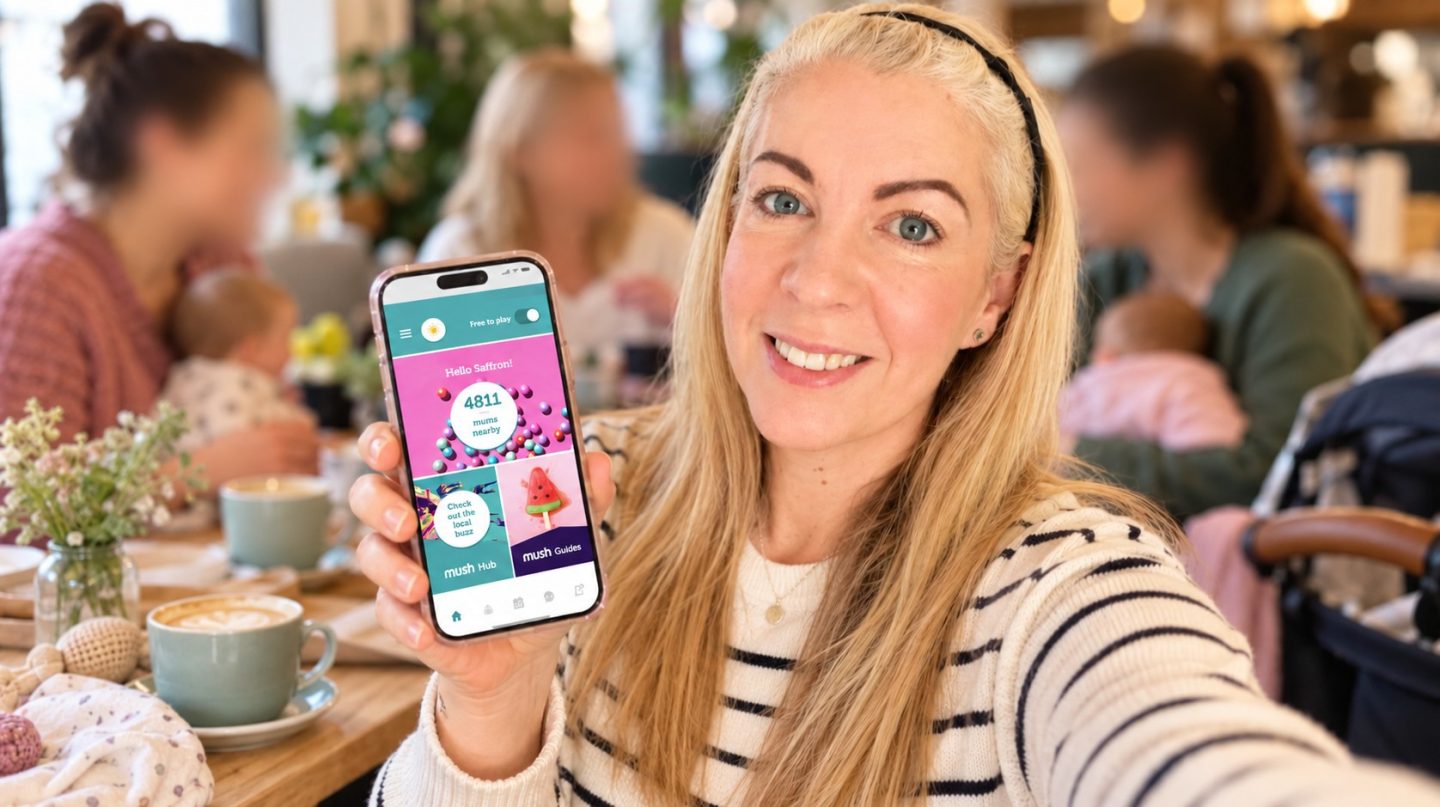
This is where I can see the usefulness of an app such as Mush. It can’t make two people like each other, but it can remove one uncertainty: the other person is there because she is also interested in meeting people. That makes saying hello easier.
I eventually signed up to Mush myself and found 18 mums nearby. I wasn’t expecting that many.
So I sent a hello. Making friends usually starts with a conversation and you find out later whether it develops into anything more.
Mush’s own early figures tell a similar story. As of 15 April 2017, the company reported having 85,000 mothers registered and 250,000 successful connections. Mush defined a successful connection as two mothers messaging and connecting with one another. It also acknowledged that some users never made a connection, while those who did tended to connect with an average of five mothers.
I actually like that qualification. It is far more realistic than suggesting downloading an app will suddenly deliver a new circle of best friends.
The phrase “find your tribe” appears everywhere in motherhood, and I am not entirely convinced by it. It suggests there is a ready-made group of perfectly compatible women waiting somewhere for us to discover them.
My experience has been much less organised. Some women become good friends. others are people you enjoy talking to at a class or over coffee. Some friendships belong to a particular stage of your children’s lives and then fade. That doesn’t make them failures.
The original Mush material describes the founders’ ambition as making sure no mum has to do motherhood alone. That strikes me as a more useful idea than promising every woman a “tribe”.
Motherhood can be lonely without being miserable. You can love your child and still miss the person you were before your days revolved around somebody else’s feeding and sleeping schedule. You can also have a partner, family and friends and still want to know another woman who happens to be going through the same thing at the same time.
Mush cannot manufacture that friendship. No app can. What it can do is make the introduction. For the mum sitting at home wondering whether there is anyone nearby who also fancies a coffee and an adult conversation, that may be enough to get things started.
Did you find motherhood lonelier than you expected? Did you make friends through an app, baby group, exercise class, community centre or simply by saying hello to another parent? And are we putting too much pressure on women to find a ready-made “mum tribe” when real friendship is usually much messier than that?
Occasional stories, experiments, discoveries and questions from Saffron & Cyrus.
Discover more from Saffron & Cyrus
Subscribe to get the latest posts sent to your email.


Saffron & Cyrus is an independent women’s editorial publication with a recognisable voice, real-life perspective, a defined midlife audience and a commercial model built around useful, relevant partnerships.
