
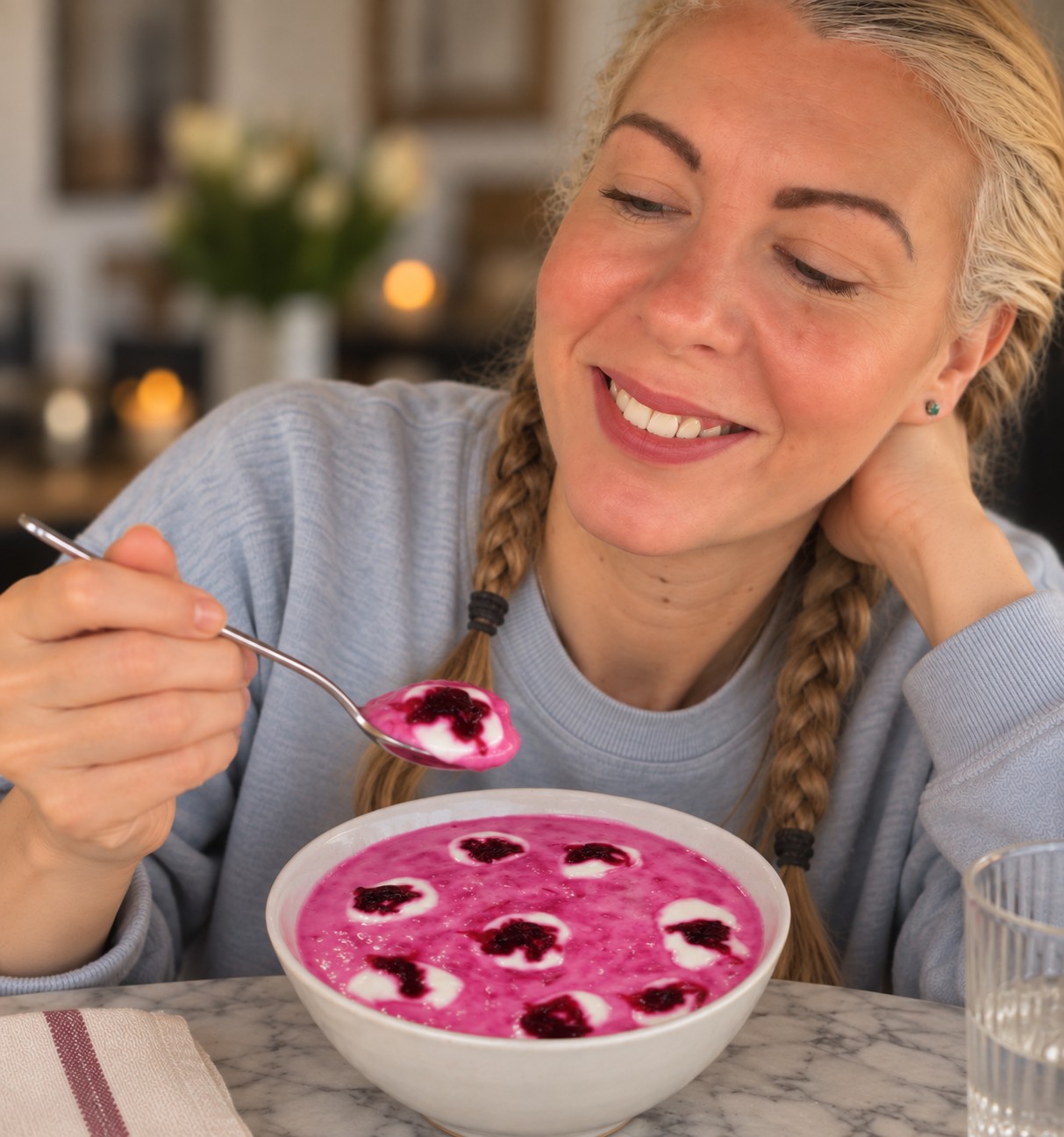
Mast-o-Laboo: How a Persian auntie changed my British opinion of beetroot.
In Britain, I knew beetroot as something that came out of a jar of vinegar. In Iran, at 12 weeks’ pregnant with Cyrus and suffering from morning sickness, I discovered a more appealing version. Unfortunately, this happened while sitting in front of a Persian auntie who had cooked enough food to feed half of Tehran.
When a Persian auntie has cooked and you can’t eat
It’s a bit unfortunate being a British woman with severe morning sickness in a Persian household. The British instinct is to politely decline food, apologise and just insist you’re absolutely fine. In H’s family, the response is usually to bring out another plate.
I was 12 weeks’ pregnant with Cyrus when we visited H’s khalleh, his auntie, in Iran. She had spent hours preparing lunch, and the tablecloth was covered with fragrant stews, rice and dishes that had taken a lot of effort. Under normal circumstances, I would have been delighted, but unfortunately, my stomach had other ideas.
Pregnancy cravings are odd. Some women want chocolate or pickled onions, but I developed a fondness for laboo, the warm, cooked beetroot sold by street vendors in Tehran during the colder months. Baghali, or broad beans, was another favourite. Neither would have been an obvious choice back in Newcastle upon Tyne, where beetroot usually meant something pickled and sitting beside a slice of ham on my plate.
H’s khalleh couldn’t understand why I wasn’t eating. To be fair, she’d spent hours cooking, and I was sitting there looking a bit green. In Persian families, feeding people is a serious business, so saying you’re not hungry rarely settles things.
Eat, eat, darling.
I smiled, thanked her and tried to explain that I felt sick. She encouraged me to try something else. It felt like a war of words. The British woman apologising for being difficult and the Persian auntie convinced that another mouthful might sort things out.
In Britain, we’d probably have settled the matter with a cup of tea and a sympathetic “Oh, you poor thing.” In H’s family, there was another serving spoon heading in my direction.
Then I noticed a bowl containing something cool, creamy and extraordinarily pink. Mast-o-Laboo. Yoghurt and beetroot. It looked like something Barbie might serve alongside a kebab. And, unlike most of the banquet, I could eat it.
Why Mast-o-Laboo stayed with me
Looking back, what I remember most is the relief of finding something I could eat without feeling sick. I’d been looking forward to visiting Iran, seeing family and enjoying the food, yet pregnancy had made even the smell of certain dishes difficult to tolerate.
There was also the awkwardness of being a guest. In H’s family, offering food is a way of showing affection, and I was beginning to understand that turning it down could be rather more complicated than I’d expected.
That afternoon taught me something about Persian hospitality. You might arrive insisting you’re not hungry, but there’s every chance you’ll leave having eaten three courses and carrying a container of leftovers.
What is Mast-o-Laboo?
Mast means yoghurt in Persian, while laboo means beetroot. Mast-o-Laboo is a traditional Persian dish made by combining cooked beetroot with yoghurt. It’s generally served as an accompaniment to a meal, often alongside rice, bread or other dishes.
Recipes vary between households. Some include walnuts, herbs or additional seasonings, while others are much simpler. The version I remember from H’s auntie’s table contained cooked beetroot, plain yoghurt and a little salt.
It’s quite a contrast to the beetroot I grew up eating in Britain. Ours generally came pickled, and served with salad. The Persians serve beetroot warm from street stalls or mix it with yoghurt until the whole thing turns a startling shade of pink.
Is Mast-o-Laboo good for you?
Beetroot is a source of fibre and folate, while plain yoghurt provides calcium and protein. Together, they make a simple addition to a meal, especially if you’re looking for something light and refreshing.
During pregnancy, I was more concerned with finding food I could tolerate than analysing its nutritional content. Nevertheless, eating a varied diet is important, and the NHS Eatwell guidance offers useful advice about balanced meals.
Of course, no single dish can provide everything you need during pregnancy. But I was grateful to discover something that tasted good and didn’t immediately send me running for the bathroom.
My simple Mast-o-Laboo recipe
This is my version of the dish I first tried in Iran. It’s straightforward to prepare, requires very few ingredients and makes a colourful accompaniment to a Persian meal. You can adjust the amount of beetroot depending on how strong you like the flavour.
Serves: 4
Preparation: Approximately 15 minutes
Cooking: Approximately 45–60 minutes
Additional time: Cooling and at least 30 minutes chilling
Ingredients
- 2 medium beetroot (approximately 400g)
- 500g ordinary plain yoghurt
- A pinch of salt
- Water for cooking
- 1 tablespoon sugar (optional)
How to make Mast-o-Laboo
01 / Cook the beetroot
Wash the beetroot and place them in a saucepan with enough water to cover. Simmer for approximately 45–60 minutes, depending on their size, until a knife passes through easily. There’s no need to peel them beforehand.
02 / Add sugar if preferred
For a slightly sweeter flavour, you can add a tablespoon of sugar to the cooking water. This is an optional variation rather than an ingredient I’ve confirmed H’s auntie used.
03 / Cool, peel and grate
Allow the beetroot to cool before removing the skins and grating them. I’d recommend using a chopping board you don’t particularly treasure. Beetroot has an impressive ability to stain anything within reach.
04 / Mix with yoghurt
Stir the grated beetroot into the plain yoghurt and add a pinch of salt. Adjust the quantities to taste, depending on how much beetroot flavour you prefer.
05 / Chill and serve
Refrigerate for at least 30 minutes before serving. Mast-o-Laboo works well alongside Persian rice dishes, kebabs or flatbread. It’s also perfectly acceptable to eat a spoonful straight from the fridge.
A little bit of Persia in our British kitchen
Since marrying H, I’ve discovered that British and Persian food traditions can be quite different. In Britain, we’re often happy with a sandwich for lunch and something simple for dinner. In Persian households, even an ordinary family meal can involve several dishes, plenty of rice and a considerable amount of preparation.
I’m gradually learning to cook more Persian food myself, although I doubt I’ll ever match the quantities produced by H’s relatives. I still find myself wondering how anyone manages to prepare so much food without spending the entire day in the kitchen.
Mast-o-Laboo is one recipe I can manage without too much difficulty. It doesn’t require complicated techniques or a cupboard full of unfamiliar ingredients, and it’s a good way of introducing a little Persian flavour into our meals. It’s also one of the few dishes where I can confidently say the finished result looks rather impressive, even if most of the work involves boiling and grating a vegetable.
Why I’ll always remember that pink yoghurt
Now that Cyrus is here, I find myself looking back on my pregnancy and remembering some of the stranger things I wanted to eat. Warm beetroot and broad beans probably wouldn’t make most British women’s lists of cravings, but they suited me perfectly.
Mast-o-Laboo remains one of my favourite discoveries from that visit to Iran. Whenever I make it, I think of H’s auntie, her enormous lunch and the difficulty of explaining that I really couldn’t manage another mouthful.
I suspect she thought I needed feeding up. I was grateful to find something that stayed down. And I can still hear her encouraging me to eat: “Bokhor, bokhor, azizam.”
More from Saffron & Cyrus
My quick and easy Persian kotlet recipe
How my Persian husband made me love celery with khoresht karafs
Motherhood after 40: Why do the days drag when the years disappear?
Occasional stories, experiments, discoveries and questions from Saffron & Cyrus.
Discover more from Saffron & Cyrus
Subscribe to get the latest posts sent to your email.


Saffron & Cyrus is an independent women’s editorial publication with a recognisable voice, real-life perspective, a defined midlife audience and a commercial model built around useful, relevant partnerships.
