
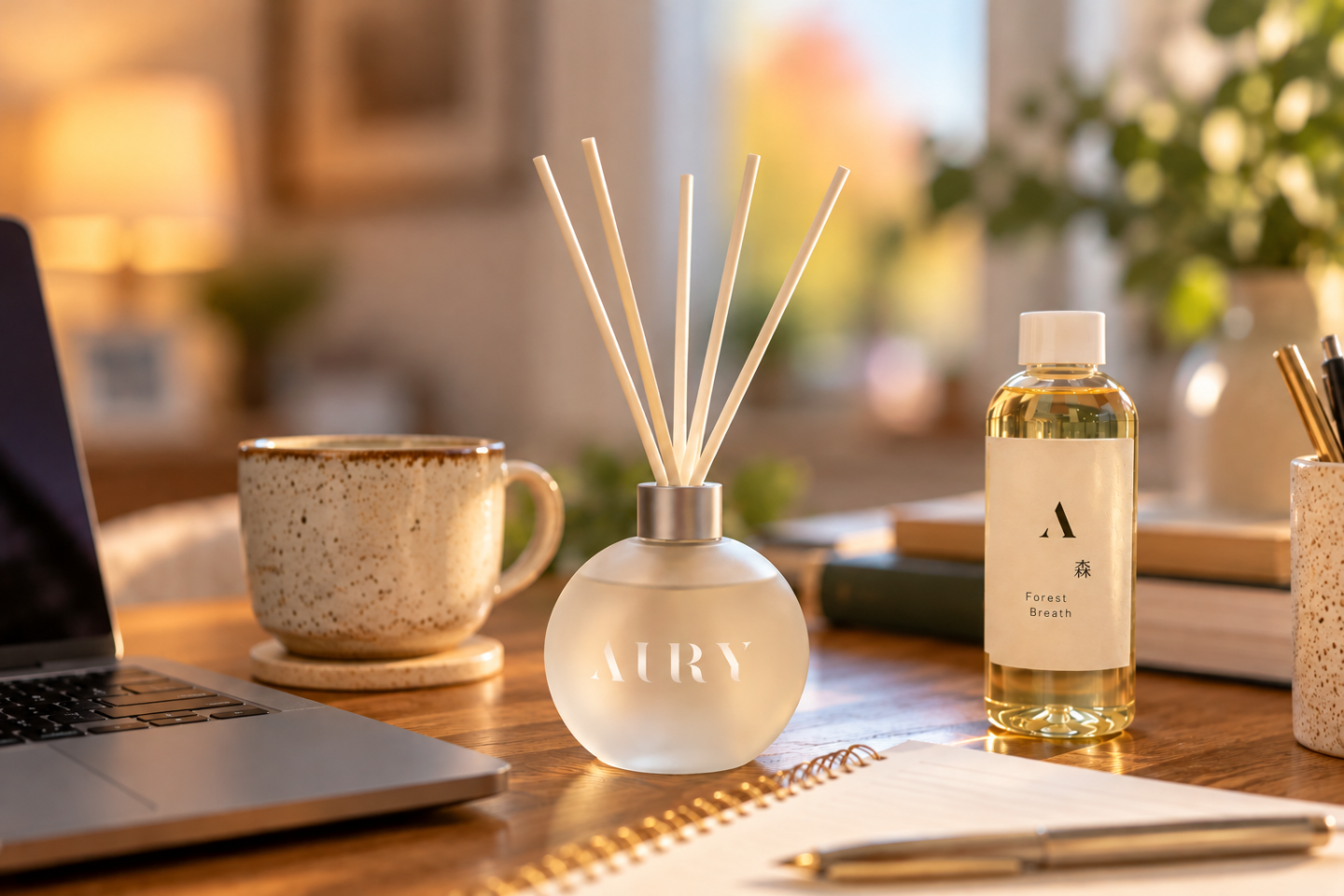
I tried AIRY fragrance for seven days to see if it helped me focus. Here’s what happened.
I’ve tried lists, reminders and the occasional stern talking-to from H when my concentration goes off-piste. This time, I spent a week testing a Japanese reed diffuser to see whether scent could make my study a more focus-friendly place. H and Cyrus joined the experiment, although my son had rather different priorities.

My concentration has a mind of its own
There are days when I sit down to write and everything falls into place. I can spend hours absorbed in a subject, barely noticing the time. Then there are the other days, when a notification, an unfinished household chore or the sudden urge to reorganise a cupboard can send my attention off on a wild goose chase. It’s not that I don’t want to concentrate. Sometimes I want to concentrate so badly that I become distracted by the effort of trying.
I’ve suspected for some time that I may have ADHD. I recognise many of the symptoms, especially forgetfulness, difficulty concentrating, disorganisation and the ability to become completely absorbed in one task while forgetting three others. But I haven’t received a formal diagnosis, and getting assessed is proving to be a long, drawn-out process via the NHS’s Right to Choose Pathway. I’m currently waiting for an assessment, and it’s frustrating knowing that getting some answers may still be months away.
At 50, there’s also the question of perimenopause, which brings its own collection of cognitive complaints. Brain fog, poor concentration and forgetfulness aren’t exactly uncommon at this stage of life. So working out where hormonal changes end and possible ADHD might have begun isn’t straightforward, which is one reason I’m keen to understand what’s happening rather than diagnose myself.
And then there are the everyday incidents that make me wonder. Yesterday, I managed to leave my bank card with the cashier in Tesco. I only realised after I’d walked away and had to double back to retrieve it. Annoying enough on its own, except this is the second time I’ve done the same thing in a matter of months. You’d think the first incident might have taught me to check I’d collected everything before leaving the till, but apparently not.
I can laugh about it, although it’s frustrating when these little lapses keep happening. Forgetting a bank card doesn’t mean someone has ADHD, of course. There are plenty of reasons why our attention has a blip, but incidents like this are part of why I want to understand my own difficulties better.
So when Japanese home fragrance brand AIRY came onto my radar during ADHD Awareness Month (October), I was curious. Could something as ordinary as a reed diffuser make my working environment feel more comfortable and help me settle into tasks? I wasn’t expecting miracles, but I was willing to give it a fair trial. I decided to give it seven days.
What does science say about scent and attention?
The idea isn’t entirely fanciful. Our sense of smell is closely connected to the brain systems involved in memory and emotion. A familiar fragrance can transport us back to a particular place or person before we’ve consciously worked out why. For me, certain smells bring back memories of Iran, family gatherings and the unmistakable aroma of Persian cooking.
Researchers at the University of Oxford’s Department of Experimental Psychology have investigated how scent interacts with attention. One brain-imaging study examined how the pleasant and unpleasant components of jasmine fragrance affected activity in areas of the brain involved in processing smells and directing attention.
The researchers found evidence that a complex jasmine scent could capture attention in the brain. It’s an intriguing finding, although considerably more modest than claiming a scented room will make someone better at completing a spreadsheet. Importantly, the study wasn’t carried out specifically in people with ADHD. It didn’t establish that jasmine improves everyday concentration, and it certainly didn’t demonstrate that reed diffusers can manage ADHD symptoms.
There’s another important distinction here. The research examined jasmine fragrance, whereas the product I tested was AIRY’s Forest Breath, which has a different scent composition. It would be misleading to suggest that the Oxford findings demonstrate anything about this specific diffuser.
That’s worth making clear, particularly when so many wellbeing products borrow the language of neuroscience to make ordinary household items sound more medicinal than they are. A pleasant smell might influence how we experience our surroundings, but that doesn’t automatically translate into better memory, sharper thinking or improved productivity.
Still, I wondered whether fragrance might change my perception of a room, even if it didn’t change my brain’s ability to concentrate.
Meet AIRY’s Forest Breath
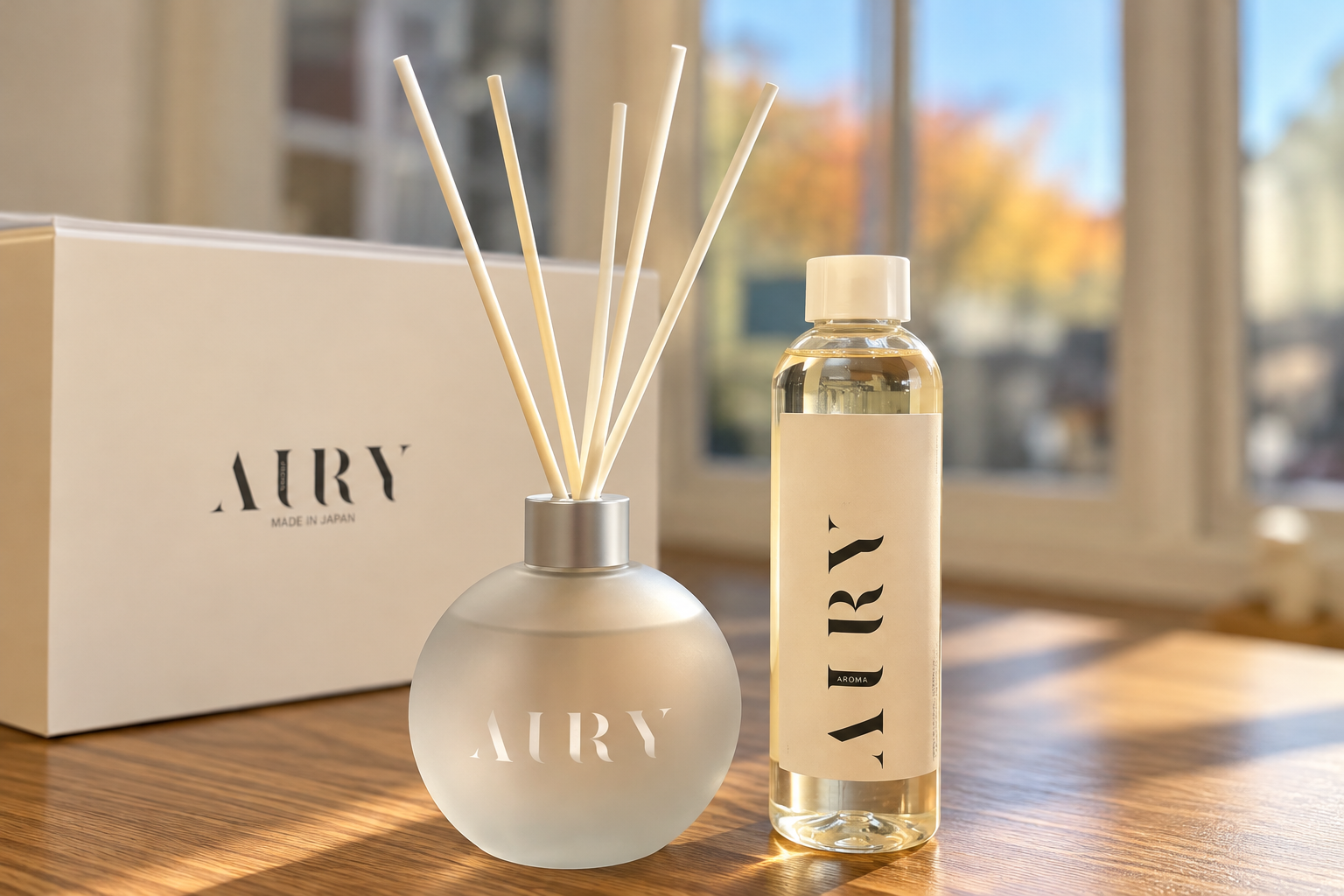
The product I tested was AIRY’s Forest Breath reed diffuser, a Japanese-inspired home fragrance presented in a frosted glass bottle with a silver collar and white reeds. The packaging is understated, which I rather like. The design looks more like something you’d find in a carefully curated Japanese home than beside the washing-up liquid bottle in my kitchen.
Forest Breath takes its inspiration from Japan’s hinoki forests. Its fragrance combines woody and floral notes, including hinoki, clary sage, geranium, rose and gardenia, with sandalwood and honey forming the base. The Japanese character 森, pronounced mori, means forest, and the fragrance draws on the atmosphere of woodland and the idea of stepping away from the noise of everyday life.
I’ve always been interested in the way different cultures approach wellbeing. Persian traditions place considerable importance on scent, from rosewater in food and celebrations to the familiar aroma of esfand, burned in traditional rituals. Fragrance has long been part of how people mark a moment, welcome visitors and create a special atmosphere.
Of course, enjoying the smell of something and experiencing a measurable improvement in concentration again are two different matters. That’s what I wanted to explore, without allowing the attractive packaging or the promise of a calmer working environment to influence my verdict.
Enjoying a fragrance and experiencing a measurable improvement in concentration are two very different things.
Seven days in my study
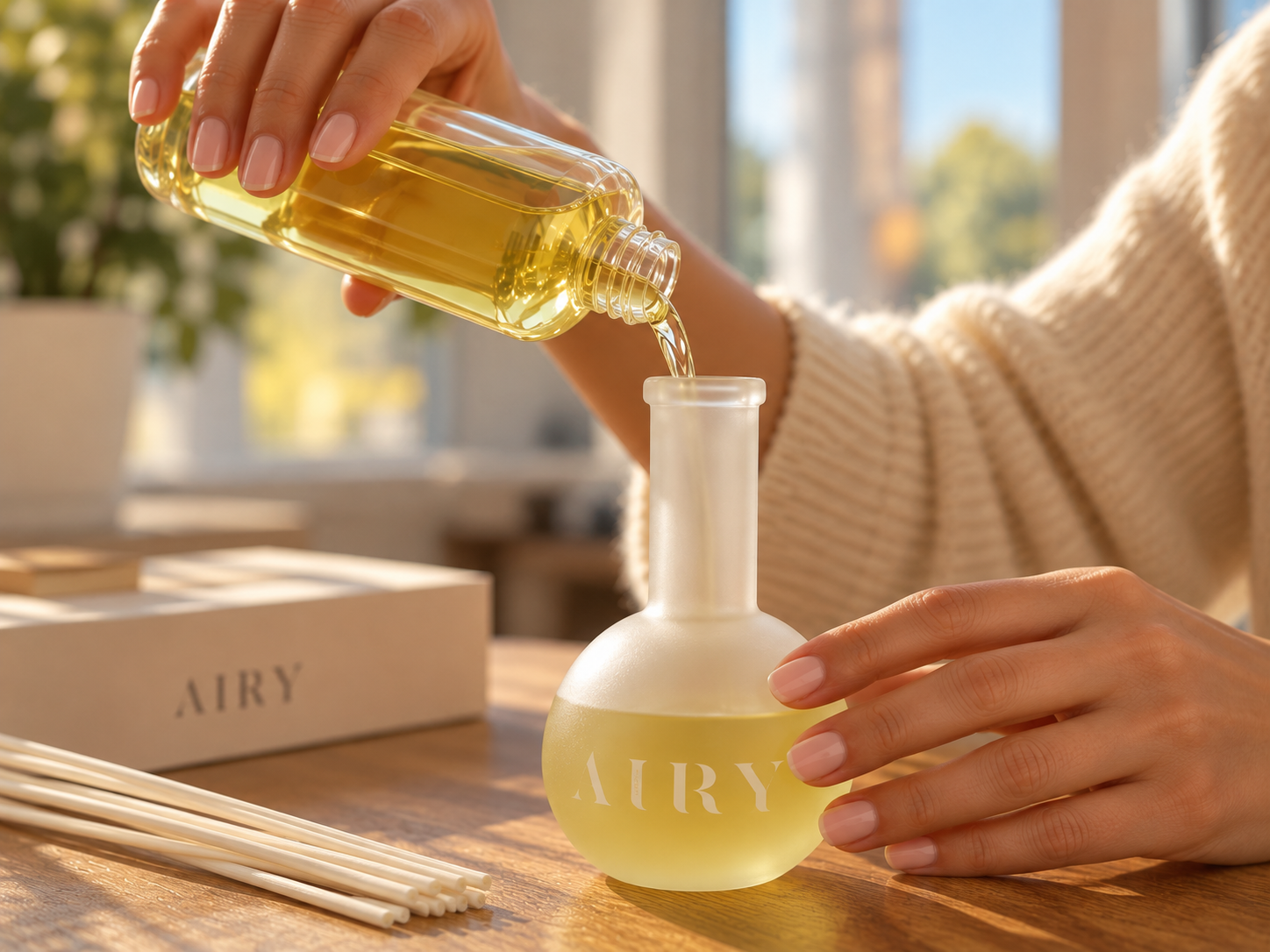
I placed the diffuser in my study, where I spend much of my time writing, researching and attempting to stay on top of the stream of information. It’s a room that serves several purposes, from professional deadlines to personal writing, and occasionally becomes a temporary dumping ground for things that haven’t quite found their proper home.
The first thing I noticed was how effectively the fragrance travelled around the room. It wasn’t one of those diffusers you have to stand directly beside to detect. The scent filled the study, creating a pleasant atmosphere without becoming overpowering. Even after leaving the room and returning later, I could still notice it.
I rather liked walking into the study and being greeted by the fragrance. There’s something appealing about a workspace that smells good before you’ve even opened your laptop, especially when the day ahead involves deadlines, emails and the occasional battle with your own attention span. It made the room feel more welcoming, although I couldn’t say whether that translated into anything more substantial.
Over the week, I became accustomed to having Forest Breath in the background. It didn’t demand attention, but I was aware of it whenever I entered the study. Unlike some fragrances that seem pleasant initially but become tiresome after a few hours, this was one I continued to enjoy.
And yes, I did notice that my concentration seemed a little better. Before anyone rushes out to buy a diffuser as a productivity aid, however, there’s a rather important complication.

My concentration has improved slightly, but I’m not entirely convinced the diffuser deserves all the credit. There’s a daily Red Bull involved, for one thing. I’ve also been taking Omega-3 supplements, and there are all the usual variables that come with being a woman in midlife, including sleep, hormones, stress and whatever else life decides to throw into the mix.
I couldn’t tell you which, if any, deserves the credit. The Red Bull contains caffeine, which can temporarily increase alertness, although that doesn’t mean it’s a solution to ongoing concentration difficulties. Omega-3 supplements have also attracted research interest, but evidence for their effects on attention remains mixed. As for the diffuser, my observations are far too limited to establish whether it made any measurable difference.
That’s the trouble with conducting an experiment on yourself. Life doesn’t conveniently stop while you test one variable. My seven days with AIRY were no different, and without controlling for everything else, it would be rather ambitious to announce that a reed diffuser had improved my cognitive performance.
What I can say is that I felt comfortable working in the room. The fragrance was pleasant, noticeable and made the study feel more inviting. Whether that helped me concentrate or made sitting at my desk a nicer experience is impossible to establish.
And that’s enough. Not every product needs to deliver a measurable improvement in our lives to be worth having around.
H, Cyrus and a Nintendo
Of course, no experiment in our house remains entirely mine for long. H and Cyrus both took an interest in the diffuser, and I’m pleased to report that the fragrance received a favourable reception from the rest of the household. H liked the scent, as did Cyrus, who is ten and has rather more pressing matters on his mind than his mum’s latest wellbeing experiment.
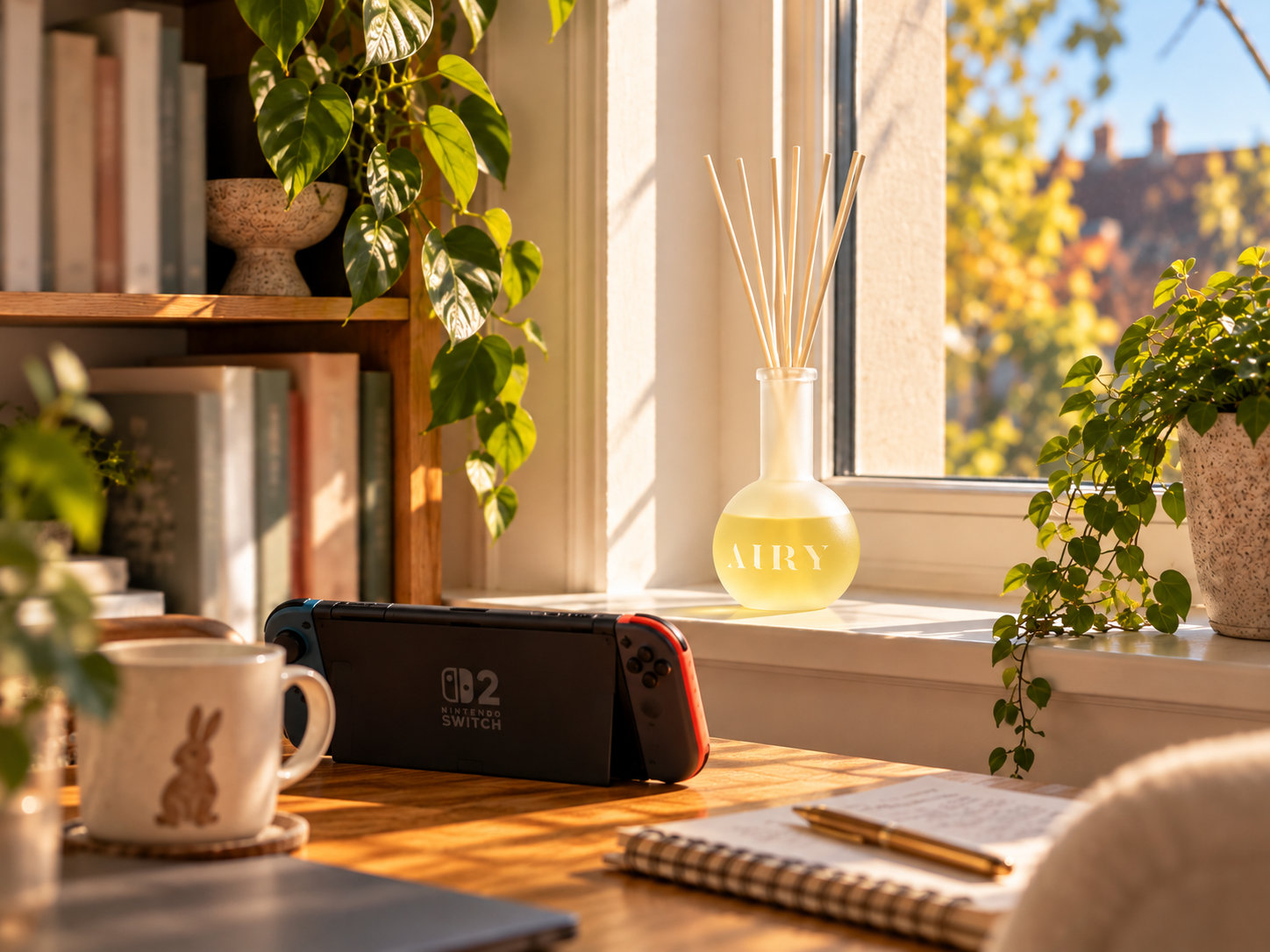
Today, Cyrus appeared focused when it came to his Nintendo. Whether Forest Breath had anything to do with that is another matter entirely. Given his enthusiasm for gaming, I suspect he would have managed a reasonable degree of concentration in a room smelling of absolutely nothing.
Still, it amused me that the fragrance had become something we could all appreciate. H enjoyed it, Cyrus liked it, and I was happy to have something in the study that didn’t involve another screen or an electronic notification demanding my attention. It’s always interesting to see how different members of the family respond to the same product when none of us has quite the same priorities.
It’s also a useful reminder that concentration is complicated. Cyrus can become absorbed in something he enjoys, just as I can lose myself in writing when a subject captures my imagination. The challenge isn’t always being able to focus. Sometimes it’s directing that attention towards the things we actually need to do.
And I’m fairly certain Nintendo doesn’t feature on Cyrus’s homework timetable.
Why our working environment deserves attention
One thing I’ve learned about concentration is that it doesn’t exist independently of everything else happening in life. A poor night’s sleep, a demanding day at work, hormonal changes or a steady stream of interruptions can all affect how easily I settle into a task. Sometimes the problem isn’t the work itself but the number of competing demands surrounding it.
I’ve become increasingly aware of the importance of making my environment work for me, rather than expecting myself to function in exactly the same way every day. That might mean reducing notifications, taking a screen break, putting my phone somewhere less tempting or simply giving myself enough uninterrupted time to finish what I’ve started.
Forest Breath became another small part of that environment during my experiment. It didn’t remove distractions or magically organise my thoughts, but it made the room a pleasant place to spend time. I also found myself appreciating having something in my study that wasn’t there to make me work harder, faster or more efficiently.
Sometimes it’s nice to enjoy something without expecting it to earn its keep.
Would I continue using AIRY?
Yes, although not because I believe I’ve discovered a secret weapon against distraction. I like the fragrance, I like the look of the bottle and I like having it in my study. The frosted glass design is understated enough to sit comfortably alongside my books, laptop and the usual collection of things I keep meaning to put away.
The scent filled the room, remained pleasant throughout the week and received approval from H and Cyrus. That’s a respectable result for a home fragrance, especially one that has been used daily rather than brought out for the occasional visitor.
Would I recommend it as an ADHD aid? No. There isn’t sufficient evidence to make that claim, and my own experience certainly doesn’t prove one. Anyone struggling with persistent attention difficulties deserves proper assessment and support rather than being sold the idea that a fragrance can resolve them.
Would I recommend considering it as a home fragrance? Based on my experience, yes, particularly if you enjoy a noticeable scent and want to make a working space feel more pleasant. Fragrance is personal, of course, and what one person finds relaxing another might find distracting, so it’s worth considering your own preferences.
The Saffron Experiment verdict
After seven days, AIRY Forest Breath earns its place in my study. The fragrance is pleasant, fills the room and has been well received by the family. It’s also attractive enough to leave on display, which is fortunate given that my study doesn’t have unlimited space for decorative additions.
My concentration may have improved slightly, but whether that’s down to the diffuser, my daily Red Bull, omega-3 or simply having a better week remains an open question. I certainly haven’t discovered a cure for distraction, and I wouldn’t suggest that scent can treat ADHD.
Besides, any improvement in my concentration clearly hasn’t extended to remembering my bank card at Tesco. Having left it with the cashier for the second time in a matter of months, I think we can safely conclude that Forest Breath hasn’t transformed me into a model of organisation.
What it has done is make my study a more pleasant place to spend time. That’s something I can appreciate without needing a scientific explanation or an impressive claim about cognitive performance.
Have you ever found yourself forgetting something moments after putting it down? And do you think your surroundings make a difference to how well you concentrate?
The Saffron Experiment is my independent, first-person series in which I test products, wellbeing ideas and everyday rituals to find out how they perform outside the marketing brochure.
Product tested: AIRY Forest Breath 森 Home Reed Diffuser, 250ml.
Editorial note: This is a personal lifestyle experiment, not a controlled scientific study. Experiences of scent are subjective, and no conclusions about ADHD treatment or cognitive improvement can be drawn from this review.
Occasional stories, experiments, discoveries and questions from Saffron & Cyrus.
Discover more from Saffron & Cyrus
Subscribe to get the latest posts sent to your email.


Saffron & Cyrus is an independent women’s editorial publication with a recognisable voice, real-life perspective, a defined midlife audience and a commercial model built around useful, relevant partnerships.
