
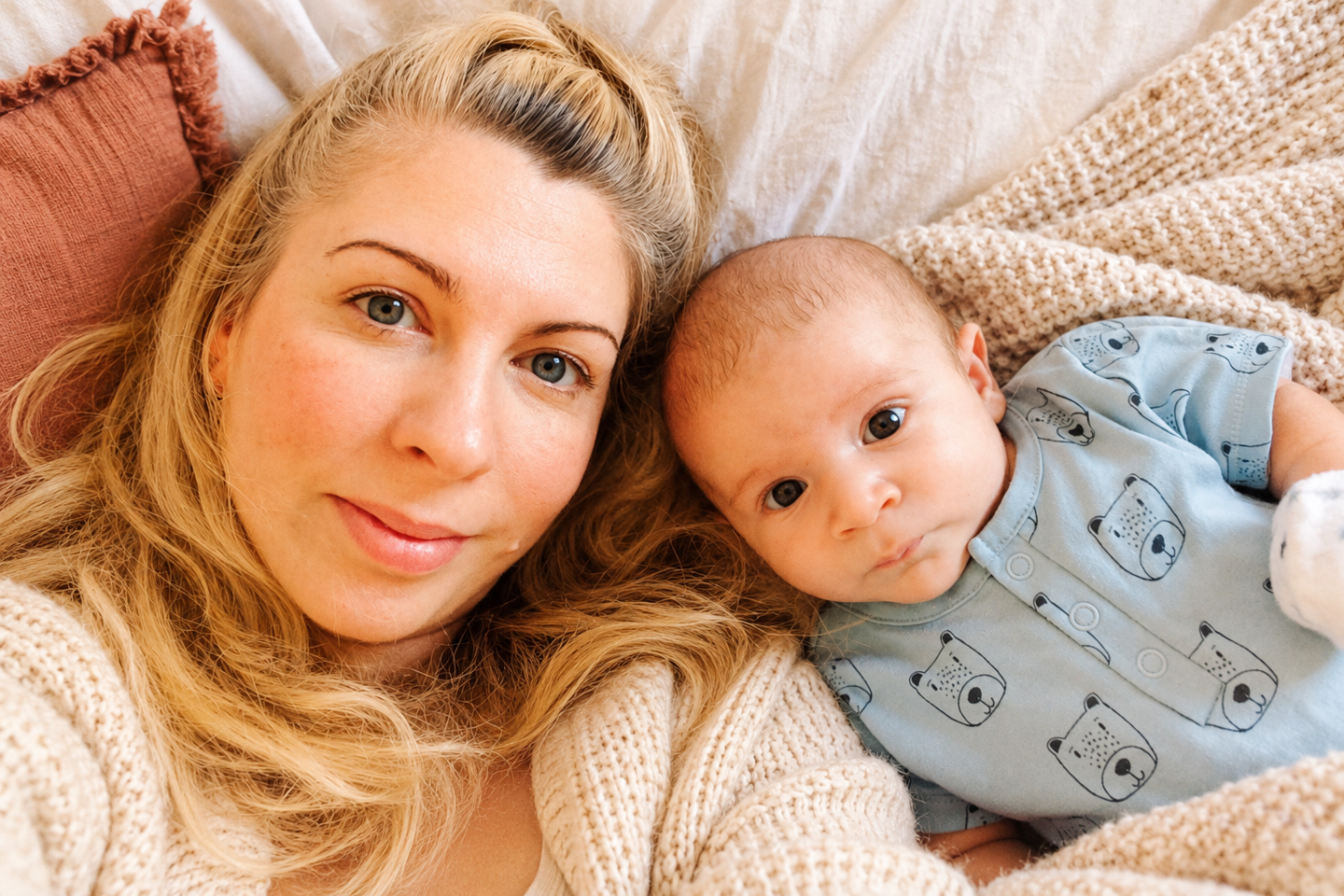
It’s 7am and I’m standing in front of the bathroom mirror wondering what on earth has happened to my hair. There’s a flattened section at the back, a collection of short, wiry strands sticking out around my temples and a bun that looks as though it was assembled in the dark. My roots are already greasy, despite having washed them yesterday.
I’m 40, a first-time mum and currently sharing my home with a small person who has developed a fascination with grabbing anything within reach. My hair is proving particularly unattractive. Cyrus doesn’t care whether I’ve washed it, styled it or spent twenty minutes attempting to make it look presentable. To him, it’s something to grab on to while I try to persuade him to release his grip without taking half my scalp with him.
Before becoming a new mum over 40, I could spend time getting ready. These days, washing my hair takes careful negotiation with H, a sleeping baby and the clock. By the time I’ve found the hairdryer, Cyrus is usually awake and demanding attention. The result is that my hair spends most of its time scraped into a bun or twisted into plaits, which is practical but hardly the hairstyle I had in mind for my forties.
Everyone talks about the lovely thick hair you’re supposed to enjoy during pregnancy. What they don’t spend quite so much time discussing is what happens afterwards, when your hormones change and your hair decides it has had enough. Mine seems to have developed several problems at once, and none of them is flattering.
From little sprouts around my temples to greasy roots and unexpected bald patches, my hair seems to be going through almost as many changes as the rest of me.
Sprouts. They seem to appear randomly everywhere from your hairline to behind your ears. Nobody warned me about these, and I don’t remember reading about them in any of the pregnancy books.
One minute I’m worrying about the amount of hair disappearing down the shower plughole, and the next I’m examining a collection of short, unruly hairs that have decided to grow back in completely different directions. Some stick straight up, while others curl around my temples, giving me the appearance of someone who’s been standing a little too close to an electrical socket. The ones behind my ears are determined, making an appearance regardless of what I do with the rest of my hair.
These little sprouts can be a sign of new growth following postpartum shedding, which is reassuring. During pregnancy, higher oestrogen levels keep more hairs in their growing phase. After childbirth, hormone levels change and those extra hairs begin to shed. When new growth appears, it doesn’t necessarily have the length or weight to lie flat, which explains why my hairline resembles something that’s been attacked by static electricity.
Straighten them to within an inch of their lives with hair straighteners, or I could wear a hat. Those appear to be my options right now, although the first isn’t sensible when the new hairs are still so fragile. A little styling cream and a soft brush can help some of the sprouts to behave, although there’s always one determined strand standing to attention in every photograph. As for wearing a hat, I’m beginning to see the attraction, but there’s only so long you can walk around Newcastle in a woolly hat before somebody starts wondering whether you’ve forgotten what season it is.
Forget the new mum glow. Why does nobody tell you that your hormones can make your hair behave as though you’re 14 again? One minute I’m dealing with sprouts sticking out around my hairline, and the next my roots are so greasy I look as though I’ve been frying chips with my head over the pan.
It’s irritating because I’ve barely got time to wash my hair in the first place. When I do manage it, I expect at least a couple of days of looking respectable. Instead, I’m back in front of the mirror wondering how something I washed yesterday can already look as though it’s been neglected for a week. And the more I wash it, the more I feel as though I’m fighting a losing battle.
Hormonal changes after childbirth can affect the scalp’s oil production, although not everyone experiences greasy hair. In my case, it seems my scalp has decided to revisit puberty without consulting me. I’ve tried tying it back, changing my parting and pretending that the slightly slick appearance is deliberate, but there’s only so much you can do.
Experiment with different shampoos. I swapped my usual shampoo for something new and noticed the difference almost straight away. My hair looked cleaner, felt lighter and, rather miraculously, had some of its old gloss back. I’m not suggesting I’ve discovered a cure for postpartum hormones in a bottle, but changing your shampoo can make a noticeable difference to how your hair looks and feels.
What worked before pregnancy doesn’t necessarily suit your hair or scalp afterwards, so it’s worth trying a different formulation before spending a fortune on expensive treatments. I’ve also learned to keep conditioner away from my roots, rinse thoroughly and resist the temptation to scrub my scalp into submission. Washing greasy hair when it needs washing is ok, and there’s no evidence that doing so automatically makes it produce more oil.
Of course, there’s always dry shampoo for those mornings when Cyrus has other plans. Between the sprouts, the shedding and the grease, I’m beginning to think my hair needs almost as much attention as he does.
Everyone tells you to expect your hair to start falling out around three or four months after having a baby. What nobody quite prepares you for is just how much can disappear, or where it might disappear from. I’m not talking about the usual collection of hairs in the shower plughole. I’m talking about patches. Actual bald patches.
I hadn’t even noticed mine until somebody took a photograph of me with Cyrus. There we were, enjoying a perfectly ordinary mum-and-baby moment, when I spotted something rather less heartwarming around my hairline. Where on earth had my hair gone? Look closely at the photograph and you can see the thinning around my temples, and believe me, it’s worse on the other side.
Naturally, I immediately found myself inspecting my head from every possible angle in the bathroom mirror, which isn’t easy when you’re trying to hold a hand mirror behind your ear. I even started examining older photographs to work out when the thinning had begun. It’s astonishing how quickly you can become obsessed with something you hadn’t noticed twenty minutes earlier.
Postpartum hair shedding often peaks around four months after childbirth as hormone levels settle after pregnancy. Most women find their hair gradually returns to its usual fullness within six to twelve months, although recovery varies. Breastfeeding can influence hormonal patterns, but it doesn’t necessarily mean that hair loss will continue for longer.
That’s reassuring, although it’s considerably easier to be patient when you’re not the one examining photographs and wondering whether you need to reconsider your parting. At 40, I’m also conscious that hair can change with age, which makes it even more tempting to blame every new development on the fact that I’ve reached a particular birthday.
Rosemary hair oil, or at least that’s what I’m considering trying. I’ve been reading about its supposed hair-growth benefits, and while the claims sound promising, there’s limited research into rosemary oil for certain types of hair loss and little reliable evidence that it helps with postpartum shedding specifically.
If I decide to give it a go, I’ll use a properly diluted preparation rather than applying concentrated essential oil directly to my scalp. Essential oils can cause irritation, and anyone breastfeeding should check with a healthcare professional before using rosemary essential oil because safety information is limited.
I’m not expecting to wake up tomorrow with a magnificent new hairline, but I would quite like to stop examining every photograph for evidence of disappearing follicles. I also know that clearly defined bald patches aren’t necessarily typical postpartum shedding. Because mine are noticeable around my hairline, they’re something worth discussing with my GP rather than assuming that hormones are the only explanation.
As if greasy roots, fluffy sprouts and thinning patches aren’t enough, my hair has also developed an irritating habit of tangling. Brushing it can feel like a battle when I’m already running late and Cyrus has decided that my hairbrush is the most fascinating object in the house.
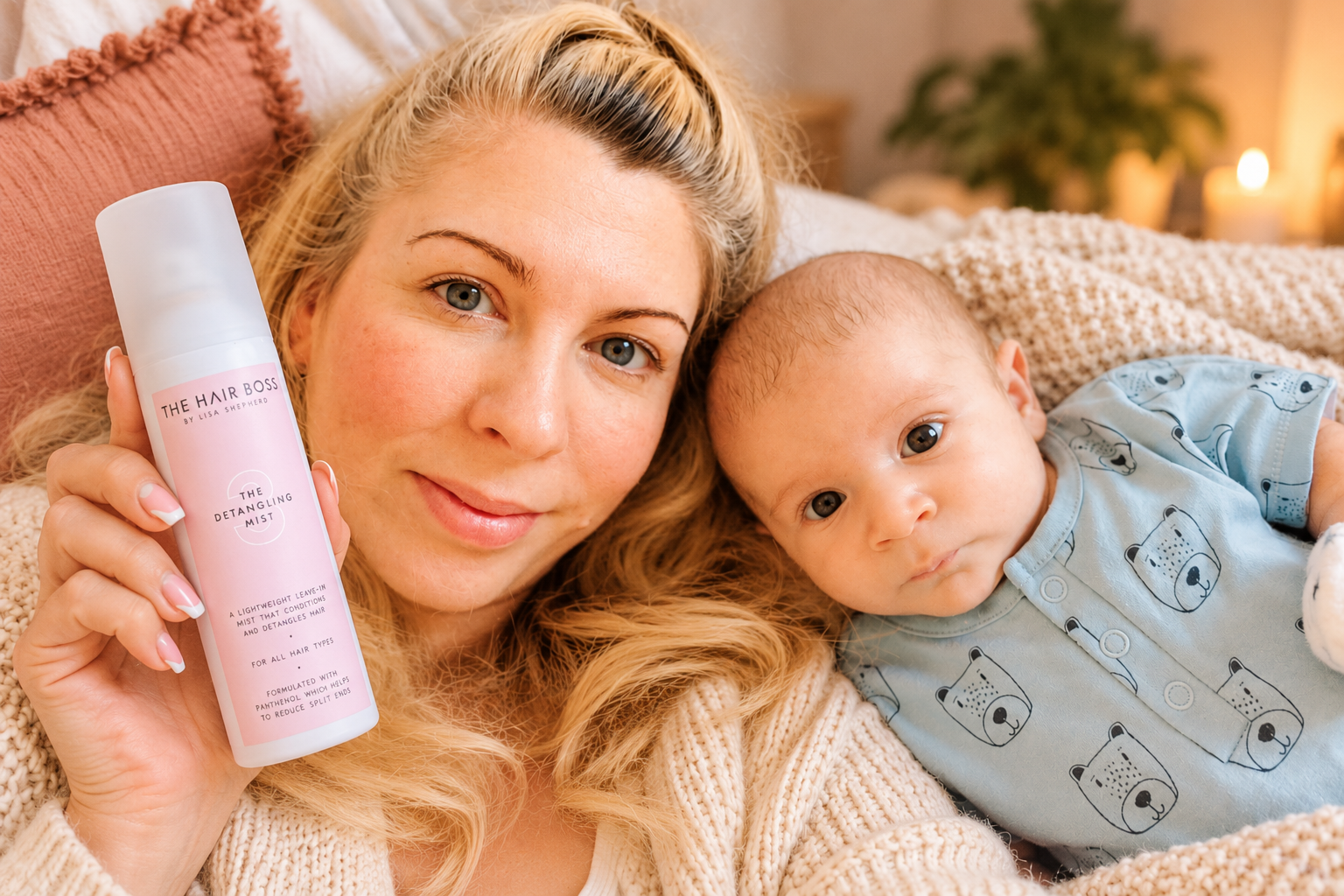
I’ve been trying The Hair Boss Detangling Mist, part of celebrity hairdresser Lisa Shepherd’s range of products designed to tackle everyday hair dilemmas. Available through Superdrug, the range caught my attention because it focuses on the sort of ordinary hair problems that don’t require a professional stylist to recognise.
The mist was kindly gifted for me to try. It’s designed to help detangle hair and make brushing easier, which is appealing when I’m trying to avoid unnecessary pulling on hair that’s already shedding. Rather than attacking knots with a brush, I’m trying to be gentler, starting at the ends and working upwards.
A detangling product can help reduce friction and make combing easier, although it won’t prevent hormonal hair loss or encourage new growth. At 40, with a baby who seems determined to grab whatever hair I have left, I’m increasingly interested in products that make everyday haircare less of an ordeal.
I don’t need a complicated routine or a bathroom shelf full of expensive bottles. I need something practical that I can use between feeds, nappy changes and the occasional attempt to drink a hot coffee. And if it means fewer arguments with my hairbrush, I’ll consider that a worthwhile development.
Between the postpartum shedding, greasy roots and fluffy sprouts, my hair is having a difficult time. I’ve reached the point where I’m prepared to try almost anything that might make the hair I’ve still got look and feel healthier.
Which brings me to Philip Kingsley’s Elasticizer, one of those treatments I’ve heard people talking about for years but never quite got around to investigating. I’ve been trying Philip Kingsley’s original Elasticizer Deep-Conditioning Treatment, a pre-shampoo product designed to improve hair elasticity, manageability and resistance to breakage.
According to the brand, more than four million units have been sold, which suggests I’m rather late to the party. The idea behind Elasticizer is straightforward. Hair needs a certain amount of flexibility to withstand everyday stresses such as brushing, styling and heat. When it becomes dry or damaged, it can lose some of that flexibility and become more prone to snapping.
Elasticizer is designed to condition the hair and improve its elasticity, which sounds appealing when every strand feels precious. It isn’t a treatment for postpartum hair loss, and I wouldn’t expect it to encourage new growth or reverse hormonal shedding. What interests me is whether it can improve the condition of the lengths I’ve still got, particularly when I’m trying to avoid unnecessary breakage.
The treatment is applied before shampooing, which requires a little forward planning. These days, organising a proper hair wash is already something of an achievement, so adding another stage to the process feels rather ambitious.
Still, I’m willing to make an exception if it means my hair might become easier to manage. I’m not expecting the sort of transformation that requires a wind machine and a slow-motion television advert. I’d settle for softer lengths, fewer tangles and hair that doesn’t look quite so exhausted.
After all, one of us ought to look well-rested, and at the moment it certainly isn’t me.
Hair extensions are something I used before having a baby. Before Cyrus arrived, I associated extensions with celebrities, glamorous nights out and women who somehow manage to spend more than ten minutes getting ready. They seemed like an unnecessary expense and an awful lot of effort. Now, with my hair looking thinner than I’d like, the idea of adding a little volume is becoming more appealing.
This is where ClipHair comes in. The company offers clip-in and tape-in hair extensions by post, with different lengths and shades to match natural hair. I bought a full-head set of clip-in hair extensions to try, which is something I never imagined I’d be writing about when I started this platform.
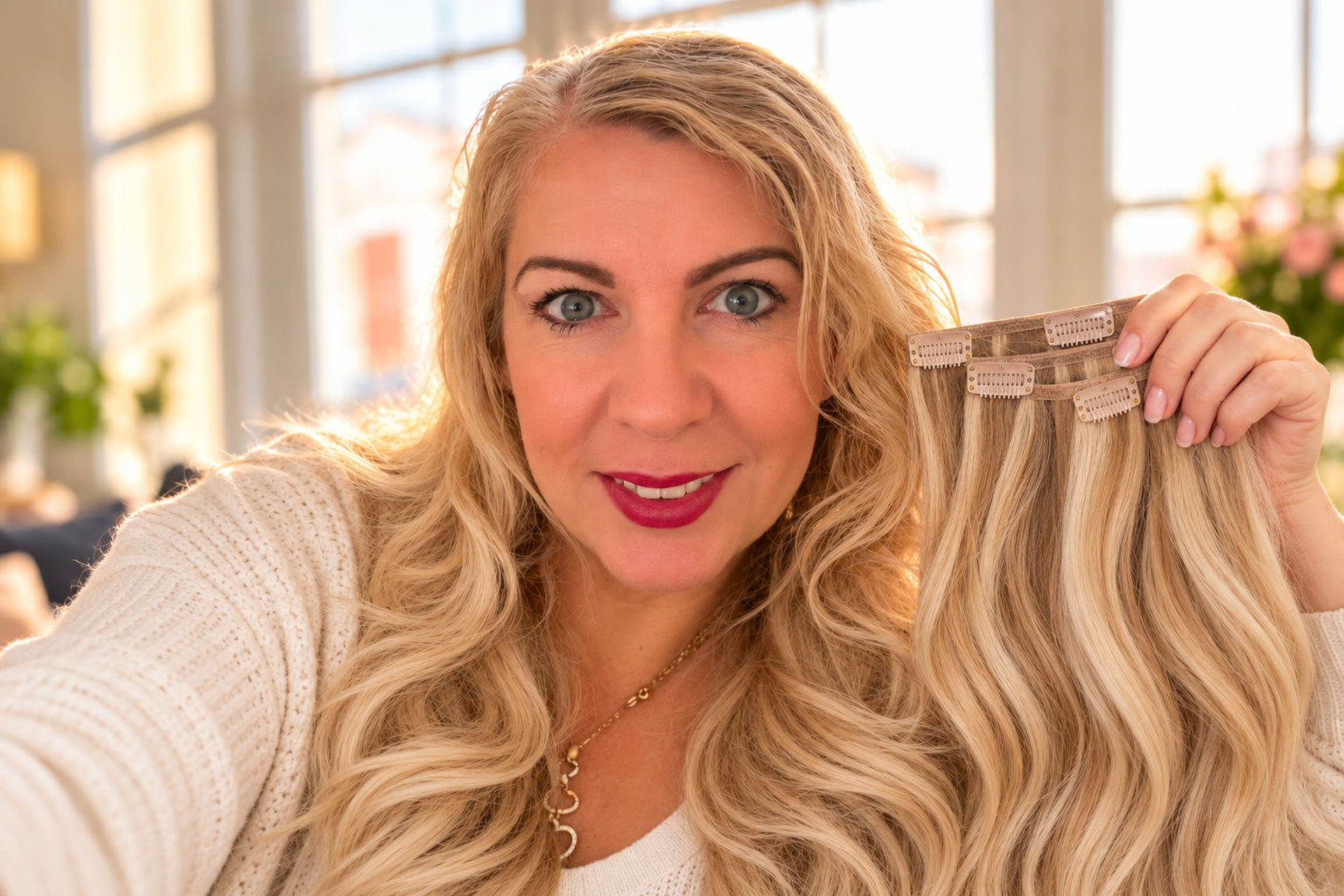
Opening a parcel containing an entire head’s worth of hair is a bit of a strange experience. There’s something faintly weird about having more hair delivered through the letterbox when you’re struggling to keep hold of the hair you’ve already got. Still, I’m intrigued by the possibilities, particularly as clip-ins can be removed rather than requiring a permanent commitment.
My main concern is whether extensions are suitable when my natural hair is already shedding. Clip-ins need enough healthy hair to support their weight, and attaching them close to fragile areas could cause further damage. Tape-in extensions also place tension on the hair, so neither option is necessarily appropriate for covering thinning patches or bald areas.
For now, I’m interested in whether the clip-ins can add some body to the healthier lengths without pulling on my scalp. I’m certainly not about to attach them to my already struggling temples. Whether I can master fitting them before Cyrus wakes up is another matter entirely.
Before becoming a new mum, I never considered washing my hair an indulgence. It was something I did, usually without an audience, a deadline or somebody crying in another room. Now, finding twenty minutes to wash, condition and dry it takes patience.
If Cyrus is asleep, I have to decide whether to risk waking him with the hairdryer. If he’s awake, I’m relying on H to keep him entertained long enough for me to emerge looking vaguely human. There are mornings when I manage to wash it but run out of time before drying it, which probably explains why the messy bun has become such a permanent fixture.
What interests me is how quickly ordinary personal care becomes something we describe as a treat. Washing your hair isn’t exactly a day at a spa, and neither is applying conditioner or spending ten minutes with a hairdryer. Yet here I am, feeling positively extravagant when I manage all three.
I’ve already surrendered quite enough of my daily routine to nappies, feeding and the mysterious disappearance of baby socks. I’d quite like to keep my hairstyle, even if I don’t always have time to do anything with it.
There seems to be an unwritten rule that once you’ve had a baby, especially if you’re over 40, you’re supposed to consider a sensible haircut. Something practical, manageable and short enough to require minimal attention. Perhaps a bob that says you’ve got everything under control, even when the kitchen looks as though somebody has emptied a changing bag across it.
I can see the appeal. Shorter hair might take less time to wash and dry, and there would be less for Cyrus to grab. A good cut could also make the ends look healthier if they’re dry or damaged. But short hair isn’t low-maintenance hair, and some styles take more effort than tying longer hair back.
A bob that looks wonderful when the hairdresser finishes it can behave rather differently when you’re attempting to recreate it with one hand while holding a baby monitor in the other. Then there’s the question of whether I want short hair or just somebody to make my mornings easier.
For now, I’ve decided against doing anything drastic. A decent trim, a few softer hair ties and a little more time with my conditioner seem like sensible places to start. I’m also curious to see whether changing my shampoo continues to help and whether the ClipHair extensions might give me a little more volume when I fancy making an effort.
I might be 40, but I’m not ready for a haircut chosen purely because I’ve had a baby. And while I appreciate the practical advantages of shorter hair, I refuse to believe that motherhood comes with a compulsory bob.
Cyrus is currently asleep, H is downstairs and I have a rare opportunity to wash my hair without an audience. Naturally, I’ve spent most of it writing about washing my hair.
The Hair Boss Detangling Mist was gifted for consideration in this feature. Philip Kingsley’s original Elasticizer and the hair clips were not gifted. All opinions are my own.
Explore more stories about motherhood after 40
Discover more women’s health and wellbeing features
Occasional stories, experiments, discoveries and questions from Saffron & Cyrus.
Discover more from Saffron & Cyrus
Subscribe to get the latest posts sent to your email.

Saffron & Cyrus is an independent women’s editorial publication with a recognisable voice, real-life perspective, a defined midlife audience and a commercial model built around useful, relevant partnerships.
