
Six weeks after giving birth, I stepped on the scales and stared at a body I barely recognised.
My belly, in particular, looked less like the soft, rounded bump I had carried through pregnancy and more like something that had wandered in from the old TV series, Alien Nation. It was also providing convincing visual evidence of the copious amount of chocolate I had scoffed in the weeks before Cyrus arrived. My old jeans, meanwhile, had disowned me and I couldn’t squeeze back into them for months.
This was not what the six-week postpartum narrative had led me to expect. Six weeks was supposed to be a finish line. A point at which you had been checked over, cleared to exercise and, if the glossy women’s mags were to be believed, beginning your transformation back into the woman you had been before. Except I wasn’t that woman anymore.
I had a newborn, defnitely exhausted and my body had stretched, shifted and done something quite profound, and my stomach was still a daily reminer of it. The idea that I should now be worrying about getting back into my jeans seemed a bit ridiculous. And yet, there was REAL pressure from the mirror confronting me.
Some of that also came from the outside. Relatives speaking in Farsi, usually intending to be affectionate or funny, made comments about my body that landed rather differently when I was already trying to work out what had happened to it. Some of it came from the crazy side of my brain.
But because I was remarkably good at absorbing the idea that my body was a project requiring constant maintenance, I threw myself back into Body Combat at six weeks postpartum. Not to be recommended!
That got me wondering.
The phrase “getting your body back” sounds harmless enough, doesn’t it? But back to what? The body before pregnancy? Before childbirth? Before the sleepless nights? Before motherhood changed me forever?
And who decided that six weeks was the point at which anyone should start worrying about any of it? It had to be a man, I was sure of it! Sorry guys!
The six-week postpartum check is culturally loaded. It can sound like a medical all-clear, followed almost immediately by an unofficial fitness deadline. Lose the weight, flatten the stomach and strengthen that core.
Get back to exercise, get back to work and just get back to yourself … as quick as you possibly can. It’s quite a list isn’t it for a woman who is still recovering from the trauma of pregnancy and birth while learning how to keep another human being alive.
The problem is not exercise though as movement can be an important part of postpartum recovery and wellbeing. The problem is the assumption that exercise exists primarily to make the postpartum body look as though nothing happened. That is where we need to start to change the conversation for sure.
In the haze of night feeds and endless amounts of washing (which I usually left in the machine) structured support was essential for me.
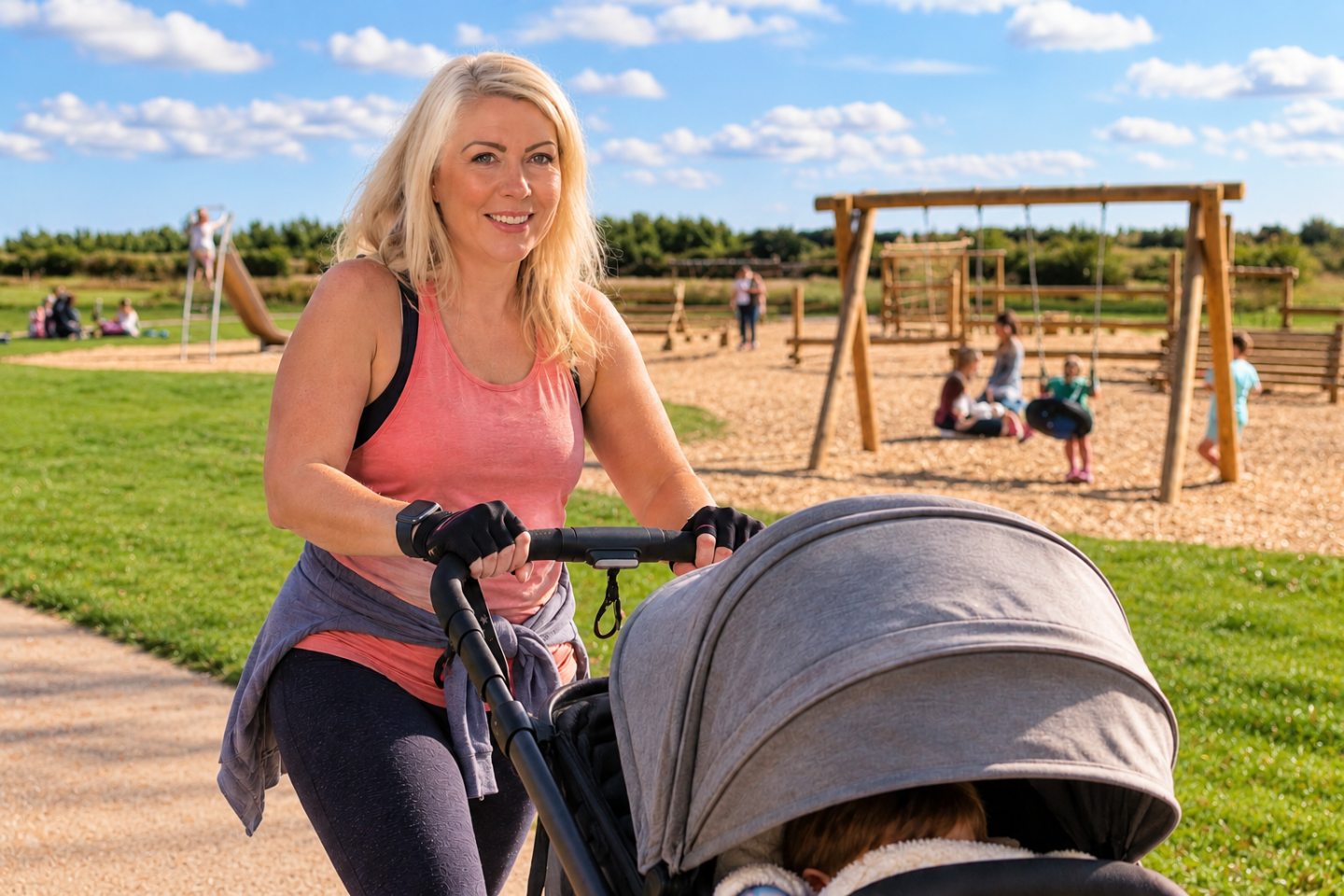
Vicky Bradley, founder of Buggies, Bums, and Tums, takes a practical approach to postpartum fitness. Her classes focus on rebuilding strength, pelvic-floor function and cardiovascular fitness while accommodating the rather significant logistical complication of having a baby in tow.
It sounds obvious, but it is surprisingly easy for fitness gurus to forget that new mothers have lives … and babies in tow! A conventional gym session assumes you can concentrate on the workout. But a new mother is also checking the pram, the baby, the feeding schedule and whether that suspicious silence means the baby has finally fallen asleep or is about to produce an entirely different kind of emergency.
Postpartum exercise in my opinion has to fit around real life.
In Vicky’s classes, the buggy becomes part of the workout rather than an obstacle to it.
A group of tired mothers move through the park with their prams, combining walking, jogging, strength work and adapted exercises. Babies watch from their buggies or mats bemused while their mothers get on with the business of rebuilding their bodies.
Push-ups, tricep dips and abdominal exercises can be adapted for a postpartum body. Pelvic-floor awareness is woven through the session rather than treated as an awkward little afterthought.
The biggest benefit is that nobody has to explain why they are tired at the end of the session because everyone already knows.
For something that does so much work during pregnancy and childbirth, the pelvic floor gets a leaflet as you leave hospital, but little else without effort.
And postpartum pelvic-floor problems are nasty! They can include urinary or bowel leakage, pelvic heaviness and symptoms associated with prolapse. Yet women can be left with the impression that these things are just part of having a baby….they aren’t symptoms women should be embarrassed about, nor are they necessarily something to exercise through.
My view is that the emphasis should be on recovery, coordination and knowing WHEN to ask for help.
- It supports bladder and bowel control after birth.
- Strengthening and coordinating these muscles can help address symptoms of pelvic-floor dysfunction.
- Good pelvic-floor and core function can support movement, posture and a gradual return to exercise.
If you experience persistent pain, leaking, heaviness or pressure after giving birth, speak to a healthcare professional or pelvic-health physiotherapist rather than assuming you simply need to work harder.
This is the part I find most interesting and frustrating! We are perfectly capable of talking about postpartum recovery in terms of healing, strength, mobility and confidence. Yet the conversation so often circles back to the stomach, the scales, the BMI, the jeans, and … the “baby weight”.
Oh and THAT photograph taken a few months later where everyone wants to know whether you’ve “got your figure back” on Facebook. It is an odd phrase when you think about it.
A woman has just grown and delivered a baby the size of a watermelon, and somehow the achievement we most want to measure is whether her waist has returned to its previous dimensions.
For women over 40, there can be another layer to this. We are already living through a stage of life in which muscle mass, hormones, metabolism and recovery can change. Add pregnancy and childbirth to that picture and the idea of simply reversing the clock becomes even less useful.
That doesn’t mean women shouldn’t want to lose weight, improve fitness or change how they feel in their bodies. Of course they can. But it means the choice should belong to the woman, rather than being presented as the inevitable next stage of motherhood.
The more I thought about it, the more I realised that the question had been slightly mislabelled. We called it postpartum recovery, but much of the conversation wasn’t really about recovery at all.
It was about appearance – again! How quickly could I lose the weight? When would my stomach flatten? When would my jeans fit? When would I look like myself again?
The six-week mark made this particularly confusing. A clinical check after childbirth can become, in the wider culture, a kind of unofficial deadline. Six weeks and you’re “back”. Six weeks and you can start exercising. Six weeks and, apparently, you should be thinking about getting your body under control.
But a medical milestone is not the same thing as being physically recovered and that’s where I think we have got it all wrong. Women don’t need another deadline just better information about what recovery can actually involve, more attention to pelvic-floor health, sensible guidance about returning to exercise and permission to recognise that bodies do not all recover at the same speed.
There is also an uncomfortable commercial question.
A woman who believes her stomach is a problem is a VERY good customer. A woman who believes she needs to get her “body back” can be sold programmes, plans, supplements, classes, clothing and an endless supply of before-and-after photographs.
I don’t think wanting to lose weight or feel comfortable in your clothes is inherently wrong. I wanted both so much myself. What gives me the jitters is just the suggestion that this should be the measure of whether a woman has successfully recovered from childbirth.
On reflection, I think that is the answer to the question I started with is this:
They are not the same thing. One asks how quickly you can make your body look familiar, while the other asks what your body needs to become strong again.
I know which question I’d rather ask a new mother. The most useful shift is from trying to fix the body to trying to understand it. That means starting with the foundations: pelvic-floor function, core control, mobility, strength and cardiovascular fitness, then gradually increasing the challenge.
For me, four principles make sense:
Don’t treat pelvic-floor exercises as an optional extra. They are vital. Regular, controlled exercises can form an important part of recovery. If symptoms persist, seek professional advice.
Buggy walks, buggy classes and floor-based exercises can make movement possible without needing childcare, a gym session or a miraculous spare two hours.
A few manageable sessions each week are more realistic than attempting to reclaim your pre-pregnancy fitness in one heroic burst in body combat. Don’t follow my example and return to too much, too soon.
Classes and peer-support groups offer something a workout video cannot: other women who understand the strange combination of exhaustion, responsibility and wanting to feel like yourself again. That’s invaluable when you’re going through this torture.
There is a slightly depressing assumption behind much of the postpartum fitness industry: that pregnancy is an unfortunate detour and the destination is the woman you were before. I don’t buy it.
Pregnancy and birth change the body. Motherhood changes the person inside it. Trying to erase all evidence of either seems like a bit of an exhausting way to spend the limited energy available to a new mother. I say that as someone who spent months unable to get into a nice dress.
I cared about my stomach and about the scales and looking like myself again, but somewhere along the way, I realised that “looking like myself” and “looking like the woman I was before Cyrus” were not necessarily the same thing.
For me, the more useful idea became reclaiming strength. The ability to carry Cyrus, push his buggy up a hill without my face becoming the colour of beetroot, and eventually, just return to the activities I enjoyed. That is fitness too.
Postpartum fitness works best when the goal is to build the body you have now. That means paying attention to pelvic-floor and core function, progressing gradually, finding exercise that fits around motherhood and asking for professional help when something doesn’t feel right.
The real achievement isn’t looking as though you never had a baby. It is feeling at home in your body again. So the real question is only ever:
Shopping list essentials for midlife women who train
Ginger squats, baby lifts and back pain relief for mums 40+
Occasional stories, experiments, discoveries and quests from Saffron & Cyrus.
“`
Discover more from Saffron & Cyrus
Subscribe to get the latest posts sent to your email.

Saffron & Cyrus is an independent women’s editorial publication with a recognisable voice, real-life perspective, a defined midlife audience and a commercial model built around useful, relevant partnerships.
