
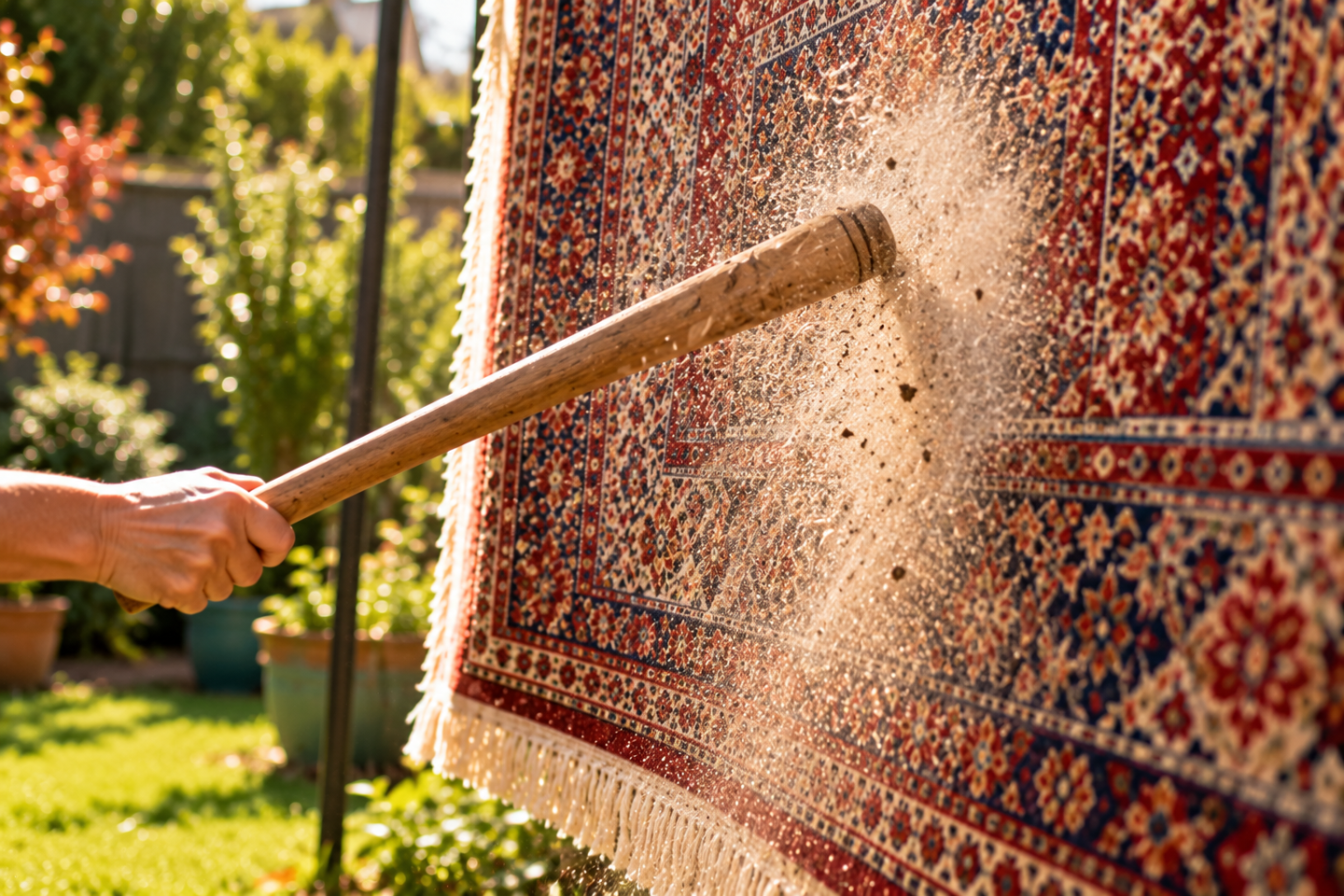
There are some things you don’t expect to see when you look into a neighbour’s garden. A grown man armed with a stick, giving a Persian rug a beating is one of them.
Yet there was H, standing in our Newcastle garden, whacking away at our rug on the washing line with enthusiasm. Thwack. Thwack. Thwack. It was hardly a discreet operation, and the spectacle hadn’t gone unnoticed. There were amused looks from our neighbours, while H carried on, entirely serious about the job.
I stood watching, wondering whether I should intervene, offer encouragement or just hide. H wasn’t taking out his frustrations on an innocent carpet, although you could have been forgiven for thinking otherwise. He was cleaning it, the traditional Persian way, and wasn’t about to stop until he’d finished.
Welcome to khaneh tekani, the Persian tradition of spring cleaning before Nowruz, the Persian New Year. The phrase means “shaking the house”, which, having married into a Persian family, I’ve found is a pretty accurate description.
For Persian families, cleaning before Nowruz isn’t just a matter of appearances. The old year’s dirt and clutter are cleared away before the new one begins. And unlike my rubbish attempts at spring cleaning, there’s an actual deadline.
We’re not talking about a quick run around with the vacuum cleaner. Carpets are cleaned, cupboards emptied, curtains washed and furniture moved to reach the dust gathering underneath. It’s a serious undertaking, and one I’ve never been enthusiastic about.
In Britain, spring cleaning is something we might tackle when the daffodils appear and the sunshine reveals six months’ worth of fingerprints on the windows. There’s no set deadline, and if we don’t manage it in March, there’s always April.
For Persian families, however, cleaning before Nowruz is a really important part of preparing for the year ahead. The Persian New Year falls around 20 or 21 March, at the spring equinox. The idea is to clear away the dirt and clutter of the old year before welcoming the new one.
The timing matters. By the time Nowruz arrives, the cleaning should be finished and the house ready for family visits and celebrations. My in-laws in Iran take these preparations seriously. Their approach makes my occasional enthusiasm for reorganising the kitchen cupboards look half-hearted. H grew up with these traditions, so his approach to carpet cleaning comes as no surprise to him, even if it attracts an audience in Newcastle.
Nowruz has been celebrated for around 3,000 years, with roots in ancient Persia and Zoroastrian traditions. Khaneh tekani is part of the preparations, although it’s difficult to say exactly when the cleaning ritual developed into the form we recognise today.
The Persians, it seems, were rather ahead of us when it came to making an occasion of spring cleaning. We Brits took a little longer to get up to speed on the whole cleaning thing. By the Victorian era, however, we’d certainly caught on. Coal fires, oil lamps and closed windows left homes covered in soot throughout winter. When spring arrived, people opened their windows, washed the curtains and took their carpets outside to beat out the dust. Better late than never, I suppose.
And the Victorians didn’t do things by halves. In her 1861 Book of Household Management, Mrs Beeton described a spring clean that involved moving furniture, taking beds apart, cleaning the joints, scrubbing floors and beating mattresses. Carpets were lifted and taken outside for a thorough beating.
Apparently, H would have made an excellent Victorian housekeeper. Although I suspect he’d have been less enthusiastic about dismantling the beds. Of course, in wealthier Victorian households, much of this work fell to servants. Families could even leave the house while their staff tackled the cleaning. A rather convenient arrangement, if you happened to be the person leaving rather than the one scrubbing.
The Edwardians then managed to turn cleaning into a social event. In 1901, British engineer Hubert Cecil Booth introduced a large petrol-powered vacuum cleaner, nicknamed the Puffing Billy. It could be transported by horse-drawn carriage and parked outside wealthy homes, with enormous hoses fed through the windows.
The machine took several people to operate, which makes my cordless vacuum look positively miraculous. According to Winterbourne House and Garden, some wealthy women even held vacuuming parties, inviting friends round for tea while Booth’s assistants cleaned around them. The service could cost around £13 for a large house, roughly a scullery maid’s annual wages at the time. Imagine spending that sort of money so your friends could watch somebody vacuum your carpets. Although, to be fair, I’ve attended social gatherings with less entertainment.
I wish I’d known about these parties when H was beating our rug. I could have put the kettle on, invited the neighbours round and called it a historical reenactment.
Khaneh tekani also involves sorting through the things accumulated over the year. Unfortunately, persuading Cyrus to part with anything is not easy. A toy he hasn’t touched for two years suddenly becomes his most treasured possession the moment I suggest donating it.
Our house is a mix of British and Persian influences. There are Persian carpets, family photographs, ornaments from Iran and the usual collection of things that accumulate when you have a child. I’ve always liked neutral walls because they make the colours of the carpets stand out, although the effect is occasionally spoiled by a toy car abandoned in the middle of the room.
We have wood-effect Amtico flooring, which survives muddy trainers, spilled drinks and whatever else family life throws at it, so I’m less precious about the house than I once was. There’s not much point having beautiful things if everybody is frightened to touch them.
Some of our belongings have travelled a long way, and others remind us of people we don’t see often enough. An ornament might look like clutter to somebody else, but if it reminds H of home or connects Cyrus to his grandparents, it stays.
As Nowruz approaches, we prepare our haft-sin, the traditional Persian New Year table. Its symbolic items include sprouted greenery, apples and garlic, each representing something associated with life, health or the coming year.
Cyrus enjoys being involved, and I like that he gets to experience the traditions H grew up with. It’s one thing telling a child about his Persian heritage and quite another having him take part in it. These are the things I hope he’ll remember when he’s older, even if he doesn’t fully appreciate them now.
I also want him to understand that the preparations are part of the celebration. Nowruz isn’t about sitting down to a lovely meal or receiving presents. There’s work involved beforehand, although I suspect he’ll be rather less enthusiastic when he’s old enough to be handed a bucket and a cloth, unless a car is involved.
As for me, I wish I could say that marrying into a Persian family has transformed me into somebody who looks forward to washing curtains, emptying cupboards and polishing every available surface before the New Year. It hasn’t. I understand why it’s important, and I enjoy the celebrations that follow, but I’d be lying if I said the prospect of cleaning behind the fridge fills me with excitement.
H can carry on beating the Persian rug in the garden. I’ll tackle a few cupboards, preferably with a large coffee nearby, and Cyrus can help prepare the haft-sin. And if the house isn’t quite as spotless as my in-laws’ home in Iran when Nowruz arrives, I’m sure we’ll survive. Although I might keep that detail to myself when talking to them.
Winterbourne House and Garden: The spring clean and vacuum origins
Occasional stories, experiments, discoveries and questions from Saffron & Cyrus.
Discover more from Saffron & Cyrus
Subscribe to get the latest posts sent to your email.

Saffron & Cyrus is an independent women’s editorial publication with a recognisable voice, real-life perspective, a defined midlife audience and a commercial model built around useful, relevant partnerships.
