
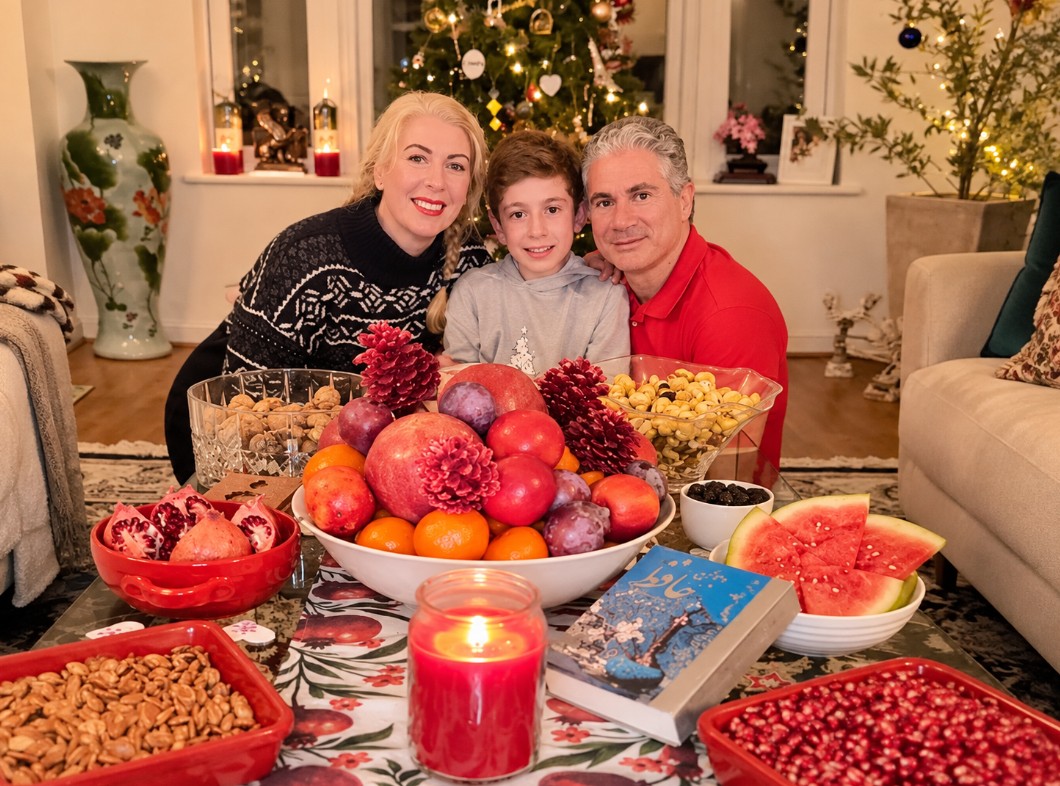
December arrives and we immediately set about trying to defeat it. We string lights over it, shop our way through it, pour wine into it and insist everybody have a lovely time.
I understand the impulse. My own childhood Decembers were full of Christmas, sweets (lots of them, emphatically not fruit), Christmas films and staying at my gran’s house every Christmas Eve.
I would lie in bed convinced I could hear reindeer hooves on the roof.
Darkness wasn’t something I contemplated. It was something Christmas happened inside. Then I married an Iranian.
H told me about a night his family celebrated every year in Iran called Shab-e Yalda. It marked the longest night of the year, but instead of pretending the darkness wasn’t there, people gathered inside it.
Shab-e Yalda marks the winter solstice, the longest night of the year. Families and friends traditionally gather, eat fruit and nuts, drink tea, read poetry and stay together through the darkness.
I loved the idea immediately. H, ironically, was rather less bothered.
Yalda belonged to his childhood. His family celebrated it every year in Iran, but when you have grown up with a tradition, perhaps you don’t always recognise how intriguing it looks to somebody standing outside it, whose interest is always sparked by new shiny things.
It was actually my idea that we should start celebrating it here. We began during Cyrus’s first year. Partly I wanted him to grow up knowing the traditions his dad had grown up with. But there was another reason. I wanted to bridge the divide and celebrate something exciting myself.
And so a tradition travelled from Iran to Newcastle and began again.
That matters enormously to me.
Cyrus knows Yalda is Persian. Every year he comes with us to buy the pomegranates and watermelon and other fruit, nuts and candles. He knows friends will come over. He knows there will be food, tea, music and a house full of people. Hafez, however, has yet to capture his imagination. He’s 10. Poetry from a 14th-century Persian poet is facing stiff competition from YouTube and the Capybara song.
But Yalda itself has become completely ordinary to him and that is exactly what I wanted. He talks about these traditions at school. They’re not exotic additions to his childhood or lessons in being half-Persian. They’re things his family does.
There is something else I love about our Yalda celebrations too. Cyrus isn’t doing this alone. Some of his Persian friends are also growing up here, learning traditions inherited from families in a faraway country. When they’re together, nobody has to explain why there is a watermelon on the table in the middle of a British winter. They just get on with being children.
This year that involved dancing, charging around the house and Cyrus breakdancing to the Capybara song. Cultural preservation takes many forms in our home.
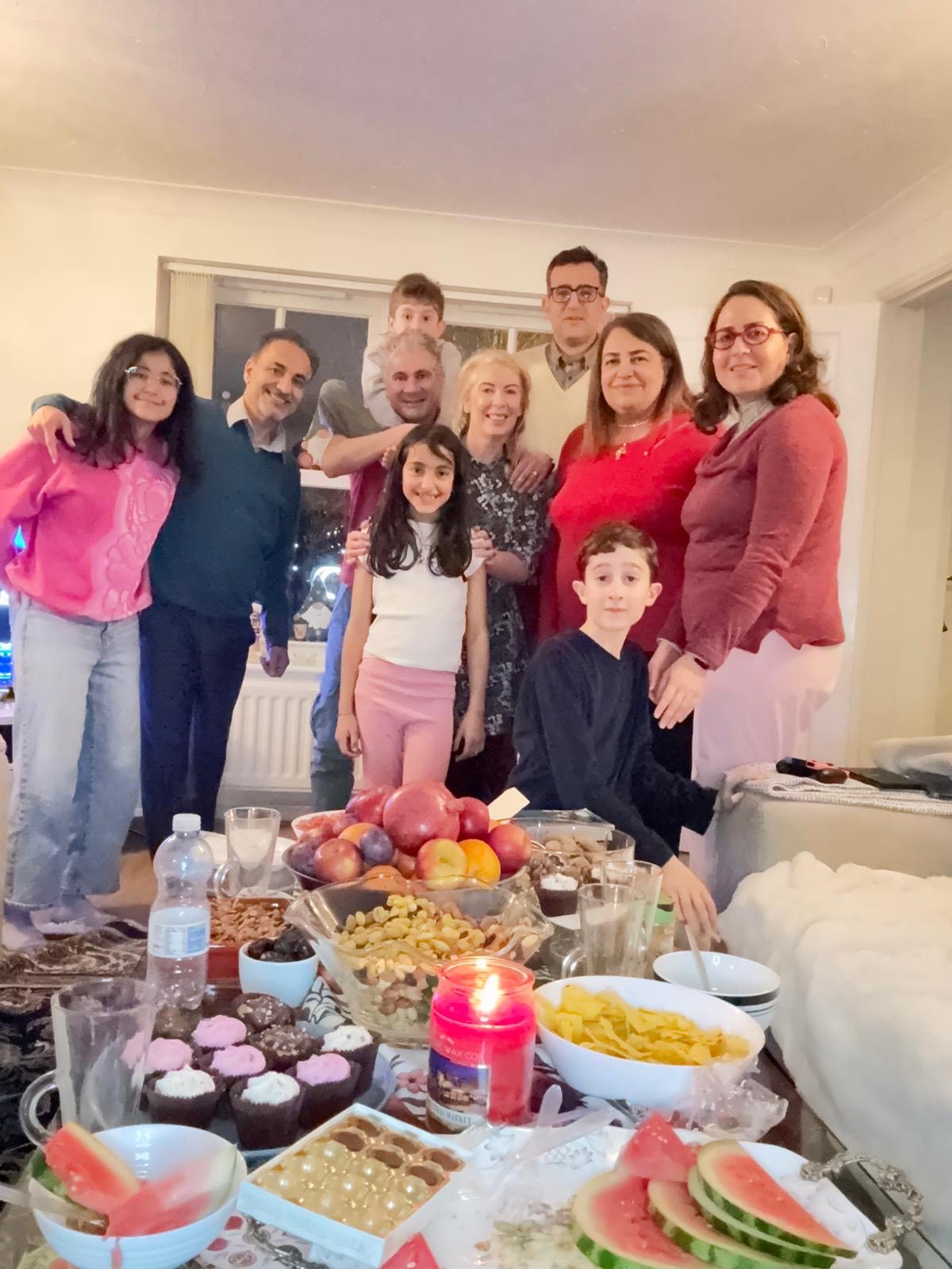
The Yalda table isn’t merely decorative. It is narrative. Everything on it means something, although admittedly I don’t always remember precisely what by the end of the evening.
There is ājil, a mixture of nuts, seeds and dried fruit. Ours was heavy on saffron-coated pistachios and cashews, which were genuinely excellent and dangerously easy to eat by the handful. There are pomegranates, their red colour associated with dawn, life and abundance.
Ours cost £14 from the West End of Newcastle. We opened them expecting deep, jewel-like red seeds and discovered pale, apologetic pink ones instead.
Spiritually disappointing.
Then there is watermelon. I remain unconvinced by watermelon in December. It feels resolutely like a summer fruit that has ended up into the wrong celebration, but tradition insists upon it and I am not brave enough to argue with centuries of Persian culture.
Tea is endlessly replenished because, as far as I can tell, all meaningful Persian life happens within reach of a kettle. And we had Christmas Market scented candles which were possibly cultural cheating, but also perfect.
We couldn’t find quince this year, and I was genuinely sad to discover that our favourite little shirini sweet shop, Honey, had closed. It was one of those small places that made Persian food and culture in Newcastle feel slightly closer to home. Its disappearance made that distance feel a little greater again. So we improvised and opted for cupcakes instead of shirini.
There is an absence at every Yalda we celebrate.
H’s family.
We are always conscious of it. While we’re building these memories with Cyrus here, H’s family is somewhere else, watching the children grow through photographs.
At Yalda, we swap pictures.
Another year. Another photograph. The children are taller. Faces change. Life carries on in separate places.
That’s tough, and also why I care so much about maintaining these traditions.
I can’t recreate H’s childhood for Cyrus. I can’t give him Yalda in Iran surrounded by the people his dad grew up with.
But I can give him a table in Newcastle.
Somewhere between refilling the kettle and preventing Cyrus from attempting a human pyramid on an unsuspecting visitor, I realised I had nearly forgotten one of the most important things on the table.
Hafez.
Imagine organising Christmas and forgetting the tree.
We retrieved the book.
Traditionally, a book of poetry by Hafez is opened at random during Yalda and the poem is interpreted as a fal-e Hafez, a kind of fortune or guidance.
Our friend from Shiraz read mine beautifully, which is how Hafez ought to be read.
I made my wish and then came the interpretation.
Apparently, 2026 was going to require even more resilience from me.
Resilience is one of those words that sounds magnificent when you’re describing somebody else.
“She is incredibly resilient.”
Lovely. But try actually being required to demonstrate it repeatedly.
As a family, we’ve had years of learning what distance requires of people. You adapt. You carry on. You make celebrations in different countries and send photographs of them to one another. That is resilience. I’d still quite like Hafez to predict a quiet year occasionally.
We had a lot of guests and not much time. So H made chicken wraps with potato wedges, hummus, salad and olives.
Everyone ate and nobody complained. It was not a masterpiece of Persian cuisine and increasingly, I don’t think that matters. There is a temptation when you’re preserving somebody else’s cultural traditions, particularly when raising a child between cultures, to worry about authenticity.
Am I doing this correctly?
Should the food be Persian?
Have I bought the right things?
Should the table look more impressive?
But culture has to survive ordinary family life. Sometimes that means Hafez beside a Christmas Market candle. Sometimes it means cupcakes because the shirini shop has closed and it also means chicken wraps and potato wedges because people need feeding.
The tradition survives because we turn up for it.
Eventually our friends went home.
Cyrus and I should probably have gone to bed. Instead, still buzzing from the evening, we decided this was the ideal moment to learn Persian dancing.
We have very different qualifications for this. Cyrus can breakdance and I have two left feet. Give me Zumba and I know where I am. Persian dancing is a fine art and I remain politely illiterate. But the house was still full of the energy of the evening and neither of us wanted it to finish. Besides, it was the longest night of the year. We had time.
Three hours later, we had footage we agreed wasn’t too bad, which is British for we are strangely proud of ourselves. Tthis is how traditions survive when families move thousands of miles from where those traditions began.
When I first heard about Yalda, I thought its beauty was in the symbolism. The longest night comes and people sit together. Eventually the light returns. I still love that.
But after years of celebrating it with our own family, I think I’ve come to understand something else. We spend December trying desperately to make darkness disappear.
Yalda doesn’t.
It acknowledges that the night is long and gathers people around it anyway. There were coats piled on beds in our house. Children travelled between upstairs and downstairs. Persian and Western music played in the background. Adults talked over endless cups of tea. Cyrus danced with friends who, like him, are growing up with memories borrowed from another country and slowly becoming their own.
The British shorthair cat we were looking after for the holidays assessed the guests, candles and emotional earnestness of proceedings and opted out entirely. He relocated under Cyrus’s bed and refused to engage with Persian culture for the remainder of the evening.
In the middle of all that noise, I felt calm.
Light doesn’t always sweep in and fix everything.
Families live apart. Shops close. Children grow up. Years aren’t always kind. Sometimes Hafez threatens you with yet more bloody resilience. But we put the fruit on the table anyway.
We invite people in.
We make the tea.
We dance badly.
We send the photographs across thousands of miles.
And we teach our children why we do it.
I didn’t grow up with Yalda. Cyrus will.
One day, when he’s an adult, I hope he remembers these nights.
Not whether his mum bought the correct quince or served sufficiently Persian food, but the feeling of a house full of people, music and tea on the darkest night of the year.
Because that, ultimately, is why we’re teaching him these traditions. So that one day they are his to carry on.
And what do you hope they remember about it?
Our Persian life
Occasional stories, experiments, discoveries and rabbit holes from Saffron & Cyrus.
Discover more from Saffron & Cyrus
Subscribe to get the latest posts sent to your email.

Saffron & Cyrus is an independent women’s editorial publication with a recognisable voice, real-life perspective, a defined midlife audience and a commercial model built around useful, relevant partnerships.
