
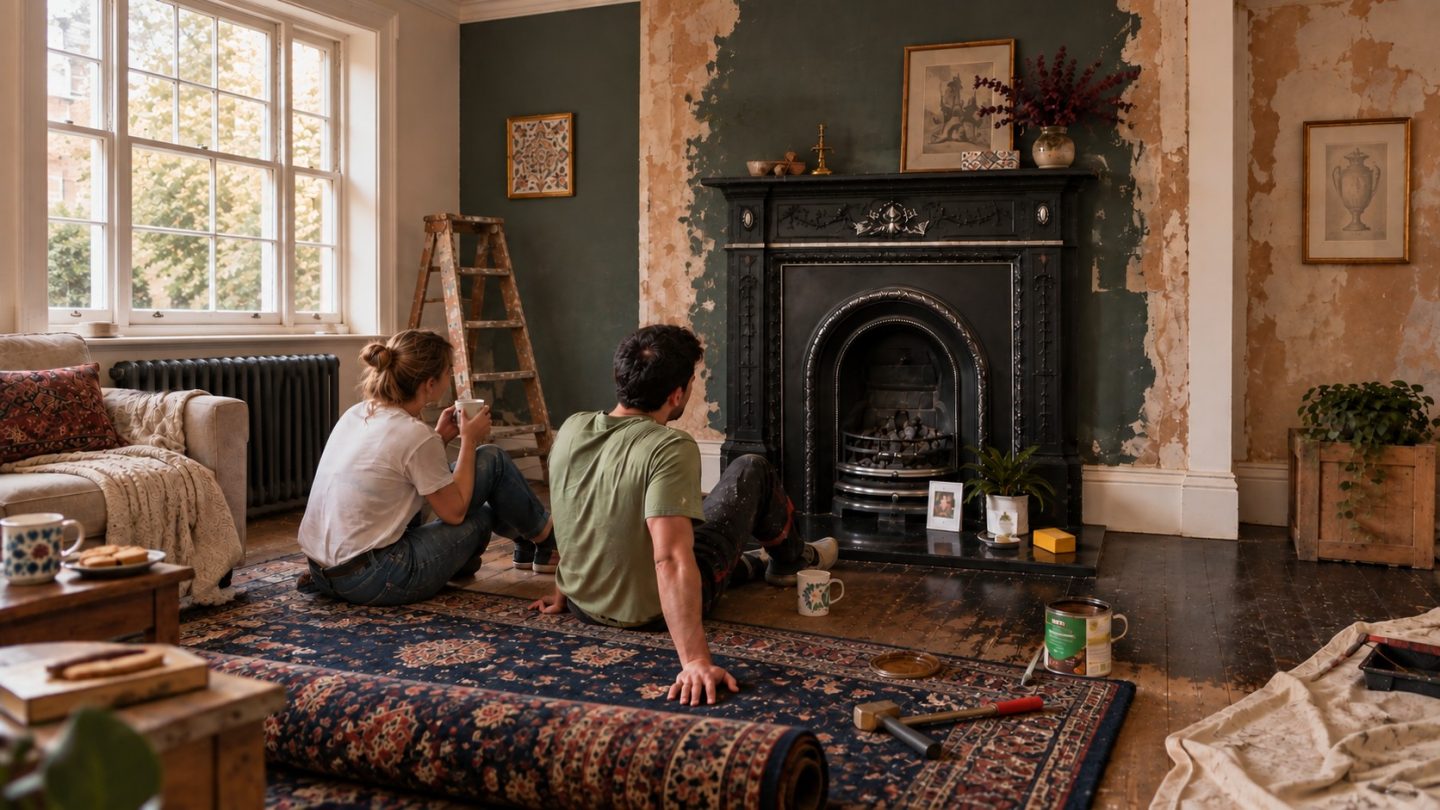
When we first stepped into my gran’s old house, calling it a “fixer-upper” felt rather generous.
There were leaks substantial enough to develop their own ecosystem, floorboards I approached with the caution normally reserved for rope bridges, and a boiler that had apparently decided retirement was for other boilers.
If our life had been a film, it would have been The Money Pit, starring me, H and an ever-expanding cast of builders, decorators and tradespeople.
Except this wasn’t an old house we’d bought and decided to do up. It was my gran’s house, which that changed everything.
When a house already carries your family’s memories, choosing what to remove becomes rather more complicated than choosing a paint colour.
The house had barely moved on from the 1970s.
Wallpaper, fittings, carpets, cupboards, the lot. Walking through it felt like wandering into a family photograph. Every room belonged to another version of my life, but I had a connection to it that I wasn’t ready to give up.
That is the thing about renovating a family home. You can look at a wall and know perfectly well that the wallpaper needs to come down, while another part of you remembers the people who once sat beside it drinking tea, talking, laughing and getting on with ordinary life.
Our plan sounded perfectly reasonable: preserve the warmth and history of the home while persuading the building itself that the 1970s had, in fact, ended. Then we started renovating.
Seven years later, H and I had acquired an accidental education in demolition, plumbing, heating, electrics, plasterboard, radiators and the many varieties of household disaster that reveal themselves only after you’ve removed a ceiling.
And we did remove ceilings.
Radiators came out. Floors came up. Walls were stripped back. At various points, the house seemed less like somewhere human beings should live and more like an archaeological dig with a mortgage.
For stretches of time, showering at home became optimistic. Thank goodness for our gym membership. Some people go for the endorphins. I occasionally went because it had functioning hot water.
The renovation you imagine involves paint samples, mood boards and possibly standing in a beautifully finished kitchen looking pleased with yourself.
The one you actually live through involves dust in places dust has no legitimate reason to be, conversations about pipework over breakfast and discovering that fixing one problem has revealed three more behind it.
Our social life became collateral damage somewhere between the plasterboard and masking tape.
Weekends disappeared into jobs. Evenings became discussions about jobs.
And H became my DIY partner whether either of us had particularly envisaged that as part of married life.
Slowly, almost imperceptibly, things changed.
The house stopped feeling like a project we were endlessly working on and began feeling like ours. My gran was still part of it. The rooms are different, the heating works. The ceilings are where ceilings ought to be. We can shower without organising an expedition to the gym.
But underneath everything we’ve changed is the house she knew. I thought preserving a family home meant protecting its past. Seven years of renovation taught me that preservation doesn’t necessarily mean leaving everything untouched. Sometimes it means allowing a place to keep living.
A home isn’t an old carpet, or the cupboard you feel guilty about removing because you remember your gran opening it. The history lives elsewhere. It lives in the stories you tell about the rooms and in the people you remember standing in them. In the tiny domestic details that somehow survive long after the décor has gone.
And now another generation gets to have its ordinary days here, too.
So, how do you modernise a family home without renovating its history out of it?
I don’t think you preserve every wall, fitting or faded scrap of wallpaper. You decide which memories matter, carry them with you and give the house permission to change.
Our home no longer looks as though it has been sealed since the 1970s. After seven years, a small fortune and enough caulk to grout the Tyne Bridge, I’m quite relieved about that.
Occasional stories, experiments, discoveries and questions from Saffron & Cyrus.
“`
Discover more from Saffron & Cyrus
Subscribe to get the latest posts sent to your email.


Saffron & Cyrus is an independent women’s editorial publication with a recognisable voice, real-life perspective, a defined midlife audience and a commercial model built around useful, relevant partnerships.
